A suitable task gives a child a way to understand what to do, attempt an answer, and continue with an appropriate amount of help. Choosing by age alone, or watching a child repeat a complete sentence, does not establish whether the level fits.
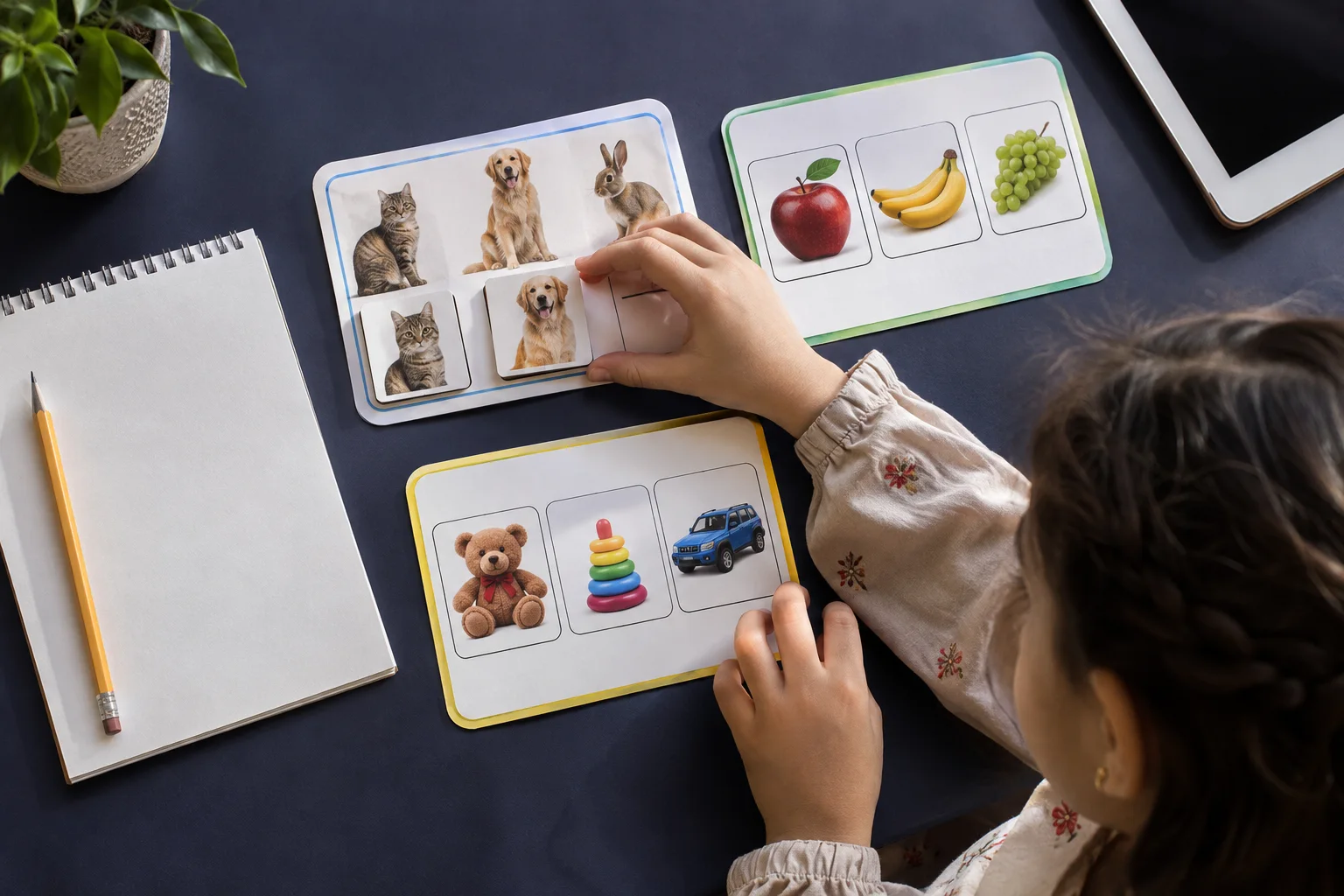
AI-generated scene illustration.
Observe understanding, expression, and support
First, notice whether your child understands what the teacher is asking them to do. Unfamiliar words do not automatically make a task unsuitable if a picture, gesture, or demonstration lets them participate.
Next, consider how much of the answer comes from memory. A child may recite “My name is…” but not recognise a differently phrased question about their name. Ask the teacher to change the picture or order of questions and observe the response.
Finally, look at whether support can decrease as the task becomes familiar. Does your child still need a parent to translate every sentence or a teacher to supply the entire answer? These are concrete points for a discussion about difficulty.
What might too easy or too difficult look like?
If your child answers mechanically without attending to the task, the teacher might ask for a reason, an extra detail, or a question from the child. Moving through pages faster is not the only possible adjustment.
If your child repeatedly does not know what to do and every answer is supplied by someone else, first check the clarity of the instructions and demonstration. Then discuss the content level. A lesson affected by tiredness or device problems is not enough on its own to judge the whole course.

AI-generated scene illustration.
Bring an observation record to the discussion
| Area | Example of a specific note |
|---|---|
| Understanding the task | Matched the pictures after a demonstration and understood when the pictures changed. |
| Independent expression | Could state a preference but needed a prompt to explain why. |
| Responding to change | Needed the question repeated once when the order changed. |
| Support | Continued after a sentence starter without repeating a complete model. |
These notes are not a CEFR placement result and cannot replace the provider’s formal assessment. They help parent and teacher discuss the same observed performance instead of relying only on “too easy” or “cannot keep up.”
For the formal placement discussion, the guide to interpreting a child’s assessment report explains which questions to ask about the proposed starting point.
Turn the discussion into an adjustment
Ask: “How will this task change next time, and what should we watch for?” A teacher might keep familiar vocabulary and add a personal choice, or reduce new words while practising two question patterns.
51Talk’s official website includes information about course levels. Use your child’s actual lesson performance to ask a consultant or teacher about the suggested stage, the basis for placement, and the next goal. An age range on a website cannot establish an individual child’s level by itself.