Before enrolling your child in an online English programme, most platforms offer a placement test or initial assessment. These vary enormously in what they measure and what they report. Some produce a comprehensive CEFR-aligned report with skill breakdowns and pronunciation notes. Others produce a badge, a star rating, or a generic ‘suitable for beginner’ recommendation that tells you almost nothing.
Saudi and Arab parents who understand what a placement test should produce are in a much better position to evaluate whether the assessment is credible and whether the programme recommendation it generates is sound. This article explains what skill areas a placement test should cover, what the report should contain, what distinguishes a strong from a weak assessment, and what questions to ask before the test begins.
What a Placement Test Should Assess
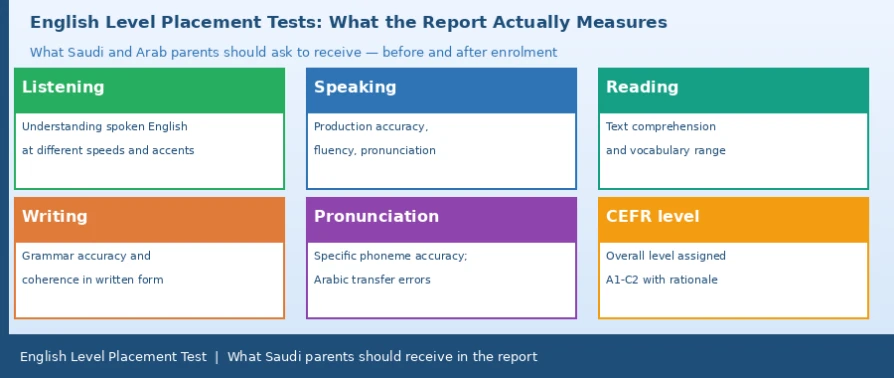
A comprehensive placement assessment covers the four core skill areas of the CEFR framework: listening, speaking, reading, and writing. For Arabic-speaking children, a fifth area is particularly important: pronunciation accuracy, which should include specific testing of Arabic-English transfer phonemes.
-
Listening: does the child understand spoken English at approximately what level of complexity and speed?
-
Speaking: can the child produce English with appropriate accuracy and fluency for the level? This should include live production, not just multiple-choice responses.
-
Reading: can the child read and comprehend texts at what level of complexity?
-
Writing: can the child produce written English at the word, sentence, or paragraph level?
-
Pronunciation: which specific phonemes does the child produce correctly, and which Arabic transfer errors are present?
Many online platform assessments skip speaking production entirely or test it through recorded audio responses rather than live interaction. An assessment that does not include a live speaking component cannot reliably place a child’s speaking level or identify pronunciation errors.
What the Assessment Report Should Include
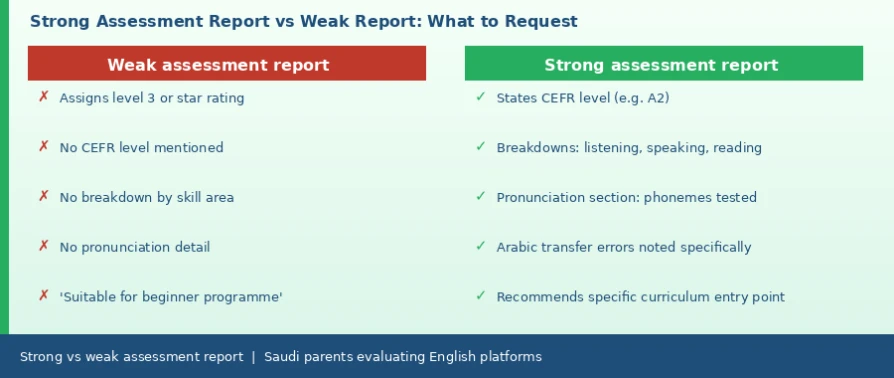
A credible placement assessment report should contain six elements:
-
CEFR level stated explicitly: A1, A2, B1, and so on. Not Level 3, not Star Learner, not Intermediate. The CEFR level.
-
Skill breakdown: what level is the child at in each of the four skill areas? A child can be A2 in reading and A1 in speaking. The breakdown matters.
-
Pronunciation section: which phonemes were tested? Which Arabic transfer errors were noted? For Saudi children, /p/, /v/, /th/, and /ch/ versus /sh/ should be specifically assessed.
-
Curriculum entry recommendation: at which unit or level should the child enter the programme? This should connect directly to the assessment level, not be a generic ‘start from the beginning’ recommendation.
-
Reassessment schedule: when will progress be formally measured again? Every six to eight weeks is standard.
-
Assessor qualification: who conducted the assessment? A trained teacher who knows Arabic phonology can identify transfer errors that an automated system cannot.
Questions to Ask Before the Placement Test
| Question | Why it matters |
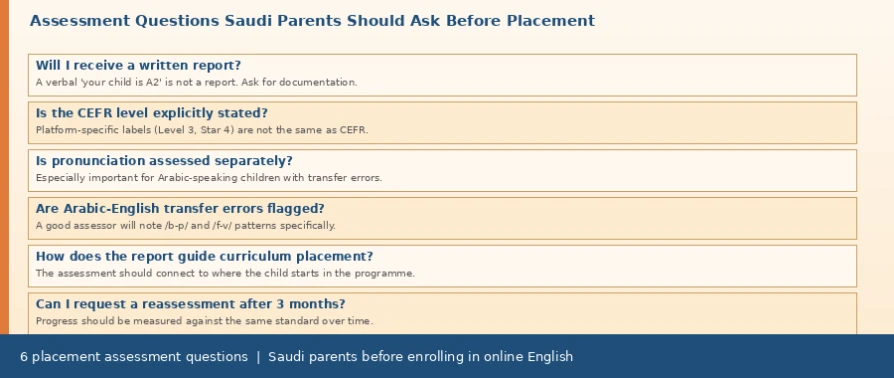
| Will I receive a written report with the CEFR level stated explicitly? | Verbal ‘your child is A2’ is not documentation |
| Is speaking tested in a live interaction or a recorded response? | Live interaction is required to identify pronunciation errors accurately |
| Will the report note Arabic-English transfer errors specifically? | A report that misses /b-p/ and /f-v/ errors places the child incorrectly |
| How does the placement connect to where the child enters the curriculum? | Assessment should drive curriculum placement, not just confirm a general level |
| Can I receive a reassessment after three months to measure progress? | Baseline assessment is only useful with a follow-up comparison |
| What is the assessor’s experience with Arabic-speaking learners? | An assessor without this background may miss transfer-specific errors |
 |
Where 51Talk Fits in Placement and Assessment
What 51Talk is
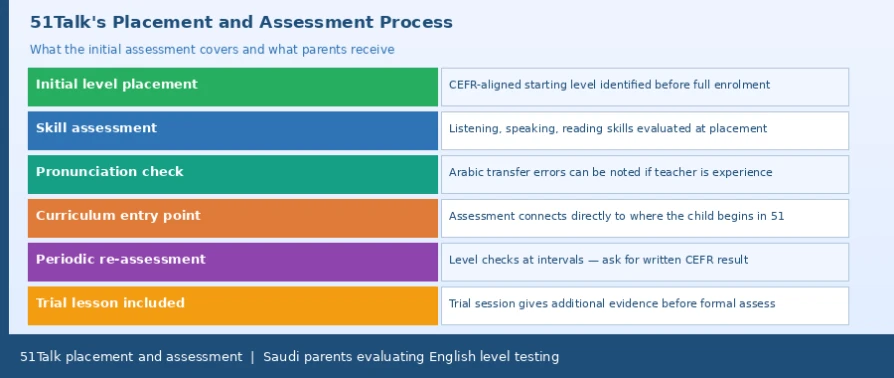
51Talk is a live one-on-one English platform for children. Sessions are 25 minutes, structured around CEFR levels and Cambridge English learning goals. The programme includes an initial placement process, CEFR-aligned curriculum, and periodic reassessments with written results.
What the 51Talk assessment process covers
-
Initial CEFR-aligned placement: identifies where the child enters the curriculum relative to A1 to C2 levels.
-
Live session as assessment context: the trial lesson functions as an assessment opportunity for pronunciation and speaking level.
-
Periodic level reassessments: ask for the written CEFR result at each reassessment, not just confirmation that the child advanced.
-
Arabic transfer error identification: ask specifically when requesting a teacher whether she can flag Arabic phonological transfer errors in the initial assessment.
What to confirm before and after the placement
Before: ask whether the placement produces a written CEFR level report and whether it includes a pronunciation section. After the placement: ask for the written result with the CEFR level explicitly stated. Ask where in the curriculum the child will enter and why. A trial lesson is available at 51talk.com and can serve as the speaking assessment component.
What to Do Next
Before any placement test, ask for a sample assessment report from a previous child. Check whether it names a CEFR level explicitly, breaks down skills, and includes a pronunciation section. After the placement, compare the report to the template above. If fields are missing, ask whether they can be added or whether the assessment can be supplemented with a live speaking evaluation.
If the platform cannot produce a CEFR level result with skill breakdowns, the placement is not a genuine CEFR assessment and the level recommendation it produces should be treated with caution.
Frequently Asked Questions
Does 51Talk provide a written CEFR placement report with skill breakdowns and pronunciation notes?
51Talk’s curriculum is CEFR-aligned and the programme includes initial placement and periodic reassessments. Whether the placement report names pronunciation errors specific to Arabic-speaking children is worth confirming directly. When you enquire, ask: will the placement report name Arabic transfer phonemes such as /b/ for /p/ and /f/ for /v/ if present? Ask for a sample report format. A trial lesson is available at 51talk.com and should be used as an additional live speaking evaluation alongside the formal placement.
My child was assessed as B1 but I think she is lower. How do I verify the placement?
Ask the assessor what specific evidence supports the B1 placement. B1 requires the ability to understand the main points of clear standard input on familiar matters and to produce simple connected text on familiar topics. If your child cannot do those things consistently, the B1 placement may be inflated. Request a second assessment, ask for the skill breakdown across the four areas, and ask specifically about speaking and pronunciation performance. A child can be B1 in reading and A2 in speaking, and the distinction matters for choosing the right curriculum entry point.
Can I request that the placement test focus specifically on pronunciation?
Yes. Ask the assessor to evaluate pronunciation specifically, naming the phonemes tested and any Arabic-English transfer errors observed. For Saudi children, mention that you want the report to note whether /p/, /v/, /ch/ versus /sh/, and /th/ are being produced correctly or with substitutions. An assessor familiar with Arabic phonology will catch these patterns. One who is not familiar may note ‘pronunciation adequate’ without identifying the specific errors that matter for your child.
What if the platform’s placement is ‘Level 3’ with no CEFR reference?
Ask whether Level 3 maps to a CEFR level, and ask for that mapping in writing. If the platform cannot provide it, the placement cannot be verified against any independent standard. This does not necessarily mean the programme is poor, but it does mean progress cannot be measured against or compared to any external benchmark — including Cambridge English qualifications, school assessments, or other programmes.