A trial lesson is not a formality. It is the best single opportunity a parent has to see how a platform, a teacher, and a child actually interact before paying for a course. Most parents who sit in on a trial either watch passively without a framework or leave the child alone at the screen entirely. Neither approach gets much value from the session.
This article covers exactly what to observe during a trial, what to ask your child and the teacher afterward, and how to use what you learn to make a well-grounded decision. It is aimed at parents of children aged 3 to 12, primarily in one-on-one or paired online English lesson formats.
It does not cover academic tutoring outside English language skills, or platforms that use only pre-recorded video content rather than live teachers.
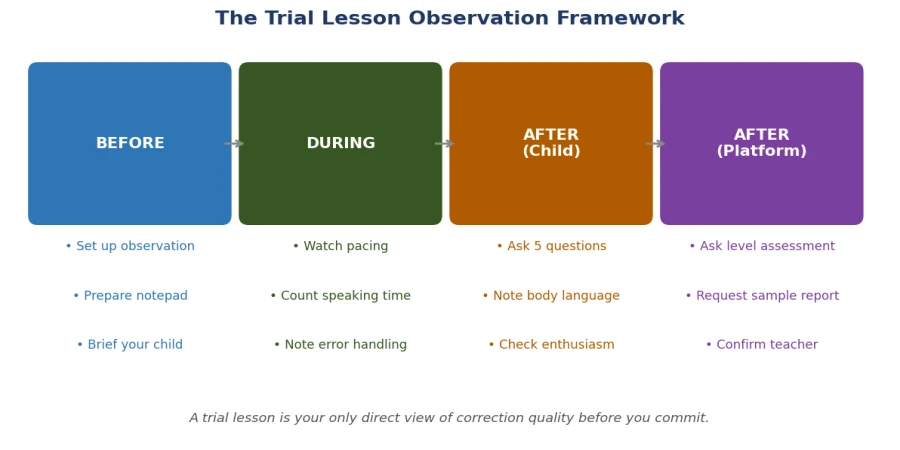
The four-stage trial lesson observation framework
Before the Trial Starts: Set Yourself Up to Observe Well
The 20 minutes before a trial lesson matter as much as the lesson itself. A parent who enters the session unprepared observes reactively. A parent who enters with a notepad and a clear framework observes systematically. The difference between the two is the difference between a vague impression and actionable notes.
• Sit near your child — especially for children under 7 — so you can observe without appearing on screen.
• Have a notepad ready. Writing observations during the lesson is more accurate than trying to reconstruct them an hour later.
• Test the audio and video before the session starts. Technical disruptions that eat into a 25-minute lesson distort what you see.
• Tell your child this is a first meeting with a teacher and that mistakes are completely fine. A relaxed child behaves more naturally than a coached one.
• Do not prime your child with phrases to use or answers to give. You want to see how the teacher handles an unprepared child, because that is what every regular lesson will involve.
Seven Things to Observe During the Lesson
A 25-minute trial contains more information than most parents extract from it. These seven areas each reveal something specific about whether the teacher and the platform will work for your child over the long term.
| What to Watch | What It Tells You |
| Opening | Does the teacher greet the child by name, use a warm tone, and establish engagement within the first minute? A cold or administrative opener predicts how corrections will land later. |
| Speaking pace | Is the teacher adjusting delivery speed based on the child’s responses, or reading from a script at a fixed pace regardless of whether the child is following? |
| Child’s speaking time | Roughly count how many minutes the child actually produces language versus listens. In a one-on-one lesson, the child should be producing for at least a third of the session. |
| Error response | When the child makes a mistake, does the teacher name the specific issue, model the correct form, invite a second attempt, and then move forward? Or ignore it? Or just repeat the answer? |
| Vocabulary handling | Are new words introduced with visuals, examples, or context — or just listed and moved past? The method matters more than the word count for young learners. |
| Child’s body language | Is the child leaning toward the screen, smiling, or engaging physically in any way? Or slumping, looking away, or waiting for it to end? The child’s body communicates what their words may not. |
| Lesson shape | Does the lesson have a recognisable structure — a warm-up, a main activity, a closing review — or does it feel improvised and unconnected from moment to moment? |
What to Ask Your Child After the Trial
Children often give more useful feedback than parents expect, especially when the questions are casual and open. Ask these within an hour of the lesson ending, while the experience is still fresh. Keep the conversation short.
-
Did you like the teacher? What did you like or not like?
-
Was there anything you did not understand during the lesson?
-
What did you learn? Can you say it or show me?
-
Would you want to have another lesson with this teacher?
-
Was anything boring or confusing?
Pay attention to tone and body language, not just answers. A child who says ‘it was fine’ while looking at the floor is giving different information from a child who immediately starts repeating a word they learned. Both responses are meaningful.
What to Ask the Teacher or Platform After the Trial
Most platforms leave time for a parent follow-up after the trial. Use it. These questions help you evaluate both the teacher and the platform’s infrastructure.
• What English level did you assess my child to be at, and what specific evidence from today’s lesson shaped that assessment?
• What would the first three regular lessons focus on, based on what you observed today?
• How do you handle a child who is reluctant to speak during a lesson?
• What feedback or report will I receive after each regular lesson, and does it name specific language items?
• How is progress tracked between lessons, and when would I expect to see a measurable change in my child’s output?
• Can you be our regular teacher, or will regular lessons be assigned across multiple teachers?
What a Trial Lesson Cannot Tell You
A trial is a useful snapshot, but it has real limits. Knowing those limits prevents parents from either over-weighting a single impressive session or dismissing a good platform because of first-lesson nerves.
A charismatic teacher who performs well in a trial can still be structurally weak over a 20-lesson arc if the curriculum does not build systematically. Conversely, a child who is visibly reluctant in lesson one may warm to the same teacher completely by lesson five — shyness is common and does not reliably predict long-term fit. Technical glitches in a trial are not necessarily representative of typical session quality. And a short session cannot show you how lessons build progressively over a full unit.
Use the trial to rule out obvious problems and to get a baseline feel for teaching style. Use the curriculum design, the review system, and the feedback infrastructure to judge long-term quality.
How 51Talk’s Trial Works in Practice
What 51Talk Is
51Talk provides one-on-one English lessons for children with trained teachers, 25-minute structured sessions, and a CEFR-aligned curriculum aligned to Cambridge English learning goals. Post-lesson reports, unit assessments, and level evaluations are built into the regular lesson cycle.
Why 51Talk’s Trial Is a Meaningful Evaluation
Because 51Talk uses structured curriculum materials in every lesson, including the trial, what you observe in the trial session is genuinely representative of what regular lessons look like. The teacher is not improvising an introduction — they are delivering the same structured format that paid lessons follow. This makes the seven observation areas above more reliable signals than they would be in a platform where teachers design their own trial content.
How to Act on What You Observe in a 51Talk Trial
After the trial, compare the teacher’s written feedback report against your own observation notes. If the report names a specific vocabulary item or skill gap and describes what was addressed in the session, that reporting system is functional. If it says only ‘great effort today’, ask whether more specific feedback is available before committing. If the content level looked wrong in either direction, ask the teacher or support team how level placement is adjusted before the next session.
Frequently Asked Questions
Can I use a 51Talk trial to evaluate a specific female teacher before committing to regular lessons?
Yes. 51Talk’s trial allows parents to observe the session directly and assess both the platform and the teacher. If the trial teacher is not a good fit for any reason, parents can request an alternative before purchasing a package. Visit 51talk.com to arrange a trial and check current teacher availability.
Should I sit in on every trial lesson, or is it fine to let my child attend alone?
For children under 8, sitting nearby and off-screen is strongly recommended. You are not there to intervene or coach — you are there to observe. For older children aged 9 to 12, sitting off-screen nearby also works well. The child performs more naturally when you are present but not visible.
What if my child refuses to speak at all during the trial?
This is entirely normal. The more useful question is how the teacher responds. A well-prepared teacher will use games, visuals, or very simple yes/no questions to reduce the pressure, and will not force the child to produce language before they are ready. A teacher who either gives up and lectures or presses the child to answer despite visible reluctance is demonstrating a response pattern that will repeat in every paid session.
How many trial lessons should I take before making a decision?
Usually one is enough to identify clear problems and confirm a basic sense of fit. A second trial is reasonable if the first was substantially disrupted by technical issues. More than two trials on the same platform without making a decision usually indicates that the parent needs a clearer evaluation framework rather than additional data.
What if the trial lesson covered content that seems too easy or too hard for my child?
Raise it directly with the teacher or platform before your next session. Most structured platforms including 51Talk have a level adjustment process. The trial itself is partly a diagnostic session, and a good teacher will use what they observed to recommend a curriculum adjustment. If the platform has no mechanism to adjust level based on trial observations, that is worth knowing before purchasing a full package.
What to Do Next
Book the trial with your observation checklist ready. Take notes during the lesson on the seven areas above. Ask your child the five questions within an hour of the lesson ending. Read the teacher’s feedback report alongside your own notes. If the lesson covered structured material, was pitched at the right level, and your child was engaged for most of the session, that is a strong positive signal. If the teacher did most of the speaking, the child was visibly disengaged after the first few minutes, or errors went uncorrected throughout, take that seriously before committing payment.