Most families treat English learning as a series of separate events: the lesson happens, then sometime later the child uses an app, then eventually there is another lesson. The events are real. The connection between them is missing.
A learning loop is different. Every component feeds the next: a warm-up activates the previous lesson before the new one starts, the live lesson builds on that activated knowledge, the post-lesson review consolidates what was just introduced, and the parent notes what still needs attention. By the time the next session begins, the child is genuinely building on what came before rather than starting fresh.
This page explains each component of the loop, how long it takes, what it accomplishes, and how to fit it into a realistic family week. It applies to children aged 5 to 14 in any combination of live English lessons and app practice.
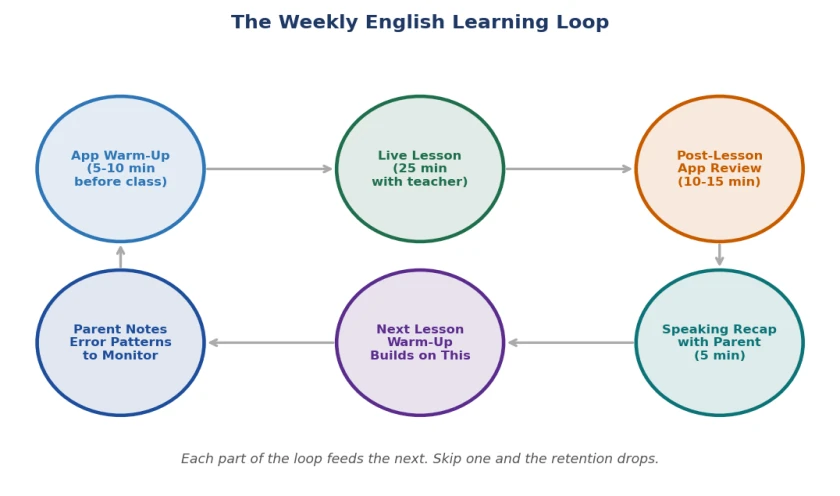
The six-component weekly learning loop and how each part feeds the next
Component 1: App Warm-Up (5 to 10 Minutes Before the Lesson)
The warm-up is a brief app activity that revisits vocabulary from the previous lesson before the current one begins. Its purpose is to reduce the startup time in the live lesson and to re-activate the memory of last session’s content so the teacher can build on it rather than re-teaching it.
This does not need to be elaborate. Five minutes of the post-class review exercises from the previous lesson is sufficient. A child who arrives at the live session with last week’s vocabulary already active will spend less of the new session on review and more on new content.
Component 2: Live Lesson (25 Minutes)
The live lesson is where new input is introduced, errors are corrected in real time, and the teacher-child relationship builds. All three of these functions are structurally impossible in an app. The warm-up prepares the child to receive the new input efficiently. The lesson itself should not be reviewing last week’s content from scratch, because the warm-up already handled that.
During the lesson, the most valuable minutes are the ones where the child produces language and the teacher corrects or confirms. A 25-minute session where the child speaks for at least 35 percent of the time and every error is addressed specifically is a more productive lesson than a 40-minute session where the teacher presents and the child listens.
Component 3: Post-Lesson App Review (10 to 15 Minutes)
Within 15 minutes of the lesson ending, the child completes the session-specific review exercises. These exercises present the vocabulary and sounds from the lesson in a slightly different format, requiring retrieval rather than passive recognition. This retrieval effort is the mechanism behind long-term consolidation.
The 15-minute window is not arbitrary. Language memory is most consolidatable in the period immediately following new input and again during sleep. Completing the review before sleep on the lesson day catches both windows. Completing it the following morning catches only one.
Component 4: Speaking Recap with Parent (5 Minutes)
After the app review, a parent asks the child to produce one or two items from the lesson. Not “how did class go?” but “can you say the word we worked on today?” The child produces the target language under mild social pressure. The parent responds naturally. The exchange is brief and not formal.
This step adds a second human interaction to the day’s English practice, which reinforces the social context of the language. Words learned in a social setting are more durable than words learned in isolation.
Component 5: Parent Error Pattern Notes (2 Minutes)
The parent notes, informally, whether the specific sounds or vocabulary items from today’s lesson appeared in the child’s spontaneous speech during the day. This does not require a formal log. A note in a phone or a mark on the fridge calendar is enough.
Over four weeks, these notes tell the parent whether certain errors are reducing, whether specific vocabulary is integrating into the child’s natural speech, and whether the loop is working. That information is more useful than any lesson score.
Component 6: Pre-Lesson Warm-Up for the Next Session
The loop closes when the next session’s warm-up revisits today’s lesson. The parent notes from Component 5 inform what to prioritise in the warm-up. If the error pattern was still present today, include the relevant sound in the warm-up exercises. If a vocabulary item appeared spontaneously, mark it as consolidated and move on.
Where 51Talk Fits In
What 51Talk is
51Talk is a live one-on-one English platform for children offering 25-minute lessons with qualified teachers, CEFR-aligned curricula, pre-class warm-up exercises, post-class review exercises, teacher feedback reports, and unit assessments. Full details and trial at 51talk.com.
How 51Talk’s lesson cycle maps onto the learning loop
51Talk’s lesson structure already includes a pre-class warm-up and post-class review as standard components. Components 1 and 3 of the loop above are built into the platform’s design. The live lesson covers Component 2. The teacher feedback report provides the content for Components 4 and 5 without the parent needing to reconstruct it from memory.
The unit assessment system closes the loop formally every few lessons, providing a structured check-in on whether the content from the loop is consolidating into measurable progress.
What to keep in mind
The loop works only if all six components happen consistently. A missed post-lesson review breaks the connection between the live lesson and the next session’s warm-up. A missed warm-up means the teacher spends the opening minutes of the new lesson on review rather than new content. Consistency matters more than perfection. A short version of each component done every time is better than a complete version done occasionally.
Before You Enrol: Questions to Ask Any Platform
• Does the platform provide both pre-class warm-up and post-class review exercises? Both are needed for the loop.
• Are the review exercises tied to that specific lesson’s content? Generic exercises break the content connection.
• Does the teacher feedback report name what was covered? This is needed for parent error pattern notes.
• How is progress tracked across multiple lessons? Unit assessments provide formal loop closure.
Frequently Asked Questions
Does 51Talk’s lesson structure support the full weekly learning loop described above?
Yes. 51Talk’s lesson cycle includes pre-class warm-up exercises, a live one-on-one session, post-class review exercises specific to that lesson, and teacher feedback reports. This structure covers Components 1, 2, 3, and the content for Components 4 and 5 as described above. The unit assessment system provides the formal Component 6 closure. Visit 51talk.com for a trial to observe the complete cycle.
What if my family cannot complete all six components every week?
Prioritise Component 3, the post-lesson app review within 15 minutes. If only one component can be done consistently, that is the one with the highest consolidation value. Components 1 and 4 are the next most valuable. Components 5 and 6 are beneficial but can be simplified to a single note and a single warm-up question.
How long before the loop produces visible results?
For most children aged 6 to 10, the first signs of spontaneous vocabulary use from lesson content appear within three to five weeks of consistent loop practice. Error pattern reduction typically becomes visible within five to eight weeks. Both timelines are faster with higher lesson frequency (three sessions per week vs two).
Can the loop work with any combination of live platform and app?
Yes, with one condition: the app review must target the vocabulary and sounds from the live lesson, not a separate sequence. If the platform does not provide session-specific review exercises, parents can set the relevant vocabulary as a custom list in a third-party vocabulary app. The connection between the live lesson and the review content is what makes the loop work.
What to Do Next
Map the six components onto your family’s current week. Identify which ones are already happening and which are missing. Start with the one gap that is easiest to fill: usually either the post-lesson review (if the platform provides it) or the speaking recap with parent (which takes five minutes and requires no technology). Add one component at a time until all six are running. The loop is a habit. It builds gradually, not all at once.