“Fully qualified English teacher.” Every platform uses this phrase. Almost none of them explain what it means, because the term is not standardised. A 40-hour online TEFL course and a 130-hour Cambridge CELTA both produce “certified” teachers. A teacher with three years of experience working with five-year-olds and one who has only taught adult business English both appear as “experienced.”
This checklist gives parents seven specific verification points for a teacher’s qualifications. All seven are answerable before the first paid lesson if you ask the right questions. The goal is not to interrogate teachers but to distinguish platforms that maintain genuinely verifiable standards from those that use credibility language without substance.
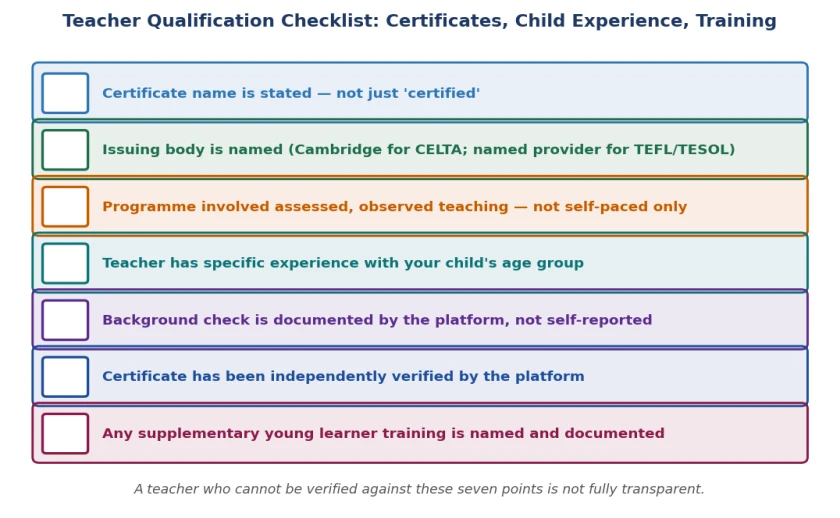
Seven-point checklist for verifying a children’s English teacher’s qualifications
Why “Qualified” Is a Low-Signal Word
Unlike medical or legal qualifications, English teaching qualifications are not regulated by a single national or international body. This means the word “qualified” describes a status that can be achieved through programmes ranging from rigorous to minimal. A parent reading a teacher profile cannot tell the difference from the word alone.
The seven checklist items below replace the word “qualified” with seven specific questions that have specific verifiable answers. A teacher whose qualifications hold up against all seven is genuinely prepared to teach children. A teacher whose profile cannot answer all seven may still be a good teacher, but the parent cannot know that from the profile.
The Seven Qualification Verification Points
• Certificate name is stated. Not “certified” or “qualified.” The specific certificate: CELTA, TEFL (provider name), TESOL (organisation name), BEd, PGCE. If the name is not given, ask.
• Issuing body is named. Cambridge for CELTA and DELTA. A specific university or accredited organisation for TEFL/TESOL. If the platform says only “TEFL certified” without naming who issued it, ask who.
• Programme involved assessed, observed teaching. A self-paced online course produces a certificate on completion of tasks. A programme with assessed teaching involves an external evaluator watching the teacher teach. Ask whether the programme was self-paced or included observed teaching assessment.
• Teacher has specific experience with the child’s age group. Experience teaching adults and experience teaching 6-year-olds are different. Ask specifically: how many years has this teacher worked with children aged 4 to 8 (or whatever your child’s age range is)?
• Background check is documented by the platform. Not just “teachers are vetted.” Ask: what does the background check cover, who conducts it, and is there a record? A platform that cannot answer specifically has not conducted a meaningful background check.
• Certificate has been verified by the platform, not only self-reported. Self-reporting means the teacher submitted a scan. Platform verification means someone checked with the issuing body. Ask which applies.
• Any young learner training is named. CELTA focuses on adults. Some teachers hold supplementary young learner modules. Ask whether any child-specific training is documented.
Where 51Talk Fits In
What 51Talk is
51Talk is a live one-on-one English platform for children with 25-minute structured sessions, qualified teachers, CEFR-aligned curricula, and structured lesson cycles. Teacher profiles and platform details at 51talk.com.
How to apply this checklist to 51Talk teachers
51Talk works with teachers who complete a training and evaluation process before being assigned to students. Parents can view teacher profiles on the platform. Apply the seven checklist items to the teacher you are considering: ask the support team which qualification standard is required, whether it is named on profiles, how background checks work, and whether young learner training is part of the evaluation. A platform of 51Talk’s scale has documented answers to all seven.
What to keep in mind
Profile information and support team answers may differ. If a support team answer contradicts what is shown on a profile, ask for written clarification before purchasing. The written answer at the point of purchase is your reference if a question about teacher qualifications arises later.
Before You Enrol: Questions to Ask Any Platform
• What is the minimum qualification required for all teachers? Required, not preferred.
• Is that qualification named on every teacher profile? Stated versus displayed.
• Does the programme involve assessed, observed teaching? The strongest predictor of preparation.
• How are background checks conducted and documented? Process, not reassurance.
Frequently Asked Questions
Can I verify whether a 51Talk teacher’s qualifications meet the seven-point checklist?
Yes. Contact 51Talk’s support team and ask specifically about the qualification standard required, how it is verified, and what the background check process covers. For teachers holding CELTA, Cambridge offers an independent certificate verification service. Visit 51talk.com to access profiles and support.
Is a CELTA-qualified teacher always better for children than a TEFL-certified one?
CELTA is more consistently rigorous because it is issued by one body and always requires assessed teaching. But a TEFL qualification from a 200-hour university programme with observed teaching and significant child teaching experience may prepare a teacher better for young learners than a CELTA without subsequent child-specific work. The combination of qualification rigour and child-specific experience matters more than either alone.
What should I do if a platform cannot answer questions 5 and 6 from the checklist?
Treat the inability to answer specifically as meaningful. A platform that says “all teachers are background-checked” without being able to describe what the check covers has not conducted a meaningful check. A platform with documented processes answers both questions readily.
Can native-speaker status substitute for a teaching qualification?
No. Native speaker status describes the teacher’s first language. A teaching qualification describes their preparation to teach that language to others. These are independent. A native speaker without a teaching qualification has no documented preparation for the correction, scaffolding, and developmental awareness that children’s English teaching requires.
What to Do Next
Apply the seven-point checklist to the specific teacher you are considering, not to the platform’s general description. Ask for written answers. Take a trial lesson and observe whether the teacher’s actual correction behaviour reflects the qualification claimed: a well-prepared teacher names errors, models the correct form, and structures a retry. That behaviour is the practical evidence of genuine qualification, regardless of which certificate appears on the profile.