A Parent’s Evidence Checklist
After two months of online English lessons, how do you know whether your child is actually improving? The platform says they are doing well. The teacher gives positive feedback at the end of every session. Your child seems to enjoy the lessons. But when you listen to your child speak English in a normal conversation, you still hear the same substitutions you heard before the lessons started. Is that normal? Is progress slower than you expected? Or is the programme not working?
These are questions most parents cannot answer clearly, because they do not have a specific framework for distinguishing between engagement and progress. Engagement is visible and easy to observe: the child attends the sessions, completes the review exercises, and relates positively to the teacher. Progress is different. Progress means specific language outcomes that can be verified independently of how the child feels about the sessions or how encouraging the teacher’s reports sound.
This guide gives parents a practical evidence checklist for verifying real progress in their child’s online English programme. It covers the four types of verifiable evidence, how to read feedback reports critically, what the progress arc looks like across sessions, and how platforms like 51Talk make progress measurable rather than assumed. It also includes a table of specific parent actions at defined intervals so you know exactly what to look for and when.
Why Engagement Is Not the Same as Progress
Most parents evaluate online English programmes primarily through engagement signals. Their child looks forward to the sessions. They complete their homework. They talk about the teacher positively. The platform sends cheerful weekly summaries. These are all good signs. They are also insufficient as evidence of learning progress.
Engagement is a necessary condition for learning. A child who is not engaged is not going to learn effectively regardless of how good the programme is. But engagement is not a sufficient condition. A child can be enthusiastic about sessions that are not producing measurable improvement, particularly if the sessions are enjoyable but lack the correction density and structured repetition that pronunciation improvement requires.
The distinction is especially important for Arabic-speaking children working on pronunciation. A child who consistently says /b/ for /p/ can attend fifty engaging sessions and still produce the same substitution at the end if no teacher has explicitly targeted that sound with consistent correction and follow-up. The child enjoyed the sessions. No progress occurred on the specific problem.
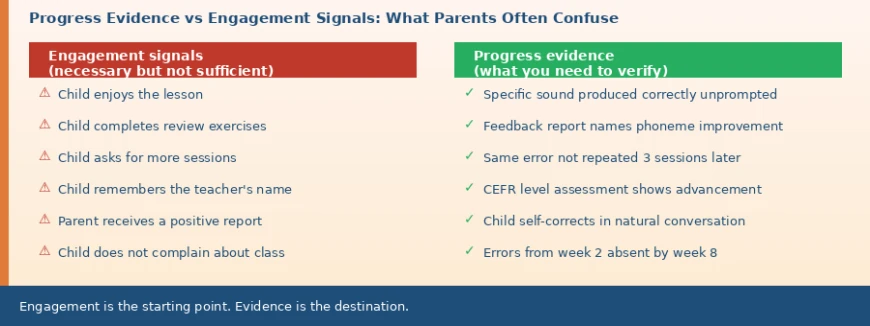
What engagement signals look like
• The child is happy to attend sessions and rarely resists.
• The child completes the post-class review exercises.
• The child mentions the teacher positively or by name.
• The parent receives a feedback report that says the child worked hard and showed enthusiasm.
• The child’s general English vocabulary seems to be growing.
What progress evidence looks like
• A specific sound that was produced incorrectly in session 2 is produced correctly in session 8, without prompting.
• The feedback report names the specific phoneme that improved and describes what changed.
• The same error that was corrected in session 5 does not reappear in session 9.
• A CEFR level assessment shows advancement to the next level.
• The child self-corrects an Arabic transfer error in natural conversation outside the lesson setting.
None of the engagement signals are evidence of pronunciation progress. All of them are worth having. But parents who mistake engagement for progress end up staying with an ineffective programme because they interpret the child’s positive attitude as a sign that the learning is working.
The Four Types of Verifiable Progress Evidence
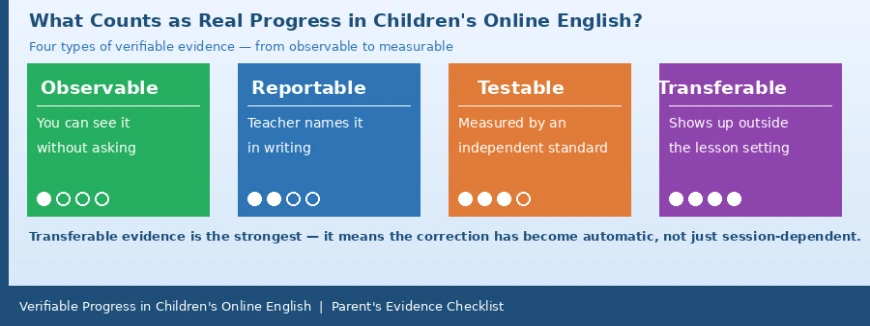
Progress evidence ranges from observable to deeply embedded. The stronger the evidence, the harder it is to fake, misreport, or mistake for something else. Here is how the four types build on each other.
Type 1: Observable evidence
Observable evidence is progress you can see and hear directly, without needing to ask the teacher or consult a report. The child says “pen” correctly in a casual conversation without prompting. The child produces /v/ in “very” correctly in a sentence. The child notices their own error and corrects it before you say anything. This is the most reliable form of evidence because it is not mediated by the teacher’s report or the platform’s assessment system. You observed it yourself.
Observable evidence is also the hardest to achieve, because it requires the correction to have moved from effortful and conscious to automatic. A child who produces /p/ correctly when specifically asked to is not yet at observable evidence level. A child who produces /p/ correctly in a normal sentence without thinking about it is.
Type 2: Reportable evidence
Reportable evidence is progress described specifically and accurately in the teacher’s feedback report. A report that says “/p/ substitution corrected three times; child produced pen and park correctly by end of session” is reportable evidence. It names the specific phoneme, describes what the teacher observed, and gives information the parent can act on.
A report that says “great effort today, wonderful session, so much enthusiasm” is not reportable evidence. It describes the child’s engagement and the teacher’s positive impression. It contains no specific phoneme information that parents can verify or follow up on.
The distinction matters because parents who accept positive-sounding reports as evidence of progress can be misled for months. Ask explicitly for phoneme-specific feedback from the start. If the reports do not contain it, ask the teacher or platform why not and whether more specific reporting is possible.
Type 3: Testable evidence
Testable evidence is progress measured by an independent standard that is not reliant on the teacher’s self-reporting. The most common form in online English programmes is a CEFR level assessment conducted at regular intervals. A child who was assessed at A1 in October and assessed at A2 in January has demonstrated testable progress: a body independent of the teacher’s daily feedback has evaluated the child’s language proficiency and found it has advanced.
CEFR assessments do not measure pronunciation specifically. They measure overall language proficiency across speaking, listening, reading, and writing. But for parents who want an objective measure of progress that goes beyond the teacher’s reports, a CEFR assessment is the most reliable available option in most online English programmes.
Type 4: Transferable evidence
Transferable evidence is the strongest and most valuable form: progress that shows up outside the lesson setting, in natural speech, without prompting. A child who self-corrects a /b/-for-/p/ substitution in a normal Arabic-English conversation at home is demonstrating that the correction has been internalised. It has moved from a deliberate effortful action in the lesson to an automatic production pattern in real speech.
This is the endpoint of effective pronunciation correction. It takes the longest to achieve and is the hardest to measure systematically. But it is the most meaningful evidence of real change, because it shows that the skill has transferred from the instructional setting to natural communication.
Evidence Checklist: Six Types of Verifiable Progress
Use this table throughout your child’s programme to track which types of evidence you have observed and at what stage. The table also notes when each type of evidence is realistic to expect and what is not sufficient as evidence on its own.
| Evidence type | What it looks like | When to expect it | How to verify | Not enough on its own |
| In-session improvement | Child produces a sound correctly by end of session that was wrong at the start | Sessions 3-6 for most target sounds | Ask teacher after session; compare to feedback report | In-session gains can fade without post-class review |
| Feedback report specificity | Written report names the phoneme improved and describes what changed | After every session from session 1 | Read report and check for phoneme names, not just general comments | Reports can be positive without reflecting real correction |
| Error absence across sessions | A specific error corrected in session 5 does not reappear in session 8 or 9 | Sessions 8-12 for most Arabic transfer errors | Compare feedback reports across 3-4 sessions for the same sound | One session without the error may be a coincidence |
| CEFR level advancement | Assessment result shows progression to the next level | Every 4-8 weeks depending on platform assessment schedule | Ask for the written assessment result with the CEFR level stated | Level advancement covers broad language skills, not pronunciation only |
| Self-correction in natural speech | Child produces an error, catches it without prompting, corrects it in normal conversation | Sessions 9-16 for most pronunciation work | Observe child speaking English casually, not in lesson setting | Must be unprompted; correction after prompting is not this marker |
| No regression after missed sessions | A sound that was corrected stays corrected even after a one-week gap | Session 12+ for most Arabic transfer errors | Resume after a break and check whether previous corrections held | Some regression after a break is normal; full reset is not |
What Verifiable Progress Looks Like Across Sessions
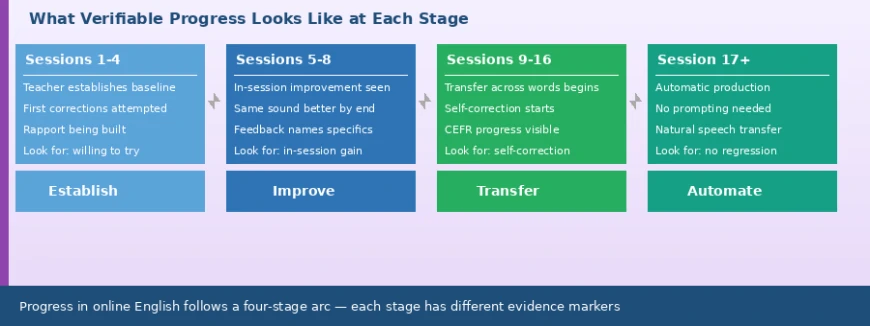
Progress in online English does not look the same in session 3 as it does in session 15. Parents who expect observable evidence in the first month will be disappointed. Parents who look for engagement signals in the first month and evidence signals from month two onward have a more accurate framework.
Sessions 1 to 4: establishing the baseline
In the first four sessions, the teacher is establishing a baseline. She is learning which sounds the child produces incorrectly, which correction approaches the child responds to, and how much trust has been built in the relationship. Evidence-seeking in sessions one to four is premature. What parents should watch for is whether the teacher is showing signs of systematic baseline assessment: does the feedback report name specific sounds rather than just describe the child’s general engagement?
If the feedback reports from sessions one through four contain no specific phoneme information, that is itself evidence of a problem. Not evidence that the child is not improving, but evidence that the teacher is not tracking the specific targets that will determine whether improvement is measurable.
Sessions 5 to 8: in-session improvement
By sessions five to eight, in-session improvement should be visible for at least one or two target sounds. This means the child produces a sound incorrectly at the start of a drill and correctly by the end of it, within the same session. This is the first form of evidence worth looking for, and it is verifiable through the feedback report if the report describes what changed within the session rather than just whether the session went well.
If no in-session improvement on any specific sound is visible or reported by session eight, ask the teacher directly: which sound have you seen the most in-session improvement on, and what does that improvement look like? A teacher who cannot answer this question specifically is not tracking the right information.
Sessions 9 to 16: cross-session retention and self-correction
Between sessions nine and sixteen, corrections should begin to hold across sessions. A sound that was corrected in session five should not be at square one in session ten. If the teacher is starting each session by re-establishing the same corrections from scratch, the in-session gains are not being retained and the post-class review either is not happening or is not session-specific.
This is also the range in which the first signs of self-correction in the lesson setting should appear. The child produces an error, catches it, and corrects it before the teacher says anything. This is not yet transferable evidence, because it is still happening in the lesson context. But it is a clear sign that the motor pattern is beginning to shift from effortful to semi-automatic.
Session 17 and beyond: automaticity and transfer
From session seventeen onward, the evidence standard shifts to transfer. Does the child produce the corrected sound correctly in natural speech outside the lesson? This is the evidence type that parents most want to see and that takes the most sessions to achieve. It is also the evidence that cannot be manufactured by a motivated teacher or a positive feedback report. It either happens or it does not.
If natural speech transfer has not appeared by session twenty-five for a sound that was targeted from the beginning, ask the teacher and the platform what is preventing it and whether the approach needs to change.
How to Read a Feedback Report as Evidence
The feedback report after each session is the primary documentation of what happened. Most parents read reports as confirmation that the session went well. Evidence-oriented parents read reports as data, looking for specific phoneme information and comparing across sessions to see whether the same targets are appearing or disappearing.
What a useful feedback report contains
A feedback report that constitutes verifiable evidence names the specific sounds addressed in the session, describes what the child produced and whether it was correct or corrected, notes whether in-session improvement occurred, and identifies which sounds need continued attention at the next session. It may also note what technique was used and whether the child responded to it. This is a report parents can act on: it tells them what to practise at home, what to observe in natural speech, and what questions to ask at the next session.
Good vs weak feedback: examples
This table shows the difference between feedback reports that constitute verifiable evidence and those that do not. Use it to evaluate the reports your child’s teacher is providing.
| Weak feedback (not verifiable evidence) | Strong feedback (verifiable evidence) |
| Great effort today! Really working hard. | /p/ substitution corrected 3 times; child produced ‘pen’ and ‘park’ correctly by end of session. |
| Good progress this week, getting better every session. | /v/ voicing still defaulting to /f/ under speed; throat-buzz technique introduced and attempted. |
| Your child is very engaged and enthusiastic! | In-session improvement on /ch/ vs /sh/ distinction; ‘chip’ vs ‘ship’ drill successful 4/5 attempts. |
| We worked on pronunciation and vocabulary today. | /th/ voiced production (/ð/) addressed in ‘the’, ‘this’, ‘that’; tongue position demonstrated twice. |
| She did really well! Looking forward to next session. | /p/ in word-final position (‘cup’, ‘map’, ‘stop’) still inconsistent; to revisit at session start next week. |
What to do if reports are consistently weak
If the feedback reports you receive session after session contain only general positive comments and no specific phoneme information, raise it directly. Email the platform or teacher and ask specifically: can the feedback report for each session include the phonemes addressed and whether they improved or still need work? Most teachers can provide this if asked. If the platform’s feedback system does not support it, that is a structural limitation worth considering when evaluating whether to continue with the programme.
How 51Talk Makes Progress Verifiable
A programme’s value is only as measurable as its evidence infrastructure allows. 51Talk’s lesson cycle is designed to produce verifiable evidence at multiple levels, which is why it is particularly worth evaluating for parents who want to move beyond the question of whether their child is engaged to the question of whether their child is improving.
What 51Talk is
51Talk is a live one-on-one English platform for children. Sessions are 25 minutes, delivered by qualified teachers, structured around CEFR levels and Cambridge English learning goals. The lesson cycle includes a pre-class warm-up, the live session with real-time correction, post-class review exercises targeted to that session’s sounds, a written teacher feedback report, and regular unit and level assessments.
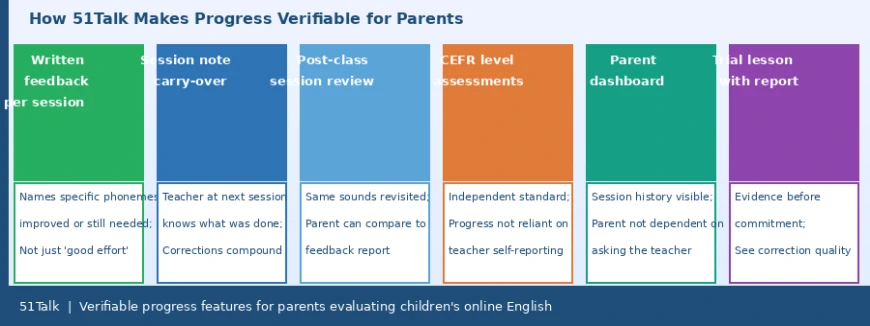
Evidence features in the 51Talk structure
• Written feedback after every session. The feedback report is not an optional add-on. It is part of the standard lesson cycle. The value of this for evidence-oriented parents depends on whether the report contains phoneme-specific information: request a sample report before enrolling to check the level of detail.
• Session note carry-over. The teacher at Wednesday’s session has access to Monday’s feedback. This is the mechanism that allows corrections to build rather than restart. It also means the Wednesday report can reference whether Monday’s corrections held, which is cross-session retention evidence.
• Post-class review targeted to session sounds. The review exercises after each session are built around the sounds addressed in the live lesson. A parent who checks whether their child is completing these exercises and whether the sounds in the exercises match the sounds in the feedback report has a self-contained evidence loop.
• CEFR level assessments. Regular assessments against the CEFR standard give parents testable evidence that is independent of teacher reporting. Ask how frequently these are conducted and whether you receive a written result with the CEFR level stated.
• Trial lesson with feedback report. The trial lesson includes a feedback report. Read this report carefully before committing. If the report from the trial lesson contains phoneme-specific information, the programme’s reporting system is capable of producing verifiable evidence. If it does not, ask whether that changes with enrolled students or whether the reporting level is the same.
Ask 51Talk specifically: do the feedback reports for enrolled students name specific phonemes, and does the platform provide written CEFR level assessment results at regular intervals? These are the two questions that determine whether the programme produces verifiable evidence by design or by exception. Check current programme details and request a trial lesson at 51talk.com.
Parent Action Checklist: What to Do and When
This table gives Saudi and Arab-American parents a specific, timed action plan for gathering progress evidence across the first three months of any online English programme. Each action corresponds to a specific evidence type.
| When | Action | What it verifies |
| Before session 1 | Ask the platform for a sample feedback report. Check that it names specific phonemes. | Whether the platform’s reporting system produces actionable evidence or just positive summaries |
| After session 2 | Read the feedback report and note which specific sounds were named. Save it. | Baseline: which sounds the teacher is targeting and what the initial correction status is |
| After session 4 | Compare the session 4 report to the session 2 report. Have the same sounds improved? | Whether in-session improvement is being tracked and documented across sessions |
| After session 6 | Observe one session. Note how many Arabic transfer errors occur and how many are corrected. | Whether the teacher’s correction quality matches what the feedback reports describe |
| After session 8 | Check whether errors flagged in sessions 2-3 are still appearing or have reduced. | Whether corrections are holding across sessions, not just improving within a single session |
| At month 2 | Ask the platform for the CEFR level assessment result. | Independent, objective measurement of English language progress not reliant on teacher self-reporting |
| At month 3 | Observe child speaking English in a natural, non-lesson setting. Note whether Arabic transfer errors appear. | Whether progress has transferred outside the lesson setting, which is the strongest evidence of real change |
| If progress seems absent | Ask the teacher specifically: which sound has shown the most improvement, and which is still a consistent error? | Whether the teacher is tracking individual sound progress at all. A specific answer means yes; a general one means no. |
What to Do Next
Before the first session on any platform, request a sample feedback report and check whether it contains phoneme-specific information. This single action tells you whether the platform’s evidence infrastructure is capable of producing verifiable progress data. If the sample report contains only general comments, ask whether more specific reporting is possible for enrolled students.
Set your first evidence checkpoint at session four. Read the feedback reports from sessions one through four and ask: does each report name specific sounds? Do the sounds mentioned match what you would expect to see targeted for an Arabic-speaking child, specifically /p/, /v/, /ch/, /sh/, and /th/? If the first four reports contain no phoneme information, raise it before session five.
Set your second checkpoint at session eight. Ask the teacher directly: which sound has shown the most in-session improvement, and which is still consistently appearing as an error? A teacher who can answer this specifically is tracking the right information. A teacher who gives a general positive answer without specifics is not.
Progress is not the same as enjoyment, and evidence is not the same as encouragement. Both enjoyment and encouragement matter. But they are not what you are paying for. Verifiable progress is what you are paying for. The checklist in this guide gives you the tools to confirm that it is actually happening.
Frequently Asked Questions
Does 51Talk’s feedback report contain specific phoneme information, and how often are CEFR assessments conducted?
These are the two most important evidence questions to confirm with 51Talk before enrolling. The platform’s standard lesson cycle includes a written feedback report per session, but whether that report names specific phonemes rather than giving general comments is worth verifying with a sample report request. Ask the platform: can you show me an example feedback report that was written for a child working on pronunciation? Additionally, ask how frequently CEFR level assessments are conducted and whether parents receive a written result with the CEFR level stated. A trial lesson is available at 51talk.com, and the feedback report from the trial is the first piece of evidence to evaluate.
My child’s teacher always gives very positive reports. How do I know if that means progress or just positivity?
Read the reports for phoneme-specific information rather than for emotional tone. A positive report that says “your child is making excellent progress and we are very proud of her” tells you nothing about what sound she produced correctly this week. A report that says “/p/ substitution reduced significantly; child produced pen, park, and purple correctly in the final drill” is positive and specific. If you have been receiving positive but non-specific reports, email the teacher and ask: which specific sound has shown the most improvement this month, and which is still appearing consistently as an error? The answer tells you whether the teacher is tracking evidence or just maintaining positive parent relations.
How long should it take before I see evidence of progress on a specific Arabic transfer error like /b/ for /p/?
For most Saudi and Arab-American children aged seven to twelve, in-session improvement on /p/ should be visible within four to six sessions of consistent targeted correction. This means the child produces /p/ correctly when prompted, by the end of a session that targeted it specifically. Cross-session retention, where /p/ is consistently produced correctly across multiple sessions without re-establishing the correction each time, typically develops by session ten to fifteen. Self-correction in natural speech, the strongest evidence, typically emerges between sessions twelve and twenty for this sound. If none of these markers are visible after twenty sessions of targeted /p/ correction, ask the teacher specifically what approach is being used and whether a different technique is worth trying.
My child has been in lessons for three months and I still hear the same pronunciation errors in normal conversation. Does that mean the programme is not working?
Not necessarily, but it is worth investigating. First, check the feedback reports from the last month: are the errors you hear in conversation the ones that have been consistently targeted in sessions, or are they different errors that have not been the focus? If the errors in natural speech are ones the teacher has been targeting, the question is whether cross-session retention is occurring. If reports show in-session improvement but the errors reappear in conversation, the gap is between session performance and natural transfer. This is common and addressable: increase the session frequency, ensure post-class review is happening the same day as each session, and ask the teacher to introduce the target sounds in conversation practice within sessions rather than only in drills.
Can I ask to see evidence of progress at any point, or is that unusual?
Not only can you ask, you should. Asking for evidence of progress is a reasonable and appropriate parental action at any point during an online English programme. Specifically, you can ask the teacher for a summary of which sounds have improved since the programme started, ask the platform for the most recent CEFR assessment result, ask to observe a session to verify correction quality, and request feedback reports from any past session if they are stored in the parent account. A platform or teacher that responds to these requests with resistance or vagueness rather than specific data is worth scrutinising. Reputable platforms that take progress seriously welcome parents who ask evidence-oriented questions.
What should I do if I observe a session and the correction quality is much lower than the feedback reports suggest?
Note the discrepancy specifically: list the errors you observed that were not addressed in the session and compare them to the sounds the feedback report says were corrected. Then raise it directly with the teacher before the next session, framing it as a question: I noticed in the session I observed that the /p/ substitution appeared several times without correction. Can you tell me how you typically address that, and whether there was a reason it was handled differently in that session? A teacher who can give a clear, specific answer is taking the discrepancy seriously. If the answer is vague, raise it with the platform rather than the teacher and ask whether a different teacher might be a better fit.