English learning for children spans a wide price range: from genuinely free resources on YouTube and library sites to structured one-on-one live lessons at $15 or more per session. When the budget is limited, parents face a real trade-off: a higher-quality option the child attends less often, or a lower-cost option the child uses daily.
This page explains what each option can and cannot produce, how to sequence them if the budget allows only one at a time, and how even a modest live lesson investment, combined with free resources, outperforms the equivalent spend on an app alone. It applies to children aged 4 to 14 learning English as a second or heritage language.
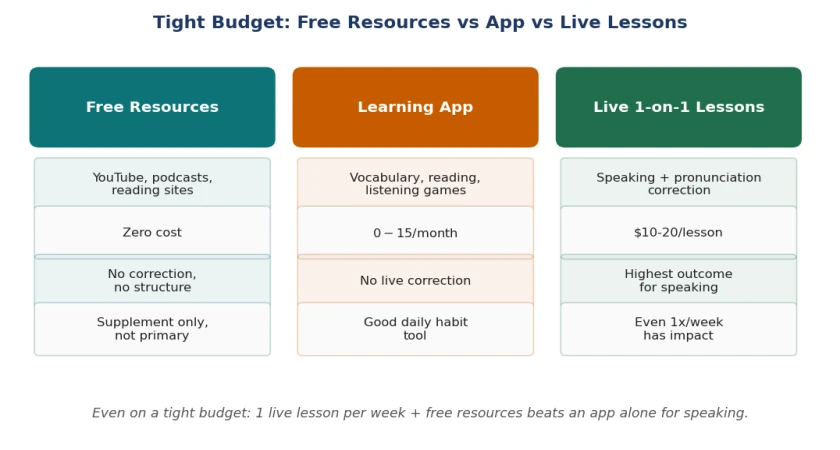
What each format produces, at what cost, and when to use each
What Free Resources Can and Cannot Do
Genuinely free English resources include YouTube channels for children (Cocomelon, Super Simple Songs, CBeebies), open reading sites (Oxford Owl, British Council Kids), and podcasts for young learners. These provide vocabulary exposure, listening practice, and reading scaffolding at zero cost.
What free resources cannot do is correct pronunciation, adapt to the specific child’s gaps, or provide the social interaction that builds spoken confidence. A child who only learns English from YouTube will develop strong listening comprehension and vocabulary recognition, and almost no spoken output capability.
What Apps Provide at Low Cost
Paid apps for children’s English (Duolingo Kids, Lingokids, reading apps) typically cost between $5 and $15 per month. They add spaced repetition for vocabulary, structured listening exercises, and game mechanics that build habit. They do not add live correction, spoken interaction, or adaptive teaching.
For a child who already has a live lesson programme, an app is an excellent supplement. For a child who only has an app, vocabulary recognition will improve without the corresponding spoken production.
What One Live Lesson Per Week Does
Even one 25-minute one-on-one live lesson per week at $10 to $15 provides something neither free resources nor apps can: a teacher who hears every word the child produces, corrects pronunciation specifically, and builds a relationship that motivates the child to try harder than they would for a screen.
One session per week is not optimal. It is however significantly more effective for spoken English development than zero sessions per week combined with any amount of app or free resource use. If the budget allows only one live lesson per week, that lesson plus daily free resource exposure is the most cost-effective combination available.
A Budget-Conscious Combination Framework
| Budget level | Recommended approach | Expected outcome |
| Very tight (under $20/month) | Free resources daily (YouTube, reading sites) | Listening and vocabulary input only |
| Low ($20-40/month) | 1 live lesson/week + free resources daily | Speaking + vocabulary at minimum frequency |
| Moderate ($60-90/month) | 2 live lessons/week + app between sessions | Progress in pronunciation and fluency |
| Comfortable ($120+/month) | 3 live lessons/week + app + post-lesson review | Strong retention and consistent progress |
Where 51Talk Fits In
What 51Talk is
51Talk is a live one-on-one English platform for children with 25-minute lessons, CEFR-aligned curricula, and structured lesson cycles. Package details and trial at 51talk.com.
Why even one 51Talk session per week matters on a tight budget
51Talk’s one-on-one format means a single weekly session provides the child’s only opportunity for real spoken English interaction with a trained teacher that week. Combined with free resource exposure between sessions and the post-class review exercises provided after each lesson, a single weekly session has a larger impact than the lesson count suggests.
What to keep in mind
One session per week is the minimum viable frequency, not the recommended one. As the budget allows, increasing to two sessions per week produces a meaningful improvement in retention and spoken progress. Start with what is sustainable, not with what is ideal.
Before You Enrol: Questions to Ask Any Platform
• Is a one-session-per-week frequency supported, or does the platform require a minimum? Some platforms only sell packages designed for higher frequencies.
• Does the platform provide post-lesson review exercises at no additional cost? These significantly improve the value of each session.
• What is the smallest package available? Lower upfront commitment matters more at tight budget levels.
• Are there free resources recommended to use between sessions? A platform that guides supplementary practice is more valuable than one that does not.
Frequently Asked Questions
Can 51Talk support a one-session-per-week schedule for a budget-conscious family?
51Talk packages are designed for regular weekly attendance. Budget-conscious families can start with a smaller package at a lower weekly frequency and increase as the budget allows. Visit 51talk.com to discuss current package options. A trial lesson is the most direct way to assess value before committing.
Are free English resources genuinely useful, or are they just low-quality background noise?
The best free resources, including Oxford Owl, British Council Kids, and age-appropriate YouTube channels, are genuinely effective for vocabulary exposure and listening practice. They are low-quality only if used without engagement. An active viewing session where a parent watches and discusses what was seen is more effective than background play.
Is an app better than one live lesson per week?
For spoken English development, one live lesson per week is more effective than any app used the same number of minutes, because the live lesson provides correction and spoken interaction that the app cannot. The app is better as a supplement to the live lesson, not as a replacement for it.
How do I make one live lesson per week as effective as possible?
Complete the post-lesson review within 15 minutes of the session. Use free resources for 10 minutes on non-lesson days. Ask your child to use one word from the lesson in conversation that evening. These three habits extend the value of the single weekly session significantly beyond the 25 minutes of the lesson itself.
What to Do Next
Identify which budget level in the table above applies to your family. Start with the approach in that row. If a live lesson is affordable at any frequency, prioritise it over an app. Supplement with free resources rather than additional app spending. Review progress at four weeks and adjust the frequency if the budget allows.