The distinction matters: there is a difference between helping a child develop the English skills needed to complete their homework independently, and completing the homework with them or for them. The first is valuable and sustainable. The second removes the learning that the homework was designed to produce.
This page covers what an online English platform can genuinely contribute to a child’s school English performance, what it cannot and should not attempt to replace, and how parents can use a platform in a way that strengthens the child’s independent capability rather than their dependence on external support.
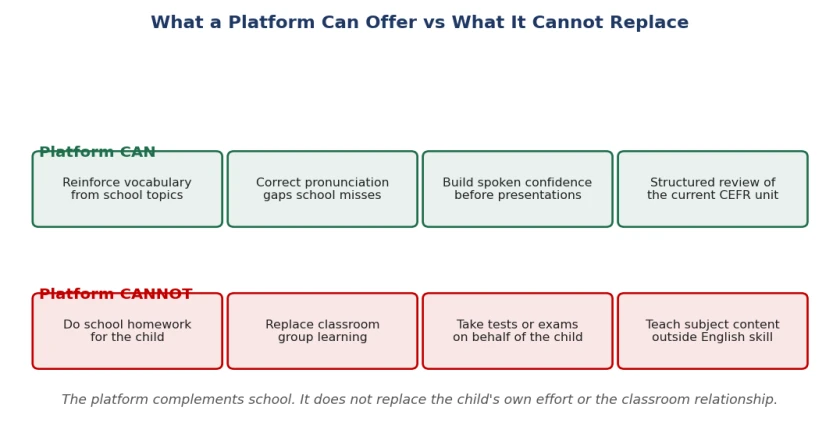
What a platform can offer, and what it cannot replace, in supporting school English
What a Platform Can Do That Does Not Overlap with Homework
A well-designed English platform supports school learning by building the underlying skills the homework requires. This is different from working through the homework itself. When a child can decode the vocabulary of a reading task, form grammatically correct sentences, and produce spoken English without freezing, they complete homework independently. The platform builds the capability. The child uses it.
• Vocabulary reinforcement aligned with school topics. If the school is covering animals and habitats in Year 3, a private lesson that reinforces the same vocabulary in a spoken context makes the child more capable of writing about it, not just more familiar with the words.
• Pronunciation and spoken fluency. Homework rarely requires spoken English. Private lessons build the spoken ability that classroom participation and oral assessments require, without substituting for any written task.
• Reading comprehension strategies. Private lessons can work on how a child approaches a reading passage, how they extract meaning, and how they manage unfamiliar vocabulary, without reading the specific homework passage for them.
• Writing structure and sentence patterns. A private teacher can demonstrate how a structured paragraph works and ask the child to produce their own, using different content from the homework assignment. This builds the skill the homework tests.
What a Platform Should Not Do
• Write or complete the child’s homework. Any private lesson that works through a homework task directly removes the learning that the task was set to produce.
• Answer the specific questions on a school assignment. Even if framed as “practice,” walking through the homework questions defeats the purpose of the assignment.
• Replace the child’s relationship with their school teacher. A private teacher who contradicts the school teacher’s instructions or teaches a different method creates confusion rather than support.
• Create dependence. A child who cannot write a sentence without a private teacher present has not developed the independent capability that school requires.
Where 51Talk Fits In
What 51Talk is
51Talk is a live one-on-one English platform for children with 25-minute structured sessions, CEFR-aligned curricula, and post-lesson feedback. Details at 51talk.com.
How 51Talk supports school learning without replacing homework
51Talk’s structured curriculum covers vocabulary, speaking, and comprehension in a progressive sequence aligned to CEFR levels. For an international school child, a parent can inform the 51Talk teacher of the school’s current topic unit and ask them to include related vocabulary and sentence patterns in the lesson without using the homework assignment itself.
The post-lesson feedback report tells the parent which vocabulary and structures were covered. The parent can then look for those same words and structures in the child’s written homework, using them as evidence of transfer rather than evidence that the platform was used to complete the task.
What to keep in mind
The boundary between vocabulary reinforcement and homework completion depends on how the lesson is structured. Ask the teacher specifically: we would like to work on the vocabulary from this school topic, but not on the specific homework assignment. A professional teacher will understand and respect this boundary.
Before You Enrol: Questions to Ask Any Platform
• Can the teacher align lesson vocabulary with current school topics? Without using specific homework tasks.
• Does the teacher understand the difference between skill building and task completion? This is the professional standard to expect.
• What does the lesson report show after a session aligned with school content? The parent needs to know what was covered.
• Can the lesson include writing structure practice using different content? The skill, not the specific task.
Frequently Asked Questions
Can I ask a 51Talk teacher to work on vocabulary from my child’s school unit?
Yes. 51Talk’s one-on-one format allows parents to share the school’s current topic with the teacher so lesson vocabulary can be aligned. The teacher works on the relevant vocabulary and speaking skills in the lesson context, not on the specific homework assignment. This alignment is most useful when communicated to the teacher before the session, not during it.
My child’s homework includes a reading comprehension task. Can the private lesson help?
Yes, by building the comprehension strategies the task requires, not by working through the specific passage. A lesson that practises finding the main idea, identifying unfamiliar words from context, and summarising a different reading passage builds the same skill the homework tests without completing the homework.
What if my child asks the private teacher for help with homework directly?
Set the expectation with your child before the lesson: the teacher is there to help you get better at English, not to help with homework. If a child raises a homework question, a good teacher will answer the general question the homework raises without completing the specific task. Communicate this expectation to the teacher as well.
How do I know whether the private lessons are building genuine independent capability?
Look for the vocabulary from recent private lessons appearing in the child’s independent written work without prompting. If words and sentence patterns from lessons are showing up in homework the child completed without help, capability is being built. If the child still cannot write independently in the areas covered by the lessons, adjust the lesson format.
What to Do Next
Identify the school English skills your child most needs to develop independently: vocabulary recall, reading comprehension, sentence structure, or spoken confidence. Choose a platform that builds those skills in a lesson context that does not use homework as its teaching material. Share the school’s current topic with the private teacher so lesson vocabulary is aligned. Review the post-lesson report to track which skills are being reinforced. The test is whether the child’s homework becomes more independently capable over time. If it does, the platform is supporting school learning correctly.