A parent searching for an English programme for their child will quickly encounter two very different types of options. One is an app: self-paced, available any time, usually affordable, popular with children because of game mechanics and rewards. The other is a live lesson platform: structured, scheduled, more expensive, dependent on teacher quality. The two feel like competitors. They are not. They address different parts of the same problem.
This page explains what each method does well, what neither does well alone, and how to combine them in a way that produces outcomes better than either approach on its own. It applies to children aged 4 to 14. It does not cover children with diagnosed language learning difficulties, for whom a speech-language pathologist should be involved first.
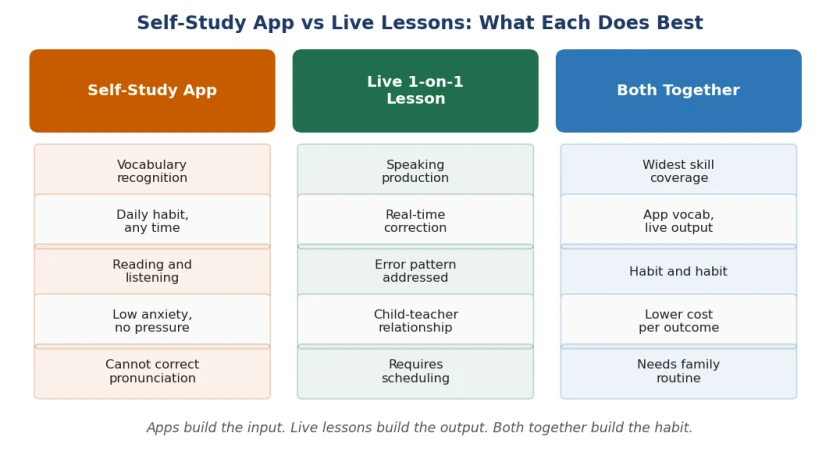
What each format does best, and why the combination outperforms either alone
What Self-Study Apps Do Well
Apps are very good at three specific things: building vocabulary recognition through spaced repetition, developing reading and listening exposure at the child’s own pace, and making English feel like a daily habit rather than a scheduled obligation.
They are also good at lowering anxiety. A child who is too embarrassed to speak in a live lesson will often complete vocabulary games and listening exercises in an app without the same reluctance. For children who are anxious about producing English, an app builds familiarity with the language before the social pressure of a live lesson.
What Live Lessons Do That Apps Cannot
• Correct pronunciation errors in real time. An app can tell a child an answer is wrong. It cannot hear that the child said /b/ instead of /p/ and demonstrate the correct lip position.
• Respond to this specific child, today. A live teacher adjusts to what the child produces, what they struggle with, and what they are ready to attempt. An app follows its sequence.
• Build spoken fluency. Fluency requires responding to unpredictable input from another person. App dialogue trees are predictable and limited.
• Provide the relational motivation that drives extra effort. Children try harder for a teacher they have a relationship with than for a badge counter.
When to Use Each Method
| Situation | Recommended Approach |
| Vocabulary building between lessons | App, daily 10 min |
| Pronunciation correction needed | Live lesson, minimum 2x per week |
| Speaking confidence is the goal | Live lesson, one-on-one format |
| Reading and listening practice | App or structured reading supplement |
| Child is anxious about speaking | App first, then live once comfort builds |
| Progress has stalled on app alone | Add live lessons to activate production |
| Limited budget | App daily + 1 live lesson per week as minimum |
How to Combine Both Effectively
The most effective combination is not just using both. It is sequencing them correctly. An app used without connection to the live lesson produces two parallel learning streams that reinforce different content. An app used to review the specific vocabulary from the live lesson produces compounding retention.
• Before the live lesson. Five minutes of app warm-up reviewing vocabulary from the previous lesson. This reduces the startup time in the live class and activates the relevant memory.
• After the live lesson. Ten minutes of session-specific app review, within 15 minutes of the class ending. This catches the consolidation window when the content is most accessible.
• Between live lessons. Ten minutes of app vocabulary practice, ideally connected to the lesson’s current unit theme. A generic vocabulary app is less effective than one where the parent has set the word list to match the lesson.
Where 51Talk Fits In
What 51Talk is
51Talk is a live one-on-one English platform for children offering 25-minute sessions with qualified teachers, CEFR-aligned curricula, and a lesson cycle that includes pre-class warm-up, post-class review exercises, teacher feedback, and unit assessments. Trial available at 51talk.com.
Why 51Talk’s lesson cycle is designed for the combined approach
51Talk’s post-class review exercises are session-specific. They review the vocabulary and language points from that day’s lesson, not a generic word list. This makes them the most direct implementation of the post-lesson app activity described above. The pre-class warm-up exercises also follow the same curriculum sequence, creating the before-and-after structure that connects live lessons to review practice.
Because the curriculum is CEFR-aligned and progresses through defined units, the parent who wants to supplement with a third-party app can also match that app’s vocabulary list to the current 51Talk unit. The alignment makes both activities more effective.
What to keep in mind
The combination only works if both activities happen consistently. A live lesson without app review produces lower retention than a live lesson with app review. An app without live lessons produces vocabulary knowledge without spoken output. The habit is the mechanism, not the platform.
Before You Enrol: Questions to Ask Any Platform
• Does the platform provide session-specific post-lesson review exercises? Generic exercises are less effective.
• Does the lesson cycle include a pre-class warm-up? Connection to the previous lesson reduces startup friction.
• Can I access the lesson vocabulary list after each class? This is needed to set up supplementary app practice.
• Is the curriculum unit-based with a clear sequence? Structured progression makes app supplementation easier to target.
Frequently Asked Questions
Does 51Talk’s lesson structure support combination with a self-study app?
Yes. 51Talk’s lesson cycle includes post-class exercises that review that session’s content, and a pre-class warm-up that connects to the previous lesson. These are the two moments when app and live practice connect most effectively. Parents can also use the lesson feedback report to guide supplementary app vocabulary practice between sessions. Visit 51talk.com for trial details.
My child’s app scores are excellent but their spoken English has not improved. Why?
App scores measure recognition. A child can score 95% on a vocabulary app by identifying the correct answer from four options without ever producing the word under social pressure. Spoken fluency requires production, not recognition. This gap is the most common reason to add a live lesson component to an existing app routine.
What is the minimum effective combination for a family with limited time?
One live 25-minute lesson per week plus 10 minutes of session-specific app review immediately after the lesson. That is the floor. It is not optimal, but it provides live correction and same-day consolidation. Increasing to two live lessons per week approximately doubles the rate of spoken progress for most children aged 6 to 10.
How do I know whether the app and live lesson are reinforcing each other?
Ask your child to use a word from last week’s lesson without any prompt at the start of this week’s lesson. If they can retrieve it, both activities are working together. If they cannot, check whether the app review is targeting the same vocabulary as the live lesson.
What to Do Next
Identify your child’s primary gap: pronunciation, vocabulary, or fluency. If it is pronunciation or fluency, start with live lessons and add an app for between-session review. If it is vocabulary, start with an app and add live lessons when the child’s anxiety about speaking has reduced. Once both are running, connect them through the timing framework above: app warm-up before, app review after, app practice between. The three-part routine is what makes the combination more than the sum of its parts.