A child who refuses to speak English at school but chatters freely at home in Arabic is not showing you a language gap. They are showing you a confidence gap. The language exists. The willingness to produce it in a high-stakes social environment does not yet.
For Saudi parents, this situation is common and specific. Many Saudi children have Arabic as their dominant language, encounter English primarily in formal school settings, and bring significant cultural self-awareness into any new learning environment. A private English lesson that ignores these factors and applies a generic high-energy lesson approach is likely to deepen the hesitation rather than reduce it.
This page covers what low-pressure genuinely means in a lesson context, what Saudi families should specifically look for, and how to evaluate a trial lesson for a hesitant child.
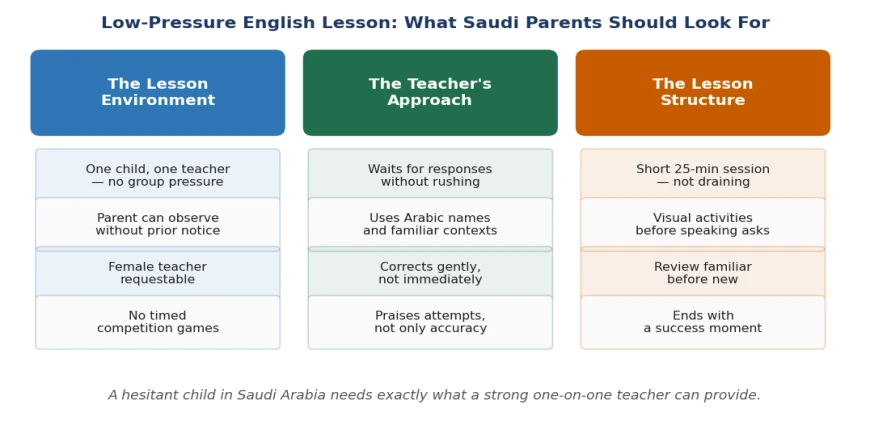
What Saudi parents should look for: lesson environment, teacher approach, and structure
What Hesitancy Looks Like in Saudi Children Specifically
Saudi children who hesitate to speak English in lessons often show a combination of factors: Arabic is socially and emotionally dominant, English errors feel more visible than Arabic ones because the language feels more foreign, and there may be an expectation from the family or school environment that English should be produced correctly rather than attempted imperfectly.
A low-pressure private lesson addresses all three factors: it creates a context where Arabic is not being compared to English, where errors are handled as steps in a learning process rather than mistakes to avoid, and where the child’s first attempts are welcomed rather than assessed.
What Low-Pressure Actually Means in a Lesson
• No timed performance pressure. Games with countdown timers or race mechanics are stimulating for confident children and terrifying for hesitant ones. The lesson should not include activities where the child feels they are failing in real time.
• Visual and contextual scaffolding. Before the child is asked to speak, they see the word, hear it, or see a picture related to it. The production ask comes after exposure, not before.
• Arabic names and familiar contexts. A lesson that uses the child’s name correctly, references familiar Saudi context (food, family, school), and does not present culturally unfamiliar scenarios feels safer to the child.
• Female teacher option. For girls especially, a female teacher removes a potential source of social discomfort.
• Consistent, predictable lesson shape. A hesitant child relaxes when the lesson follows a familiar structure. Unpredictability is itself a stressor.
The Scheduling Factor
For Saudi children, the timing of the lesson matters for comfort as well as attendance. A lesson that falls immediately after a long school day, before the child has had any downtime, adds tiredness to the anxiety already present. The AST 5:00 to 7:00 PM window, after school, a snack, and 30 minutes of rest, is typically when most Saudi children are most ready for an additional learning session.
Where 51Talk Fits In
What 51Talk is
51Talk is a live one-on-one English platform for children with 25-minute structured lessons, qualified teachers, CEFR-aligned curricula, and post-lesson feedback. Trial at 51talk.com.
Why 51Talk’s one-on-one format suits hesitant Saudi children
The absence of a peer audience is the most important structural factor for a hesitant Saudi child. In a one-on-one lesson, the child’s hesitation is visible only to the teacher, whose role is specifically to respond to it productively. No comparison to peers, no performance in front of classmates, no social risk beyond the teacher’s response.
Female teachers can be requested, which matters for many Saudi families with daughters. The 25-minute format is short enough to feel manageable for a child who approaches the lesson with anxiety. Philippine-based teachers in the AST after-school window provide scheduling options that fit most Saudi family routines.
What to verify in the trial
Request a teacher with experience in hesitant or shy children before booking the trial. Ask specifically whether the teacher uses visual scaffolding before spoken asks. During the trial, count the waiting time after the first question. Five or more seconds is the standard for a patient teacher. Less than two seconds is a signal to request someone else.
Before You Enrol: Questions to Ask Any Platform
• Can I request a female teacher specifically experienced with hesitant children? Both factors matter for Saudi daughters.
• Does the lesson use visual and contextual scaffolding before speaking asks? Confirm this is built into the approach.
• Are lesson slots available in the AST 5:00 to 7:00 PM post-rest window? The timing affects readiness.
• What is the process if the teacher is not a good fit for my child? A trial with an alternative teacher should be straightforward.
Frequently Asked Questions
Does 51Talk offer low-pressure private lessons suitable for hesitant Saudi children?
51Talk’s one-on-one format, female teacher availability, and short 25-minute session format create the structural conditions for a low-pressure lesson. Whether the specific teacher requested uses scaffolding, patient waiting time, and warm error handling should be verified in the trial. Arrange one at 51talk.com.
My daughter speaks Arabic confidently but completely refuses English. How do I start?
Start with a trial where the expectation is only that she listens. Tell her explicitly: “You just have to watch and listen. You don’t have to say anything today.” Removing the speaking expectation entirely for lesson 1 or 2 is the most effective way to get a resistant child through the first session. Once the teacher and format feel familiar, most children begin to respond.
Should I tell the teacher that my child is hesitant before the lesson?
Yes. Telling the teacher before the trial allows them to prepare accordingly: slower pacing, more visual scaffolding, more waiting time. A teacher who knows in advance delivers a different lesson from one who discovers the hesitancy mid-session.
How long should I give a hesitant child before expecting any English output?
Two to four lessons before expecting any voluntary spoken output is realistic for very hesitant children. Counting spoken output in lesson 1 as a success metric is too early. The success in lesson 1 is that the child attended, watched, and did not refuse to return.
What to Do Next
Book a trial with a female teacher experienced in hesitant learners, at your daughter’s best available time slot after school rest. Tell the teacher in advance that your daughter is hesitant. During the trial, observe waiting time and scaffolding rather than output. After the trial, ask one question: would she come back? A reluctant “maybe” is progress for a child who said “no” last week.