Choosing an online English programme for your child is one decision. Choosing when to schedule the sessions is a separate one, and it matters more than most parents expect. A well-structured 25-minute lesson delivered at the wrong time in the child’s day produces noticeably weaker results than the same lesson delivered when the child is alert, settled, and able to focus.
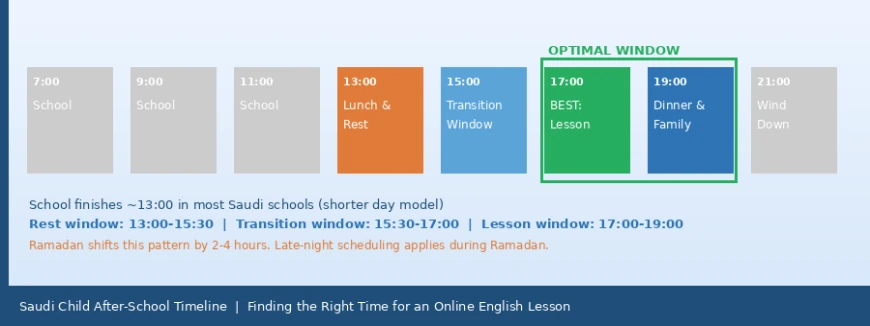
Saudi children’s daily schedules have specific patterns that differ from the schedules parents in other countries are planning around. School often ends around 13:00. A rest period typically follows. Religious commitments, prayer times, family meal rhythms, and the significant schedule shifts that come with Ramadan all shape which windows are genuinely available for focused English practice and which are not.
This guide gives Saudi parents a practical framework for identifying the best lesson time for their child’s specific schedule. It covers the cognitive factors behind timing, the four main after-school windows and what each one supports, how the Saudi weekly calendar affects lesson placement, how Ramadan changes everything, and a weekly planner template to map the ideal slots across the week. It is written specifically for families considering or already using short, frequent online sessions like the 25-minute format offered by 51Talk.
Why Lesson Timing Affects Pronunciation Work Specifically
Timing matters for all learning, but it matters more for pronunciation than for vocabulary or grammar. Here is why.
Vocabulary learning is largely declarative: the child hears a new word, connects it to a meaning, and stores it. That process can happen at various energy levels with reasonable results. Pronunciation correction is procedural: the child must notice a sound, feel the difference between their current production and the target, physically adjust the mouth position, attempt the new sound, and repeat it until the pattern begins to consolidate. Each of those steps requires active attention.
When a child is fatigued after a full school day, the procedural steps degrade. The child can still follow a story or answer vocabulary questions passively. But the focused attention needed to feel the difference between /b/ and /p/, to notice the air burst, and to consciously repeat the correction is not available at the same quality. A pronunciation correction delivered when the child is cognitively depleted often does not stick, because the working memory needed to embed it is already occupied with managing tiredness.
This means that for Saudi parents whose primary goal is pronunciation correction for Arabic transfer errors, finding the right timing window is not a scheduling nicety. It is a learning quality variable. The same teacher, the same session structure, and the same correction approach will produce better outcomes at 17:30 than at 13:30, for most children on most days.
The Saudi School Day and What Follows It
Most Saudi government schools and many private schools operate on a schedule that ends between 13:00 and 14:00 for primary and intermediate-level students. Some international schools run later, finishing at 15:00 or 15:30. The specific end time of your child’s school day is the starting point for any scheduling decision.
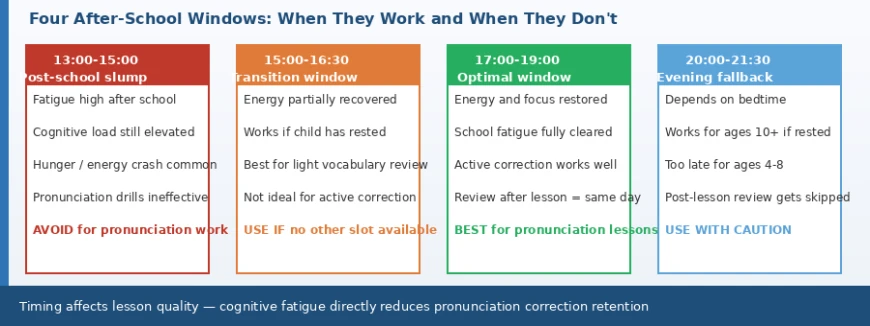
The post-school slump: 13:00-15:00
Immediately after school, most children are in a state of mixed cognitive depletion and physical energy discharge. They have been sitting, concentrating, and managing social dynamics for five to six hours. The brain’s glucose is depleted and the working memory system is saturated. Many Saudi children also arrive home hungry, as school lunch arrangements vary.
This window is poorly suited to a live one-on-one English lesson for pronunciation work. The child can go through the motions of a session, but the real-time correction cycle that makes pronunciation lessons effective, noticing the error, feeling the new position, attempting the repeat, confirming the correction, requires attentional resources that are at their lowest point right now. Scheduling lessons in this window because it is administratively convenient produces sessions that feel complete but retain less than sessions scheduled two to three hours later.
The transition window: 15:00-16:30
After a meal and a rest period, the child begins to recover. Energy levels rise, working memory clears, and the child can engage with moderate-intensity cognitive tasks. For children aged ten and above, this window can be used for a pronunciation session if no better slot is available. For younger children, it is still below the optimal focus level for active correction work.
If this is the only realistic window in a family’s schedule, it can work. The session should be preceded by a genuine rest period rather than screen time or stimulating activity that keeps cognitive load high. A child who has watched television for two hours and then starts a lesson at 15:30 is not in the same state as a child who has eaten, rested, and had thirty minutes of quiet play.
The optimal window: 17:00-19:00
For the majority of Saudi children aged five to twelve, the window from roughly 17:00 to 19:00 represents the best balance of recovered energy, cleared working memory, and available time before the family evening routine. School fatigue has dissipated. The child has eaten and rested. The household is typically quieter before the evening meal than after it.
This is the window where pronunciation correction sticks most reliably. The attention needed for a full five-step correction cycle, notice, name, model, repeat, record, is available. The child can attempt a /p/ production with the paper-puff test, notice whether it worked, and try again without the effort of sustained attention feeling like a burden. Post-class review completed in this window, while the session content is still fresh, adds its consolidation effect before the first overnight sleep period.
The evening fallback: 20:00-22:00
For older children aged ten and above, a lesson between 20:00 and 22:00 can work if the child’s bedtime is genuinely late and they are alert at that hour. Some Saudi family schedules naturally run late, particularly during summer, and a child who is wide awake and focused at 21:00 can have a productive pronunciation session at that time.
The risk with late evening sessions is the post-class review. A child who finishes a lesson at 21:00 and goes to bed at 22:00 may not complete the review exercises, or may complete them too quickly because they are tired and want to sleep. The review is the mechanism that closes the correction loop and interrupts the forgetting curve, and a missed review is a half-closed correction. For younger children, any session after 20:00 is too late, both for the session quality and for the sleep that follows it.
The Saudi Weekly Calendar: Planning Around Real Life
The Saudi working and school week runs Sunday through Thursday, with Friday and Saturday as the weekend. This creates a different scheduling rhythm from the five-day Monday-to-Friday pattern common in Western countries, and it affects how a three-to-four-session-per-week pronunciation plan should be laid out.
Sunday through Wednesday: the core scheduling days
These are full school days for most Saudi children. The pattern is consistent: school until 13:00 to 14:00, rest and meal, then the 17:00-19:00 window becoming available. Three lessons per week placed on Sunday, Tuesday, and Thursday, or Monday, Wednesday, and Thursday, provide even spacing that keeps the maximum gap between sessions at two days, which is inside the window where motor memory consolidation benefits from reinforcement.
Wednesday evenings often carry Quran classes, religious study, or family visits for many Saudi families. This is worth checking before committing a Wednesday slot to a lesson. A slot that conflicts with a regular religious commitment will produce inconsistent attendance, which breaks the frequency model. Better to choose Tuesday and Thursday as session days and leave Wednesday for religious commitments, then add a light home drill on Wednesday instead.
Thursday: shorter school day advantage
Many Saudi schools have a shorter or lighter Thursday schedule, with some children finishing earlier or having a reduced afternoon. This makes Thursday a particularly useful session day: the child is less fatigued than on a full school day, the afternoon is more relaxed, and the transition window from 15:30 onwards is more effective than the same time on a heavier school day.
Friday and Saturday: the weekend
The weekend offers scheduling flexibility that the school week does not. Morning slots on Friday or Saturday, around 10:00 to 11:30, are often available when the child is rested and the household is settled. These are good slots for a session with a slightly more relaxed pace or for a lesson that includes extended speaking practice.
The risk with weekend sessions is consistency. Weekend routines in Saudi families tend to be more variable, with family visits, outings, and travel more common than on school days. A session that works smoothly on a quiet Friday morning may frequently be disrupted by competing family activities. If the weekend is the only available slot, protect it explicitly and inform the family that it is a firm commitment rather than something that gets moved when something else comes up.
Religious commitments and prayer times
Prayer times run throughout the day and represent natural breaks in any schedule. Lessons that are timed to end before a prayer time or begin after one work more smoothly than lessons that land in the middle of a prayer window. For most families, scheduling sessions in the 17:00-19:00 block means the lesson typically falls between Asr prayer, which is usually around 15:30 to 16:30 depending on the season, and Maghrib, which is around 18:30 to 19:30. Confirming the specific prayer times for your location and season before locking in a lesson slot avoids disruptions mid-session.
Timing Windows at a Glance
This table summarises the six main after-school timing windows, what each one supports, and what it does not work for. Use it as a starting reference when planning the weekly schedule.
| Time window | Label | Ages it suits | What works | What does not work | | 13:00-15:00 | Post-school slump | None well | — | Pronunciation drills, active correction, new input | | 15:00-16:30 | Transition window | Ages 10+ | Light review if child has rested | Intensive correction, new phoneme work | | 17:00-19:00 | Optimal window | All ages | Full lesson + same-day review | — | | 19:30-20:30 | Post-dinner | Ages 7-12 | Works if dinner is early and relaxed | Too rushed if dinner finishes late | | 20:30-22:00 | Evening fallback | Ages 10+ | Older children with late bedtimes | Ages 4-9; review gets skipped | | After 22:00 | Ramadan special | Ages 10+ during Ramadan | Post-Iftar settled state, quiet home | Young children; disrupts sleep cycle |
Ramadan: How the Schedule Shifts
Ramadan changes the daily rhythm of Saudi family life significantly, and it changes the optimal lesson timing accordingly. Parents who have built a working schedule for the regular year often find that the same slots no longer function during the holy month and need to re-plan rather than simply persist with a schedule that no longer fits.
How the Saudi school day changes during Ramadan
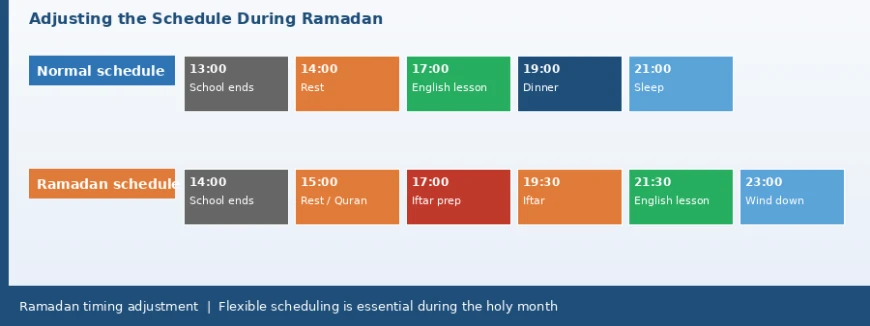
During Ramadan, most Saudi schools shift to a shorter timetable, typically ending around 13:00 to 14:00 rather than later. Children observe the fast throughout the school day, which means energy levels during school hours are lower than usual and the post-school fatigue is often more pronounced.
The conventional post-school and mid-afternoon windows, 13:00 to 17:00, are generally worse for lessons during Ramadan than at other times of year. The child is fasting, physically tired, and often resting or doing lighter activities until Iftar. Scheduling a live pronunciation lesson in this window during Ramadan is likely to produce a session that goes through the motions rather than one where active correction sticks.
The Iftar window and what follows it
Iftar typically takes place between 18:30 and 19:30, depending on the time of year and location. The period immediately after Iftar, while the family is eating together and managing the social dimensions of the meal, is not a good lesson window. Children need 30 to 60 minutes to settle after Iftar before they can engage productively with focused cognitive work.
The window from approximately 21:30 to 23:00 is often the optimal lesson slot during Ramadan for children aged ten and above. The child is fed, rested after Iftar, the household has settled, and the energy that was low all day is partially restored. Many Saudi families with children in online English programmes find this late-evening window works significantly better during Ramadan than any slot they would use during the rest of the year.
Young children during Ramadan
For children aged four to nine who are not yet observing a full fast, the schedule disruption is less severe but the household rhythm still shifts. The evening meal is later, bedtimes often extend, and the family’s attention is on Ramadan activities in ways that crowd out structured lesson time. For this age group, a flexible booking approach during Ramadan is more realistic than a fixed weekly timetable. Book sessions when the child is rested and alert, and accept that the week-to-week pattern will vary more than in regular periods.
Post-class review during Ramadan
One practical complication with late-night Ramadan sessions is that post-class review at 22:30 or 23:00 is difficult to sustain consistently. Children who finish a session at 22:30 and go to bed at 23:30 will often skip or rush the review. During Ramadan, the review can be shifted to the following morning before school, which is typically a quieter time than the evening. It loses some of the same-day consolidation benefit but is significantly better than no review at all.
Weekly Planner: A Template for Saudi Families
This planner covers all seven days of the Saudi week and maps the typical timing considerations, recommended lesson slots, and post-lesson practice for each day. Adapt it to your child’s specific school end time and family routine.
| Day | School day? | Best lesson time | What to do after lesson | Watch for | | Sunday | Yes (most schools) | 17:00-18:00 | Post-class review same evening | Energy level after first day of week | | Monday | Yes | 17:00-18:00 | 10-min home drill on session sounds | After-school activities clash? | | Tuesday | Yes | 17:00-18:00 | Review + passive English listening | Midweek fatigue building | | Wednesday | Yes | 17:00-18:00 | Post-class review, vocabulary practice | Quran or religious classes common | | Thursday | Yes (half day often) | 16:00-18:00 | Review + family conversation practice | Afternoon more relaxed than full days | | Friday | No (weekend) | Morning or 16:00-18:00 | Extended review or minimal pairs drill | Weekend disruptions to routine | | Saturday | No (weekend) | Flexible: 10:00 or 16:00 | Passive listening or reading | Maintain routine for consistency |
How to Use 51Talk’s Scheduling System Around Saudi Family Life
The practical value of any scheduling recommendation depends on whether the platform you are using can accommodate it. A platform with rigid fixed-timetable booking is difficult to reschedule around Ramadan, family events, or the week-to-week variability that Saudi family life produces. A platform with flexible advance booking, a clear rescheduling policy, and teacher availability across the 17:00-to-22:00 window makes the scheduling framework above practically achievable.
What 51Talk is
51Talk is a live one-on-one English platform for children. Sessions are 25 minutes, delivered by qualified teachers, and structured around CEFR levels and Cambridge English learning goals. The lesson cycle includes a pre-class warm-up, the live session with real-time pronunciation correction, post-class review exercises targeted to that session’s sounds, a written teacher feedback report, and regular level assessments.
Scheduling features to confirm before booking
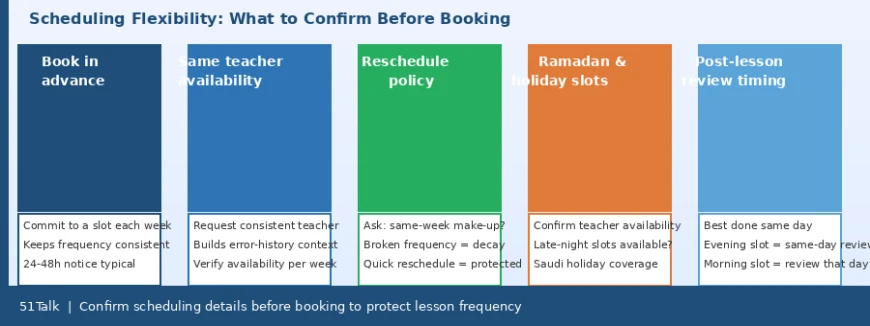
• Advance booking window. Ask how far in advance sessions need to be booked and whether the same slot can be reserved consistently each week. A consistent slot builds routine; ad-hoc booking creates the risk of irregular attendance.
• Rescheduling policy. Ask specifically: if a session is missed, can it be made up within the same week? A broken session that cannot be rescheduled quickly creates a gap in the consolidation cycle that matters more for pronunciation than for vocabulary.
• Evening and late-night availability. Ask whether teachers are available in the 17:00 to 19:00 window and, for Ramadan, whether late-evening slots after 21:30 are bookable. Teacher availability in these windows varies by platform and region.
• Ramadan-specific planning. Ask whether the platform has experience with Saudi families rescheduling during Ramadan and whether there is a process for adjusting the weekly plan during the holy month rather than simply defaulting to missed sessions.
• Post-class review accessibility. Ask whether the post-class review exercises are accessible on a mobile device for completion the same evening, and whether the review is available immediately after the session ends rather than only through a desktop interface.
A trial lesson at 51talk.com lets you test both the session quality and the scheduling system before committing to a plan. Use the trial to verify that the platform’s booking experience matches the flexibility claims, and ask the teacher directly whether they are familiar with Saudi family scheduling patterns and Ramadan schedule adjustments.
Parent Checklist: 10 Questions Before Setting the Weekly Schedule
Use this checklist before locking in a lesson schedule with any platform. It covers the child’s daily rhythm, platform policy, Ramadan planning, and the post-lesson review timing that completes each session’s learning value.
| Question to ask or confirm | Field | What the answer tells you |
| What time does my child get home from school on each day of the week? | Child schedule | Baseline for identifying available windows; varies by school and day |
| Does my child eat and rest before the lesson, or do sessions start immediately after school? | Recovery time | A 90-min gap after school significantly improves attention quality |
| Is the 17:00-19:00 window genuinely free of other commitments on most days? | Slot availability | Quran class, sports, and family activities often occupy this window |
| Can the same slot be protected consistently 3-4 days per week? | Frequency | Consistent timing builds habit; inconsistent timing produces irregular attendance |
| Does the platform allow flexible booking with 24-48h notice? | Platform policy | Flexible booking protects frequency when the primary slot is unavailable |
| What is the rescheduling policy if a session is missed? | Make-up policy | A broken week without make-up disrupts the motor memory consolidation cycle |
| Is the same teacher available at the preferred time slot most days? | Teacher continuity | Teacher familiarity with your child’s errors is built across consistent sessions |
| During Ramadan, what time does Iftar typically happen and when is the child settled? | Ramadan schedule | Optimal lesson time shifts to 21:30-23:00 post-Iftar during Ramadan |
| Is the post-class review completed the same day as the lesson? | Review timing | Same-day review is significantly more effective than next-day or deferred review |
| Does the child attend any religious classes or Quran sessions that affect weekday evenings? | Religious schedule | Quran classes commonly fall in the 16:00-19:00 window; plan around them |
What to Do Next
Start with the child’s school end time and map the 17:00 to 19:00 window to see whether it is genuinely free or crowded with other commitments. If it is free three or four days per week, that is your primary scheduling block. If it is occupied two of those days by Quran class or other activities, plan the sessions around those fixed commitments and use the occupied evenings for home drills rather than live lessons.
For Ramadan, make the scheduling adjustment before the month begins rather than during it. Identify the likely Iftar time for your city during that year’s Ramadan period and mark out the 21:30 to 23:00 window as the Ramadan lesson slot for children aged ten and above. For younger children, keep Ramadan sessions more flexible and accept that frequency may drop during the month, compensating with home review on the days when live sessions are not possible.
Before booking with any platform, confirm the rescheduling policy explicitly. A platform that allows missed sessions to be made up within the same week protects the frequency model when family life, as it inevitably does, disrupts the plan. And verify that the post-class review is accessible on the device your child will use the same evening the session happens. The timing of the review matters almost as much as the timing of the session.
The right time for an online English lesson is the time when your child is alert, has had enough recovery from school, and can complete a post-class review the same evening. For most Saudi children, that is the 17:00 to 19:00 window on school days and a flexible morning or afternoon slot on weekends. Everything else is an adjustment from that baseline.
Frequently Asked Questions
Does 51Talk offer lesson slots in the 17:00-19:00 window for Saudi families, and are late-evening slots available during Ramadan?
51Talk operates across multiple time zones and has teacher availability across a broad daily window. Whether specific slots in the 17:00 to 19:00 block and late-evening Ramadan slots are available for your region is worth confirming directly when you enquire, as availability depends on your local time zone and the current teacher pool. When you contact the platform, ask specifically about consistency: whether the same teacher is available at your preferred slot most days per week, and whether there is a clear process for adjusting the schedule during Ramadan. A trial lesson is available at 51talk.com to test the booking experience directly.
My child comes home at 13:00 and I want to start the lesson immediately. Is that a problem?
For pronunciation correction specifically, yes. A child who starts a lesson within 30 to 60 minutes of arriving home from a full school day is typically at the lowest point in their daily attentional cycle. The motor correction steps that make pronunciation work effective, noticing the sound, feeling the new position, attempting the repeat, require working memory resources that are depleted right after school. The session will run, but the retention is lower. Even a 90-minute gap with a meal and a rest period makes a measurable difference to how much of the correction sticks. If 13:00 to 14:30 is genuinely the only available window, keep the sessions light on new correction and use them for review of previously practised sounds rather than introducing new phoneme work.
We observe all five prayers strictly and they affect the timing of everything. How do I plan around prayer times?
Prayer times are the most reliable fixed points in any Saudi schedule and the most useful anchors for lesson planning. For most of the year, the 17:00 to 19:00 lesson window falls between Asr and Maghrib prayers, which are typically around 15:30 to 16:30 and 18:30 to 19:30 respectively. A lesson starting at 17:00 and ending at 17:25 finishes well before Maghrib and follows naturally after Asr. Check the exact prayer times for your city and season using a reliable prayer time app, then mark them into the weekly planner before selecting lesson slots. Sessions that end at least 20 minutes before any prayer time feel natural and unrushed.
My child has Quran classes three evenings a week. How do I fit pronunciation lessons around them?
Use the days without Quran class for live lessons and the days with Quran class for home drills. If Quran classes are on Monday, Wednesday, and Friday evenings, the live sessions go on Sunday, Tuesday, and Thursday. The Quran class evenings become drill days: five minutes of minimal pair practice on the target sounds from the last live session. This preserves three live sessions per week and adds three light drill sessions, which is a strong frequency plan even though none of the Quran class days contain a live lesson. Keep the drills short and low-pressure, and treat them as maintenance rather than as a replacement for live correction.
During summer holidays, should I increase the number of lessons per week?
Yes, if the child can sustain it without burning out. The summer holiday period in Saudi Arabia is long, the schedule is flexible, and there are no competing school commitments. This makes it an excellent window for intensive short-session work on pronunciation. Four or five sessions per week in the morning at 10:00 to 11:00, when the child is rested and the day is still cool, can produce rapid pronunciation improvement over six to eight weeks. The key is consistency: five sessions per week that happen reliably produce better outcomes than five sessions scheduled and three actually attended. Start at three per week and increase to four or five once the habit is established.
How do I know if the lesson timing is working or if I need to adjust the slot?
Watch the child during the first five minutes of several sessions. A child who is alert, responds quickly to the teacher’s warm-up prompts, and attempts sounds without repeated prompting is in the right attentional state. A child who takes a long time to settle, gives low-energy responses in the warm-up, and struggles to focus on correction is probably being scheduled at the wrong time. One difficult session proves nothing, but a consistent pattern of low engagement in the first ten minutes across several sessions is a signal to move the slot. Try shifting the session one to two hours later and observe whether the engagement improves. Two to three sessions at the new time is enough to tell whether the change helped.