A teacher profile says “TEFL certified.” Another says “TESOL qualified.” A third says “CELTA-trained.” From a parent’s perspective, these might seem equivalent. They are not. The three terms describe different things, come from different types of issuing bodies, carry different quality standards, and require very different levels of assessed teaching practice.
This page explains what each qualification actually means, what to look for when reading a teacher’s profile, and what questions to ask when a profile says only “certified” without naming the specific credential. It covers qualifications relevant to online English teaching for children. It does not cover degree-level teacher training or subject teaching outside English language instruction.
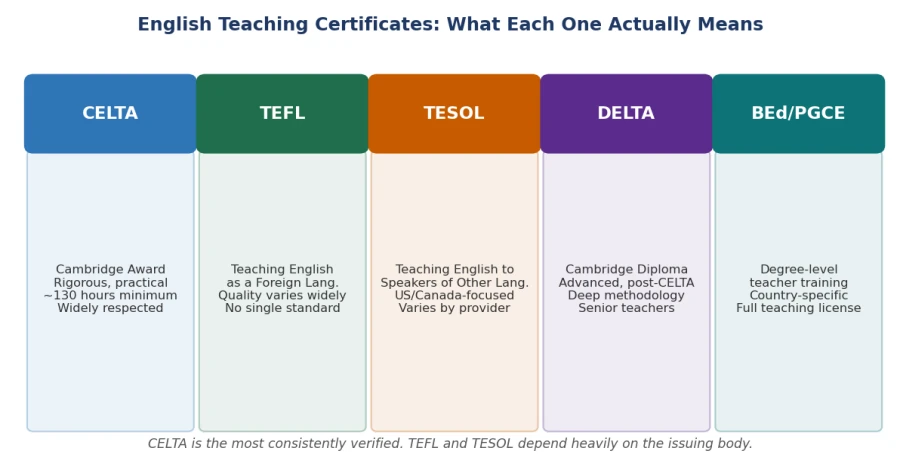
Five English teaching qualifications: what each one covers and what parents should note
Why Certificate Names Are Not Self-Explanatory
TEFL and TESOL are category names, not specific qualifications. Both describe a type of teaching orientation, not a single accredited course. An online TEFL certificate obtained in 40 hours from an unvetted provider is called a TEFL certificate. A 150-hour TEFL programme from a university with assessed teaching practice is also called a TEFL certificate. The name is the same. The quality and rigour are very different.
CELTA is different. It is a specific qualification issued only by Cambridge, with a minimum of 130 hours and a mandatory observed teaching component. There is no unaccredited version of CELTA. That consistency makes it the most reliably comparable credential when reading teacher profiles.
The Four Credentials Explained
• CELTA. Certificate in English Language Teaching to Adults. Issued only by Cambridge. Minimum 130 hours. Always includes observed live teaching assessed by an external examiner. The “Adults” in the title does not prevent the skills from transferring to children, but parents should still ask about child-specific experience separately.
• DELTA. Diploma in English Language Teaching to Adults. Advanced-level, post-CELTA qualification also issued by Cambridge. Indicates significant experience and deeper methodology. Senior or lead teachers often hold this.
• TEFL. Teaching English as a Foreign Language. A category, not a single qualification. Quality depends entirely on the provider. 40-hour online-only courses and 250-hour university programmes both use this label. When you see TEFL on a profile, ask: which provider, how many hours, and was there assessed live teaching?
• TESOL. Teaching English to Speakers of Other Languages. Similar to TEFL in that it is a category rather than a specific qualification. More common in North American contexts. Quality varies by programme. The same verification questions apply.
| Credential | Issued By | Minimum Hours | Assessed Teaching | Consistency |
| CELTA | Cambridge only | 130+ | Always required | Highly consistent |
| DELTA | Cambridge only | Extensive | Always required | Highly consistent |
| TEFL | Many providers | 40 to 250+ | Varies by programme | Highly variable |
| TESOL | Many providers | Varies widely | Varies by programme | Highly variable |
| BEd/PGCE | Universities | Degree-level | Always required | Country-specific |
What “Experience with Children” Means on a Profile
Teaching adults and teaching children require different skills. A teacher with excellent CELTA credentials who has only ever taught adult corporate clients is not the same as a teacher with the same credentials who has spent five years teaching primary-age children. Both qualifications may look identical on a profile.
When reading a profile, look for specific mentions of: age ranges taught, types of content used with young learners, and any supplementary training in young learner methodology. Ask directly: how many of your current or recent students are children under 10?
Where 51Talk Fits In
What 51Talk is
51Talk is a live one-on-one English platform for children with qualified teachers, CEFR-aligned curricula, 25-minute structured sessions, and a lesson cycle that includes teacher feedback and unit assessments. Details at 51talk.com.
How 51Talk presents teacher qualifications
51Talk works with teachers who are trained and evaluated before being assigned to students. Parents can view teacher profiles on the platform. Before booking, parents should ask the support team specifically about the qualification standards required for teachers on the platform and what the profile shows by default. Understanding what is displayed versus what must be requested clarifies how to assess the options available.
What to keep in mind
Qualification standards on any platform should be verified at the point of purchase, not assumed from general descriptions. Ask 51Talk specifically: what minimum qualification is required to teach on the platform, is that qualification named on the teacher’s profile, and has the teacher’s credential been independently verified by the platform?
Before You Enrol: Questions to Ask Any Platform
• Which specific certificate does the teacher hold? Name, not category.
• Who issued the certificate? Cambridge CELTA is very different from an unaccredited TEFL provider.
• How many hours did the training involve? 40 hours and 200 hours are not equivalent.
• Was there assessed, observed live teaching in the programme? This is the strongest predictor of actual teaching readiness.
• What child-specific teaching experience does this teacher have? Years and age ranges.
Frequently Asked Questions
What qualifications should I look for in a 51Talk teacher for my child?
51Talk teachers go through platform training and evaluation before being assigned to students. Before booking, ask the support team specifically what minimum qualification is required, whether it is named on the teacher’s profile, and what child-specific teaching experience is expected. Visit 51talk.com to view current teacher profiles and contact support.
Is a CELTA-trained teacher automatically better for children than a TEFL-certified one?
CELTA is more consistently rigorous than most TEFL programmes because it always requires assessed live teaching and is issued by a single body with fixed standards. That said, a TEFL qualification from a serious 200-hour programme with observed teaching is more meaningful than CELTA without any subsequent experience with children. The combination of qualification quality and child-specific experience matters more than either alone.
What does “native English speaker” mean on a teacher profile, and should I prioritise it?
Native speaker status indicates the teacher grew up speaking English as a first language. It does not indicate teaching qualification, knowledge of language acquisition theory, or experience correcting the specific errors Arabic or other language speakers produce. Native speaker and qualified teacher are different things. Both together is ideal. One without the other is a partial picture.
Can I ask a platform to show me a teacher’s actual certificate?
Some platforms display certificates on profiles. Others summarise qualifications in a category. You can ask the support team whether the specific certificate named has been verified by the platform and how. A platform that says “all teachers are certified” without being able to name the certificate and the issuing body is not providing verification. It is providing reassurance.
What to Do Next
When reading a teacher profile, look for the specific certificate name and the issuing body. If only a category is named, ask the five questions above before booking. Take a trial lesson and observe whether the teacher’s correction method reflects actual training, not just confidence. A well-trained teacher corrects specifically, models the correct form, and gives the child an opportunity to repeat. That pattern is more informative than any certificate name.