Your child’s international school teacher says they are quiet in class and hesitate to answer questions even when they know the content. At home, they speak about the same topics confidently in Arabic. The issue is not ability. It is that English production under social pressure feels different from English knowledge in private.
Private one-on-one lessons address this specific gap in a way that group classes and apps cannot. This page explains the mechanism, covers what to look for in a private lesson designed to build classroom confidence, and describes how the transfer from private practice to classroom participation actually happens.
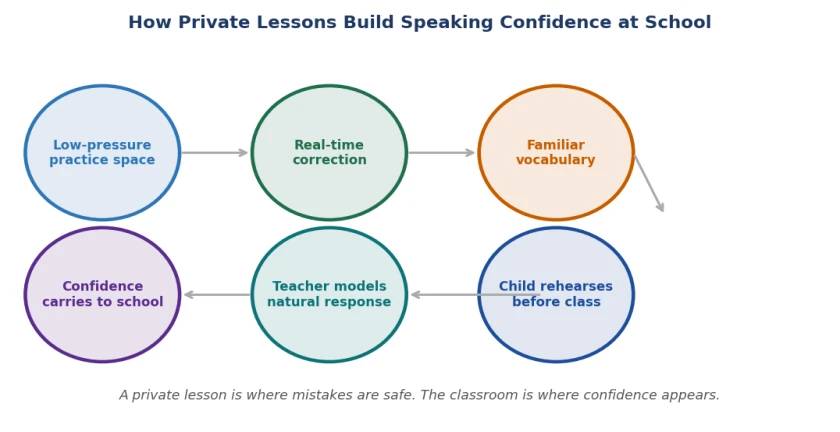
How private lesson practice leads to classroom speaking confidence
Why Classroom Speaking Feels Different
A child who hesitates to speak English in the classroom is not demonstrating a language gap. They are demonstrating a production-under-pressure gap. They know the words. The problem is that producing language in front of peers, while a teacher waits, with the possibility of being wrong in public, adds a cognitive and emotional load that the home environment or a private lesson does not create.
The brain manages this load by defaulting to silence or minimal response. The solution is not more English input. It is more experience of producing English correctly under gradually increasing social pressure, in an environment where the consequences of an error are safe.
What a Private Lesson Provides That a Group Class Cannot
• The only listener is a trained teacher. There is no audience of peers. Errors happen without social consequence. Over weeks, this builds the experience of speaking English and being understood, which is the foundation of confidence.
• Every error is addressed. In a class of 25, a hesitant child’s quiet mistake is invisible. In a one-on-one lesson, it is corrected gently and specifically. The child learns that their errors are fixable, not permanent.
• The teacher adapts in real time. A private teacher who notices hesitation can immediately lower the pressure: switch to a game, ask a yes/no question, use a picture instead of a spoken prompt. A classroom teacher managing 25 students cannot do this.
• The child produces much more language. In a private 25-minute lesson, the child may speak for 10 to 12 minutes. In a 60-minute group class, they may speak for 3 to 5 minutes total. The volume of practice is not comparable.
How Confidence Transfers to the Classroom
Transfer happens because of familiarity, not frequency. A child who has said a word or answered a question correctly 20 times in private has a memory of succeeding with that language. When the same word or question appears in the classroom, the memory of success makes the public response feel less risky.
This is why vocabulary alignment matters: a private lesson that teaches the same words the school is currently covering creates the greatest transfer. A private lesson that teaches unrelated vocabulary produces fluency without classroom-relevant confidence.
Where 51Talk Fits In
What 51Talk is
51Talk is a live one-on-one English platform for children with 25-minute sessions, qualified teachers, CEFR-aligned curricula, and structured lesson cycles. Details and trial at 51talk.com.
Why 51Talk’s format is designed for confidence building
51Talk’s one-on-one format removes the peer audience that makes classroom speaking feel risky. The teacher’s correction method, which names errors and models the correct form before asking for a retry, builds the experience of successfully producing English that transfers to the classroom. The 25-minute length keeps the session within the child’s comfortable attention range so each lesson ends with a productive experience rather than exhaustion.
For international school parents, confirming with the teacher that lesson vocabulary is aligned with the school’s current topics maximises transfer. This alignment is possible in a one-on-one format because the teacher can adjust the lesson content to match the school’s current unit.
What to keep in mind
Confidence transfer takes time. Most children show visible classroom improvement after 6 to 10 weeks of consistent private practice at a minimum frequency of two sessions per week. Expecting improvement in 2 to 3 sessions is unrealistic and will produce disappointment rather than evidence.
Before You Enrol: Questions to Ask Any Platform
• Can the teacher align lesson vocabulary with my child’s school topics? This maximises transfer.
• What is the teacher’s approach when a child hesitates to speak? This is the most important question for a school-confidence goal.
• How much does the child speak in a typical 25-minute session? Aim for a teacher who achieves 40% or more child speaking time.
• How does the teacher feedback describe speaking confidence, not just accuracy? Confidence and accuracy are different.
Frequently Asked Questions
Can 51Talk specifically help a child who is confident at home but hesitates to speak English at school?
Yes. 51Talk’s one-on-one format is the structure best suited to building the production-under-pressure experience that school speaking requires. The absence of a peer audience, combined with a teacher whose job is specifically to respond to every attempt, creates the practice environment where hesitation is reduced most effectively. Arrange a trial at 51talk.com to observe the teacher’s approach to hesitation directly.
How do I know if private lessons are improving my child’s classroom confidence?
Ask the school teacher specifically whether they have noticed any change in the child’s willingness to speak in class. Compare the child’s classroom behaviour at week 2 against week 8. The change is usually gradual rather than sudden. A child who raised their hand once in week 8 when they never did in week 2 has made progress, even if it does not look dramatic.
Should I tell my child’s private teacher what vocabulary the school is covering?
Yes. Sharing the school’s current vocabulary unit or topic area takes one message and allows the private teacher to include the same language in the lesson. The school teacher then encounters vocabulary the child has already practised, which reduces the hesitation that comes from attempting unfamiliar language in public.
What is the minimum lesson frequency for classroom confidence to develop?
Two one-on-one sessions per week is the minimum for consistent confidence development. At one session per week, the gap between lessons is long enough that the confidence built in one session partially resets before the next. Three sessions per week is closer to the frequency at which confidence builds cumulatively across a school term.
What to Do Next
Book a trial lesson and observe specifically how the teacher handles your child’s first hesitation. A warm, patient response that lowers the pressure and provides a successful speaking experience is the signal you are looking for. Share the school’s current vocabulary topics with the teacher before the first paid session. Allow 6 to 8 weeks at consistent frequency before assessing whether classroom transfer is occurring.