After your child’s online English session ends, what do you receive? If the answer is a message saying ‘great session today’ or a star rating in an app, you do not have a feedback report. You have an engagement signal dressed up as one.
A genuine post-lesson report is the mechanism that connects what happened in the lesson to what the parent does at home and what the teacher addresses in the next session. For pronunciation work — the primary need for Arabic-heritage children learning English — a report without phoneme detail is nearly useless. This article gives Saudi and Arab parents a practical template for what every post-lesson report should contain, how to spot weak reporting, and what to request if the current reports are not specific enough.
Why Report Quality Matters
Most parents read feedback reports to confirm the session went well. Evidence-focused parents read them as data: which specific sound was addressed, did it improve within the session, which sound still needs work, what should the child practise tonight? These two reading modes produce completely different information.
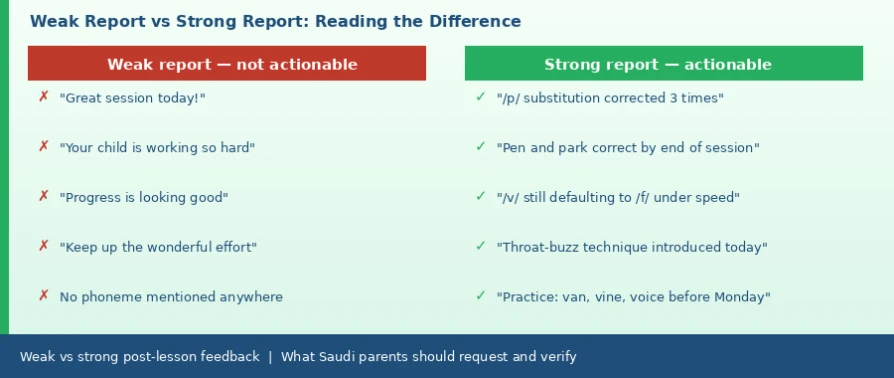
A report that says ‘/p/ substitution corrected three times; child produced pen and park correctly by end of session’ is actionable. A parent who reads that report knows to run pen and park drills at dinner. A report that says ‘great lesson, your daughter is working so hard’ tells you nothing you can act on before the next session.
The Post-Lesson Report Template: 6 Required Fields
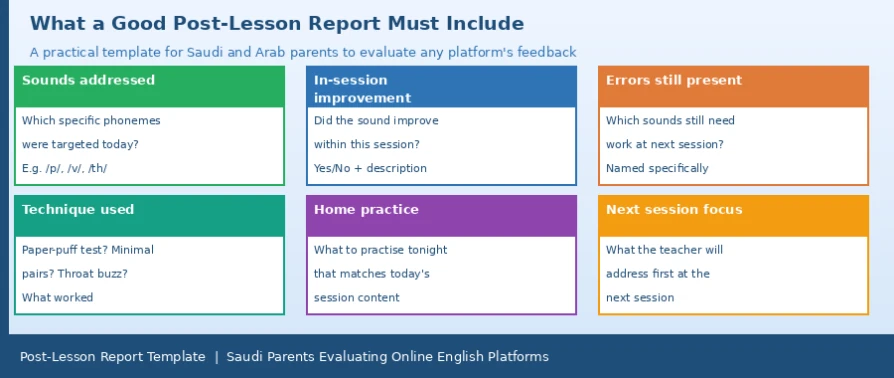
Every post-lesson feedback report for a child working on English pronunciation should include these six fields. Parents can use this template to evaluate any platform’s reporting system.
-
Sounds addressed: which specific phonemes were targeted in this session? Name them. /p/, /v/, /th/, /ch/ versus /sh/.
-
In-session improvement: did the targeted sound improve within this session? Yes or no, plus a brief description of what changed. ‘Child produced pen correctly by end of session after /p/ correction’ is a full answer.
-
Errors still present: which sounds still appeared as errors at the end of the session? Name them specifically.
-
Technique used: what method did the teacher use to address the error? Paper-puff test for /p/? Throat-buzz check for /v/? Minimal pair drill? What worked and what did not?
-
Home practice: what specific exercises should the child do before the next session? This should match the sounds addressed today, not a generic vocabulary list.
-
Next session focus: what will the teacher address first at the next session? This ensures the teacher starts from where this session ended, not from a generic curriculum position.
What Weak Reports Look Like — and What to Do
| Report content | Type | Action to take |
| ’Great session today!’ | Engagement signal, not progress data | Ask teacher: which phoneme did you work on today? |
| ‘Your daughter is making excellent progress’ | Vague positive | Ask: progress on which specific sound? From what to what? |
| ‘We worked on pronunciation and vocabulary’ | Category label, not data | Ask: which pronunciation sounds? Name them specifically |
| ’/p/ addressed; worked on vocabulary too’ | Partial — some phoneme detail | Ask for in-session improvement and home practice fields |
| All 6 fields present with phoneme names | Full report | Use it to guide home practice and track across sessions |
 |
How to Use the Report for Home Practice
The report’s home practice field tells you what to do with your child between sessions. Keep it to five to ten minutes. Pick two or three words from the session that targeted the main error. Say them with your child, using the technique the teacher described. Do not correct every mistake — focus only on the sounds named in the report.
After each session, save the report. After four sessions, compare the first report to the most recent one. Are different sounds being flagged, or is the same error appearing session after session? If the same error appears four times with no trajectory of improvement, ask the teacher specifically: what approach are you using for this sound and why is the frequency not reducing?
Where 51Talk’s Report System Fits
What 51Talk is
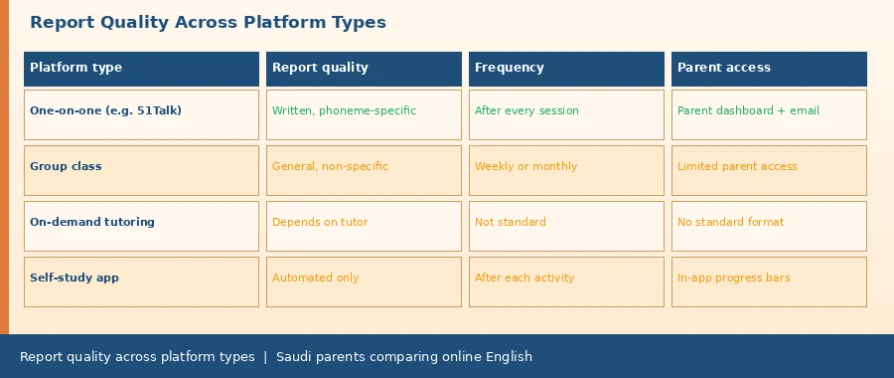
51Talk is a live one-on-one English platform for children. Sessions are 25 minutes, delivered by qualified teachers, structured around CEFR levels and Cambridge English learning goals. The lesson cycle includes a pre-class warm-up, the live session, post-class review exercises linked to that session’s sounds, a written teacher feedback report, and regular level assessments.
What the 51Talk feedback system includes
-
Written report after every session: part of the standard lesson cycle, not optional.
-
Post-class review exercises linked to session content: not a generic template. The exercises target the sounds from that specific session.
-
Session note carry-over: the teacher at the next session sees what was addressed previously.
-
CEFR level tracking: periodic assessments give parents a written level result.
What to verify before enrolling
Ask for a sample feedback report before enrolling. Check specifically whether phonemes are named in the sample. If the sample report contains only general comments, ask whether more specific reporting is available for enrolled students. Request that the teacher’s reports include the six fields described above. A trial lesson is available at 51talk.com — read the trial feedback report as your first evaluation of whether the reporting system delivers what you need.
What to Do Next
Before committing to any programme, request a sample feedback report and apply the six-field template. If the sample does not name phonemes, ask whether more specific reporting is possible. After your first session, read the report against the template and ask about any missing fields. After four sessions, compare reports and check for a trajectory rather than isolated sessions.
If you are receiving comprehensive reports but the session frequency is low, the reports alone will not produce results. The reports show you whether correction is happening. The session frequency determines whether it sticks.
Frequently Asked Questions
Does 51Talk’s feedback report include phoneme-specific content that I can use for home practice?
51Talk’s lesson cycle is structured to include written feedback after each session. Whether the report in practice names specific phonemes rather than giving general comments depends on the teacher. Request a sample before enrolling. Ask the teacher after the trial: can you include in the report which phonemes were addressed and what specific practice I can do with my child tonight? Most teachers can provide this when asked explicitly. A trial is available at 51talk.com.
How do I get my child’s teacher to write more useful reports?
Send a direct message after the first session and ask: could the report include the specific sound you addressed today and whether it improved within the session? Include a note that you are using the home practice recommendation in the report to guide what you do with your child between sessions. This framing makes the request practical rather than critical, and most teachers respond to it positively.
My child’s platform sends automated reports after sessions. Are those useful?
Automated reports describe what activities were completed and how many were answered correctly. They do not describe the quality of the child’s pronunciation production, which sounds were corrected, or what the teacher specifically did to address errors. They are useful for tracking completion rates, not for tracking pronunciation correction. If your child is working on phoneme accuracy, automated reports are supplementary information, not the primary evidence of progress.
What is the minimum I should accept from a feedback report?
At minimum, the report should name at least one specific phoneme that was addressed in the session and state whether it improved. That is a two-sentence minimum: ‘/v/ substitution corrected; child produced van and vine correctly by end of session.’ Anything shorter than that does not give you the information needed to guide home practice or track progress across sessions.