Watching a trial lesson for a shy child requires a different focus from watching one for a confident child. The most informative moments are not the moments when the child speaks. They are the moments when the child hesitates, goes quiet, or looks away, and what the teacher does next.
This checklist gives parents six specific things to observe during a trial lesson for a hesitant learner. It takes about five minutes to review before the lesson and produces actionable evidence after it. It applies to any live online English lesson format for children aged 4 to 12.
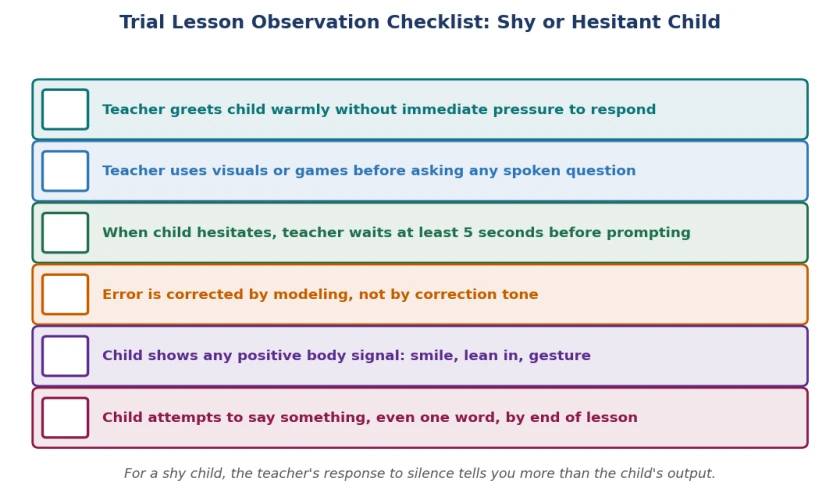
Six observation points for a trial lesson with a shy or hesitant child
Before the Trial
Tell your child this is a first meeting with a new teacher and mistakes are fine. Do not say “just try your best” or “don’t be nervous.” Both phrases increase the pressure rather than reducing it. Sit off-screen so your child cannot see your reactions during the lesson. Have a notepad ready.
The Six Observation Points
• Warm opening without immediate pressure. Does the teacher greet the child and establish a relaxed tone before asking any question? The first 60 seconds of a lesson set the emotional context for the rest of it. A teacher who immediately asks “what is your name?” and waits is creating an assessment frame, not a welcome frame.
• Visual scaffolding before spoken asks. Does the teacher show a picture, play a sound, or set up a game before asking the child to produce any English? For shy children, seeing something concrete before speaking lowers the exposure risk significantly. A lesson that opens with a direct verbal question has removed this safety step.
• Response to silence: waiting time. When the child does not answer immediately, does the teacher wait at least five seconds before speaking again? Count silently. A teacher who fills silence within two seconds is inadvertently teaching the child that silence will always be rescued, which reduces the child’s incentive to push through the hesitation.
• Error handling method. When an error occurs, does the teacher model the correct form warmly and ask for a retry? Or does the teacher explain what was wrong? Explanation creates a correction frame. Modelling creates a practice frame. Shy children respond much better to the second.
• Any positive body signal from the child. A smile, a lean toward the screen, a gesture, or a laugh indicates that the child is present and engaged at some level, even if they are not speaking freely. The absence of any positive signal after 15 minutes is a concern.
• Child attempts language by the end. Does the child produce any English, even a single word, by the end of the 25-minute lesson? For very shy children, one word in the first lesson is not failure. It is the baseline. What matters is whether the teacher created the conditions for that one word to happen.
After the Trial: Three Questions for Your Child
• “Did you like the teacher?” Tone and body language tell you more than the word “yes.”
• “Was anything scary or confusing?” Surfaces specific triggers you can address with the teacher.
• “Would you want to come back?” The most direct signal available. Even a reluctant “maybe” is more informative than a reflexive “no.”
Scoring the Trial
| Score on 6 points | What it means | Recommended action |
| 5-6 out of 6 | Strong teacher fit for a shy child | Book regular lessons with this teacher |
| 3-4 out of 6 | Some fit, some concerns | Identify weak points and raise with platform before purchasing |
| 1-2 out of 6 | Poor fit for a hesitant learner | Request a different teacher before deciding on the platform |
| 0 out of 6 | Teacher approach not suitable for shy children | Try a different platform or teacher profile entirely |
Where 51Talk Fits In
What 51Talk is
51Talk is a live one-on-one English platform for children with 25-minute structured sessions and qualified teachers. Trial at 51talk.com.
Why the 51Talk trial format suits this checklist
51Talk’s structured lesson format means the trial uses the same approach as regular paid lessons. The six observation points above are therefore representative rather than trial-specific. A teacher who scores well on all six in the trial is showing you how they will behave in every subsequent session.
What to keep in mind
A low score on this checklist reflects the specific teacher, not the platform. Ask for an alternative teacher before deciding the platform is unsuitable.
Before You Enrol: Questions to Ask Any Platform
• Can I request a teacher with specific experience in shy or hesitant children? Ask this before booking the trial.
• If the trial score is low, can I request a second trial with a different teacher? This should be straightforward.
• Is the trial the same format as paid lessons? Confirms the observation is representative.
Frequently Asked Questions
Can I use this checklist for a 51Talk trial lesson for my shy child?
Yes. This checklist applies to any one-on-one trial lesson and is particularly effective on a structured platform like 51Talk where the trial format is representative of regular lessons. Arrange a trial at 51talk.com, request a teacher experienced with hesitant learners, and use the six points above during the session.
What should I do if my child refuses to come to the trial lesson?
Do not force it. Instead, let the child watch the teacher for five minutes without any expectation that they will speak. Frame it as “you just get to listen.” Removing the performance expectation entirely is often the only way to get a hesitant child through the door. Once the teacher is familiar and safe, participation usually follows.
Is a shy child’s silence in the trial a reliable indicator of how they will perform over time?
No. Silence in the first lesson is common even for non-shy children. What predicts long-term performance is the teacher’s response to the silence and the child’s body language during the rest of the lesson. A child who is silent but watching attentively, with occasional positive signals, is processing. A child who is both silent and disengaged is showing something different.
What to Do Next
Review the six points before the trial. Take brief notes during the session, especially at moments of silence or hesitation. Score the trial after the lesson. Ask your child the three questions within an hour. Use the scoring guide to decide whether to continue with this teacher, request an alternative, or try a different platform. For a shy child, the teacher relationship is the most important variable, and one trial gives you reliable evidence about whether the right relationship can form.