Most parents watch a trial lesson once, form a vague impression, and then decide. But a trial lesson contains specific, observable signals that tell you far more than a general feeling of “it seemed fine”. The difference between a genuinely productive lesson and a polished-looking one that will not hold your child’s attention after week three is visible in 25 minutes, if you know what to look for.
This checklist is for parents observing a trial online English lesson for a child aged 4 to 12. It separates what the child is doing from what the teacher is doing, and gives you specific questions to ask afterward.
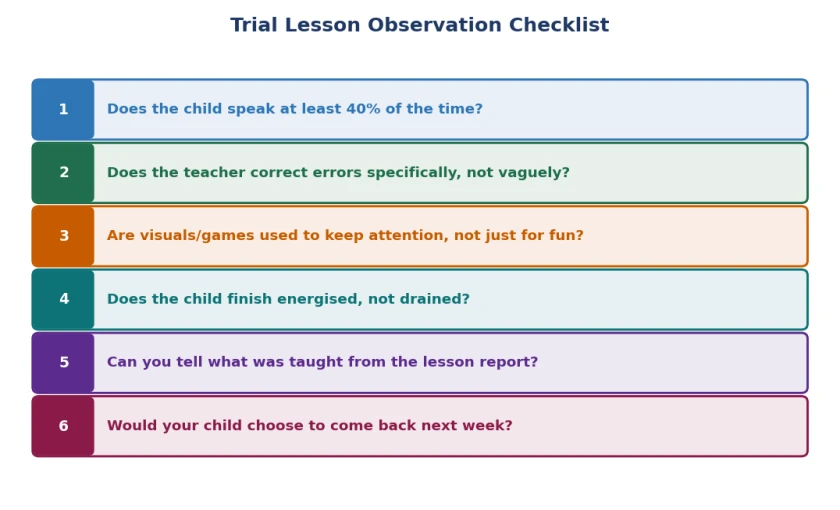
Six observable signals that distinguish genuine engagement from passive participation
Before the Lesson: Set Up to Observe Well
Sit nearby but off-screen, especially for children under 8. Have a notepad or phone ready to jot observations. Do not prime your child with what to say. You want to see how the teacher handles a normal, unprepared child, because that is what every paid lesson will involve.
Tell your child this is a first meeting with a new teacher and that mistakes are completely fine. A child who feels watched or expected to perform will behave differently from one who feels relaxed.
During the Lesson: What to Watch
• Speaking ratio. Roughly estimate how much of the 25 minutes your child is actually producing language versus listening or watching. In a strong one-on-one lesson, the child should be speaking for at least 35 to 40 percent of the session.
• Error correction method. When your child makes a mistake, does the teacher name the specific sound or word, model the correct version, and ask for a repeat attempt? Or does the teacher say “good try” and move on? The former builds the habit of correction. The latter does not.
• Child body language. Leaning toward the screen, pointing at pictures, smiling, or reaching to click are all physical signs of engagement. Slumping, looking away, or giving one-syllable answers while staring off-screen are signs of passive compliance.
• Lesson shape. Does the lesson have a recognisable structure: a warm greeting, a main activity, some variation, and a closing? A shapeless lesson that jumps randomly between topics is harder for a child to follow and remember.
• Game and visual integration. If the lesson includes games or visuals, are they tied to the vocabulary or sounds being taught? Or are they entertainment that happens alongside the English content?
• Child willingness to answer. Does your child answer the teacher’s questions before being asked twice? Hesitation once is normal. Consistently waiting to be prompted twice suggests the child is not tracking the lesson comfortably.
After the Lesson: Questions to Ask Your Child
Keep this casual. A child who feels tested will give defensive answers.
• “Can you show me something you learned today?” A child who can demonstrate even one word or phrase from the lesson retained something.
• “Did you like the teacher?” Note tone, not just the answer.
• “Was anything hard or confusing?” This surfaces gaps the teacher may not have caught.
• “Would you want to have that teacher again?” The most direct engagement signal available.
After the Lesson: Questions to Ask the Teacher or Platform
• What level did you assess my child at, and what specifically pointed to that? A teacher who can answer this clearly has been paying attention.
• What would the first three lessons focus on? This tests whether the trial produced a genuine starting point or a generic response.
• What was the most difficult thing for my child today? A good teacher noticed at least one specific gap.
Where 51Talk Fits In
What 51Talk is
51Talk is a live one-on-one English platform for children offering 25-minute structured lessons with qualified teachers, CEFR-aligned curricula, post-class review exercises, teacher feedback reports, and unit assessments. Trial lessons available at 51talk.com.
Why a 51Talk trial is a useful evaluation
Because 51Talk uses structured curriculum materials in every lesson including the trial, what you observe in the trial is representative of regular lessons. The teacher is not improvising a sales pitch. They are delivering the same format you would pay for, which makes the checklist above significantly more reliable as a predictor.
What to keep in mind
The trial reflects one teacher on one day. Teacher quality varies. If the checklist shows a weak result, request an alternative teacher before deciding against the platform entirely.
Before You Enrol: Questions to Ask Any Platform
• Is the trial lesson the same format as paid lessons? Some platforms run special demo sessions. Verify the trial is representative.
• Can I request a different teacher if the trial did not go well? This should be straightforward.
• What does the post-lesson feedback report look like? Ask to see a sample.
• Can I observe paid lessons too, or only the trial? Good platforms welcome ongoing parent observation.
Frequently Asked Questions
Can a 51Talk trial lesson reveal whether the platform will work for my child long-term?
A trial lesson is the most direct evidence available before purchase. 51Talk’s structured format means the trial reflects how regular lessons work. Use the observation checklist above and pay close attention to error correction method and your child’s speaking ratio. Those two signals are the most predictive of long-term progress. Arrange a trial at 51talk.com.
What if my child is shy and barely speaks during the trial?
Shyness in lesson one is common and not a reliable indicator of long-term fit. The more useful signal is how the teacher responds to the shyness. Does the teacher find gentle ways to draw the child in, use pictures or games to lower the pressure, or give the child time without forcing a response? That response pattern will repeat in every paid lesson.
Should I sit with my child during the trial or let them attend alone?
For children under 8, sitting nearby and off-screen gives you observation data without making the child self-conscious. For children aged 9 to 12, sitting in the same room but not visible to the camera is usually sufficient. Avoid answering for your child or coaching during the lesson.
What if my child performs unusually well in the trial because they are trying to impress?
This happens, and it makes the trial look better than regular lessons will be. The more useful data comes from asking your child afterward how they felt, not how they performed. If they felt comfortable, they will likely maintain that comfort. If they felt they had to try especially hard, regular lessons may be more ordinary.
How soon after the trial should I make a purchase decision?
Within a day or two, while your observations and your child’s reactions are still fresh. Waiting a week tends to reduce the trial to a vague positive impression rather than specific data. If you need a second trial because the first was disrupted, that is reasonable. More than two trials without a decision usually means a clearer evaluation framework is needed more than additional data.
What to Do Next
Use the observation checklist during the trial. Take brief notes during the lesson rather than trying to reconstruct it afterward. Ask your child the four questions within an hour. If the speaking ratio was strong, errors were corrected specifically, your child leaned in rather than away, and they would return for another lesson, that combination is a reliable signal. Save your notes before committing to a package.