Most parents watch a trial English lesson once, decide it seemed good or not, and move on. But “it seemed good” is not enough to commit a year’s worth of lessons to. A trial lesson contains specific, observable evidence about teacher quality, lesson structure, correction method, and your child’s actual engagement — if you know what to look for.
This checklist gives you seven things to score during the lesson and four questions to ask afterward. It takes five minutes to review before the lesson and produces a decision-ready result after it.
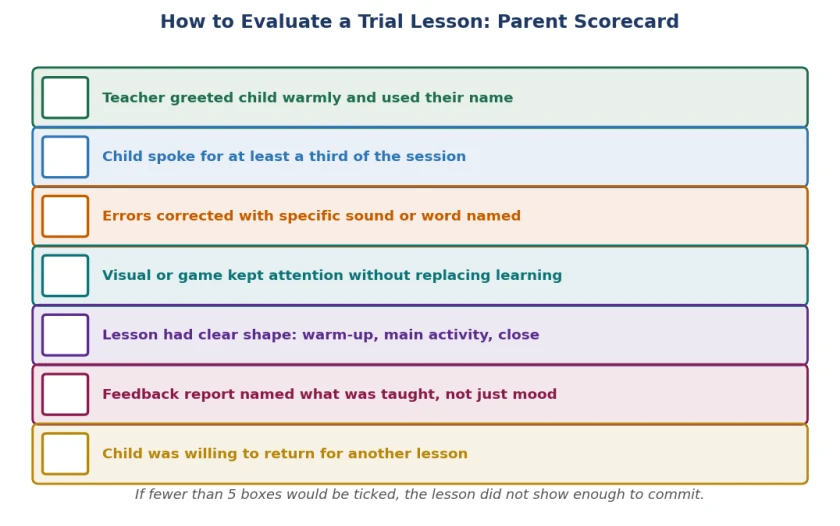
Seven-point parent scorecard for evaluating a children’s English trial lesson
Before the Lesson: What to Prepare
• Sit nearby but off-screen. For children under 8, stay close. For older children, be in the same room but not visible to the camera. Your presence reduces anxiety without distorting the lesson.
• Have a notepad ready. Notes written during the lesson are more accurate than impressions reconstructed afterward.
• Do not prime your child. Tell them it is a first meeting with a new teacher and mistakes are fine. A coached child gives you data about coaching, not about the platform.
• Test audio and video first. A technical disruption that eats five minutes of a 25-minute lesson significantly distorts what you observe.
During the Lesson: Seven Things to Score
• Warm greeting. Did the teacher use the child’s name, make eye contact, and establish a warm tone in the first minute? A cold opening predicts cold correction.
• Child speaking time. Estimate what percentage of the lesson the child was actually producing language. Aim for at least 35 percent. Below 20 percent is a red flag.
• Error correction quality. When an error occurred, did the teacher name the specific sound or word, demonstrate the correct version, ask for a repeat, and confirm the attempt? Or did they say “good try” and move on?
• Visual and game integration. Were visuals and games tied to the vocabulary being taught, or were they decorative? Did the child have to produce language during the game or only click?
• Lesson shape. Did the lesson have a clear warm-up, main activity, and close? Or did it jump between unconnected topics?
• Post-lesson report quality. Did the teacher’s feedback (if provided after the trial) name specific sounds, vocabulary, or skills? Or was it a general “she did well today”?
• Child willingness. The most important signal: would your child choose to come back? Ask this directly after the lesson.
After the Lesson: Four Questions to Ask Your Child
• “Can you show me one thing you learned today?” Retrieval indicates retention.
• “Did you like the teacher?” Note tone and body language, not just the word “yes”.
• “Was anything confusing?” Surfaces gaps the teacher may not have caught.
• “Would you want to have this teacher again?” Direct and reliable.
After the Lesson: Questions to Ask the Platform
• What level did you assess my child at, and what specifically led to that assessment? A specific answer means the teacher was paying attention.
• What would the first three lessons focus on? Tests whether the trial produced a genuine learning plan.
• What was the most difficult sound or structure for my child today? A good teacher noticed at least one specific gap.
Where 51Talk Fits In
What 51Talk is
51Talk is a live one-on-one English platform for children with 25-minute structured lessons, CEFR-aligned content, post-class review exercises, teacher feedback reports, and unit assessments. Trial available at 51talk.com.
Why a 51Talk trial is a useful evaluation
51Talk’s structured lesson format means the trial reflects actual paid lessons rather than a specially prepared demo. The checklist above is more predictive on a structured platform than on an open tutor marketplace, because what you observe in the trial is what you will get in regular sessions.
What to keep in mind
Teacher quality on any platform varies. If the checklist score is low for the trial teacher, ask for an alternative before ruling out the platform entirely. One weak trial does not mean the platform is weak.
Before You Enrol: Questions to Ask Any Platform
• Is the trial lesson the same format as paid lessons? Some platforms run special demos.
• Can I request a different teacher if the trial did not go well? Ask specifically about the process and timeline.
• How is feedback shared after regular lessons? Ask to see a sample report.
• What happens to lessons that are missed or cancelled? Know the policy before you are in that situation.
Frequently Asked Questions
Can I use this checklist to evaluate a 51Talk trial lesson specifically?
Yes. The checklist applies to any live one-on-one English lesson, and 51Talk’s structured format makes it particularly reliable because trial lessons follow the same structure as paid lessons. Arrange a trial at 51talk.com, use the seven scoring items above during the session, and ask the four questions within an hour of the lesson ending.
What score on the checklist should make me confident enough to purchase?
Five out of seven is a reasonable threshold. If the teacher used the child’s name warmly, the child spoke for at least 35 percent of the session, errors were corrected specifically, the lesson had a clear shape, and the child would return, that combination predicts a productive learning relationship.
What if the lesson report was not provided after the trial?
Ask for it. Platforms that provide written lesson reports should be able to supply one after a trial. If the platform says reports are only available for paid lessons, ask to see a sample report from a regular lesson before purchasing. A platform that cannot show you what a report looks like is asking you to trust without evidence.
My child performed unusually well during the trial. Should I adjust my assessment?
Noted performance anxiety can make trial lessons look better than regular ones will be. Account for this by weighting the post-lesson questions more heavily. A child who felt they had to try unusually hard will often say so if asked casually.
What to Do Next
Prepare five minutes before the lesson. Observe with the seven-point checklist during it. Ask the four questions within an hour after. Add up the signals. A strong trial gives you specific evidence, not just a feeling. Save your notes before committing to a package, and return to them if a doubt arises in the first few paid lessons.