A trial lesson is the most direct evidence available before paying for an English programme. For Muslim parents specifically, there are signals beyond lesson quality that matter: how the teacher presents themselves, whether the content is consistent with family values, and whether the environment feels appropriate for your child. These things are observable in a single 25-minute session, if you know what to watch.
This page covers what to look for during the trial, what to ask your child afterward, and what questions to raise with the platform before committing. It applies to children aged 4 to 14 in live online English lessons. It does not assume any particular school of thought within Islam and does not make judgements about individual family standards.
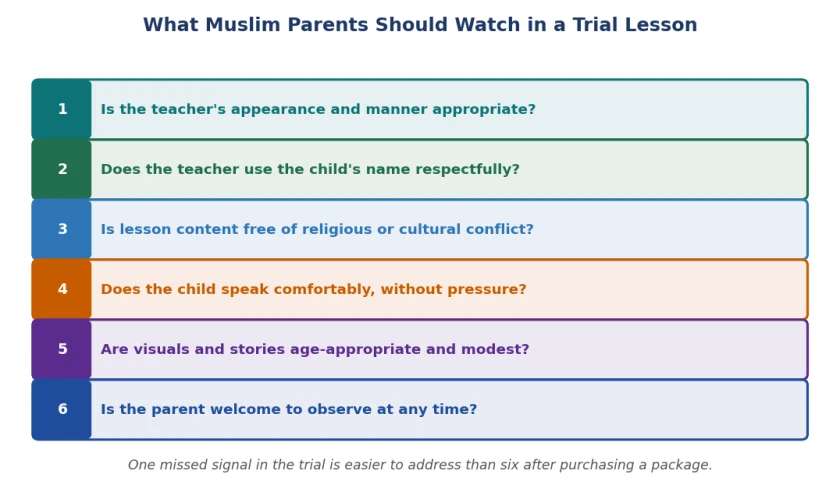
Six things Muslim parents should observe during a children’s English trial lesson
Before the Trial: Prepare to Observe
Sit nearby but off-screen, especially for younger children. Have a note ready to record observations during the lesson. Tell your child this is a first meeting with a new teacher and that mistakes are fine. Do not prime them with what to say.
If you have specific preferences regarding teacher appearance, lesson content, or interaction style, state them when booking the trial. Most platforms can flag these preferences before the session begins.
During the Trial: Six Things to Watch
• Teacher presentation. Is the teacher’s appearance and on-screen presentation appropriate for your family’s standards? Note this in the first minute. It does not require a long assessment.
• Use of the child’s name. Does the teacher address your child respectfully, using their name from the outset? This matters because it sets the tone for how the relationship will develop in regular lessons.
• Content themes and visuals. Are the stories, pictures, and vocabulary topics free from content that conflicts with your values? Watch specifically for visual representations of characters, social scenarios, and any references to religion, gender, or relationships.
• Child speaking environment. Does the child seem comfortable, or is there any pressure to engage with content or questions that feel inappropriate? A good teacher adjusts the lesson based on the child’s comfort, not a fixed script.
• Parent observation dynamic. If you are observing, does the teacher acknowledge your presence appropriately or behave differently because you are watching? The second pattern is a signal worth noting.
• Lesson content control. Are the materials clearly coming from a platform curriculum, or is the teacher introducing their own content, stories, or video clips? Platform-controlled content is more predictable and reviewable.
After the Trial: Questions for Your Child
• “Did you like the teacher?” Note tone and body language, not just the answer.
• “Was anything strange or confusing?” This surfaces content the child noticed that you may not have.
• “Would you want to have this teacher again?” A direct and reliable signal.
After the Trial: Questions for the Platform
• Can this same teacher be our regular teacher? If the trial teacher is suitable, consistency matters.
• What level did you assess my child at? A specific answer means the teacher was genuinely paying attention.
• Can I see the materials used in today’s lesson? Reviewing them afterward confirms what was presented.
• Is the content for this age group reviewed by the platform before being used? Curriculum-controlled is more reliable than teacher-selected.
Where 51Talk Fits In
What 51Talk is
51Talk is a live one-on-one English platform for children offering 25-minute sessions with qualified teachers and structured, CEFR-aligned curricula. Trial lessons available at 51talk.com.
Why a 51Talk trial is a useful evaluation for Muslim families
51Talk’s structured lesson format means the trial reflects actual paid lessons rather than a specially prepared demonstration. The curriculum materials used in the trial are the same platform-controlled materials used in regular sessions. This makes the content signals you observe during the trial representative, not staged.
Muslim families can request a female teacher for the trial. If the trial teacher is suitable, the same teacher can be requested for regular lessons. This consistency is more achievable in a one-on-one format than in any group class structure.
What to keep in mind
The trial reflects one teacher on one day. If any of the six observation signals raise a concern, raise it with the platform before purchasing rather than hoping the issue does not recur. Most concerns that appear in a trial will reappear in regular lessons.
Before You Enrol: Questions to Ask Any Platform
• Can I request a female teacher for the trial? Confirm the process before booking.
• Is the trial lesson the same format as paid lessons? Some platforms run special demos.
• Are lesson materials platform-controlled or teacher-selected? Ask specifically.
• Can I observe any lesson at any time without prior notice? This is a baseline transparency standard.
Frequently Asked Questions
Can Muslim parents request a female teacher for a 51Talk trial lesson?
Yes. 51Talk’s teacher pool includes female teachers and parents can request a female teacher when booking. Contact the platform directly to confirm current availability at your required time slots and the process for maintaining the same teacher for regular sessions. Arrange a trial at 51talk.com.
What should I do if the trial lesson included content I found inappropriate?
Note the specific content and raise it with the platform before purchasing. Ask whether this type of content appears regularly in the curriculum or whether it was an exception. Ask to see the lesson materials in advance for the first few sessions. A platform that cannot address this clearly is not a reliable choice for a family with specific content standards.
Is it appropriate to sit with my child during the trial?
For children under 8, sitting nearby and off-screen is strongly advisable. For older children, being in the same room but not visible to the camera is typically sufficient. Your presence during the trial is normal and expected. A teacher who behaves differently because a parent is present is showing you something important.
What if my child is too shy to speak during the trial?
Shyness in lesson one is very common. The more useful signal is how the teacher handles it. Does the teacher use games, pictures, or gentle yes/no questions to lower the pressure? A teacher who pushes the child or gives up quickly is showing you their standard response to resistance, which will repeat in paid lessons.
How do I verify that lesson content will remain appropriate after the trial?
Ask to preview the materials for the first five lessons before purchasing. Ask whether the curriculum is reviewed periodically for cultural appropriateness. Save any written assurances alongside your purchase confirmation. Unexpected content after enrolment is easier to address when you have documented the platform’s prior representations.
What to Do Next
Use the six observation points above during the trial. Take notes rather than relying on impressions. Ask your child the three questions within an hour of the lesson ending. Raise any concerns with the platform before paying. If all six signals were positive and your child would return willingly, that combination is a strong basis for enrolment.