A trial lesson is the most direct evidence available before purchasing an English programme for your child. For parents in Jeddah, the trial needs to answer more questions than it does for families in other markets. It is not only about whether the lesson was well-structured and the child was engaged. It is also about whether the teacher’s presentation is appropriate, whether the content fits family values, and whether the time slot actually works within the Saudi school and prayer schedule.
This checklist covers all of those dimensions in a single evaluation framework. It is designed to be used during and immediately after the trial lesson. It applies to children aged 4 to 14 in any live online English format.
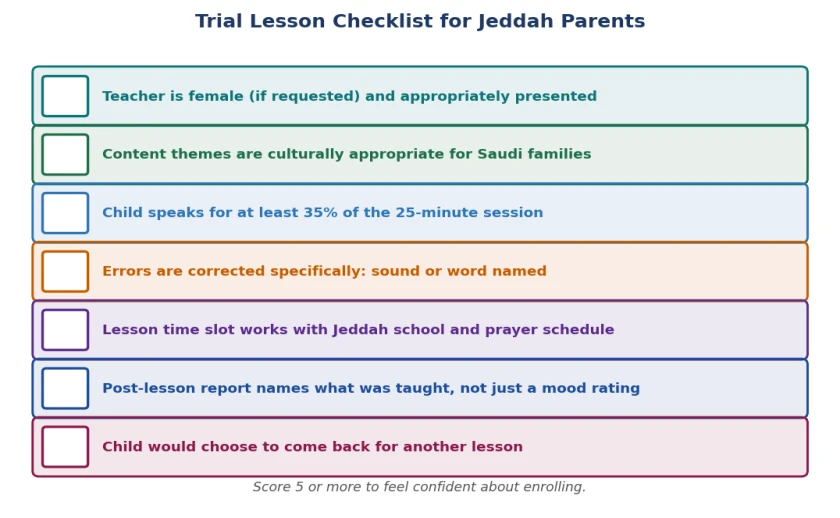
Seven-point trial lesson evaluation checklist for Jeddah parents
Before the Trial: Set Up for a Useful Evaluation
Sit nearby but off-screen. Have a notepad ready for brief observations during the lesson. State any preferences regarding teacher gender, content themes, or lesson timing when booking, not during the lesson itself. Book the trial at your intended regular lesson time, not at a different slot chosen for convenience.
Tell your child this is a first meeting with a new teacher and mistakes are completely fine. A child who is told they are being assessed will behave differently from one who is relaxed. You want to see how the teacher handles a normal, unprepared child.
During the Trial: Seven Things to Score
• Teacher presentation and manner. Is the teacher’s appearance and on-screen manner appropriate for your family’s standards? Note this in the first minute.
• Content cultural fit. Are the story themes, visual materials, and vocabulary topics free from content that conflicts with your values? Watch specifically during any visual or reading activity.
• Child speaking time. Estimate the percentage of the lesson where your child was actively producing language. Aim for at least 35 percent in a one-on-one session.
• Error correction method. When your child made an error, did the teacher name the specific sound or word, model the correct version, and invite a retry? Or did they say “good try” and continue?
• Scheduling realism. Did the lesson start on time? Does the time slot actually work without rushing from school or cutting into prayer time? The scheduling question is as important as the quality question.
• Post-lesson report quality. Did the teacher’s feedback (if provided after the trial) name specific sounds or vocabulary? Or was it a general “she did well today”?
• Child willingness to return. Ask your child directly after the lesson: “Would you want to have this teacher again?” Their answer, and how they say it, is the most direct engagement signal available.
After the Trial: Questions for Your Child
• “Can you say something you learned today?” A child who can retrieve a word or phrase retained something.
• “Did you like the teacher?” Note tone and body language.
• “Was anything strange or confusing?” Surfaces content signals you may not have caught.
• “Would you want to come back?” Direct and reliable.
After the Trial: Questions for the Platform
• Can this teacher be our regular teacher for all lessons? If the trial teacher is suitable, consistency is the next priority.
• What level was assessed, and what specifically led to that? A specific answer means the teacher paid attention.
• What would the first three lessons focus on? Tests whether a genuine learning plan was formed.
• What content themes does this age group’s curriculum cover? Request the overview before purchasing.
Scoring the Trial
| Score | Recommendation |
| 7 out of 7 | Strong basis for purchase. Confirm package terms and enrol. |
| 5 to 6 out of 7 | Good overall. Identify which 1-2 items were weak and raise them before purchasing. |
| 3 to 4 out of 7 | Mixed result. Request a second trial with a different teacher before deciding. |
| Below 3 | Not a suitable match. Try a different platform or request a substantially different teacher profile. |
Where 51Talk Fits In
What 51Talk is
51Talk is a live one-on-one English platform for children with 25-minute sessions, qualified teachers, CEFR-aligned curricula, and post-lesson feedback. Trial lessons available at 51talk.com.
Why a 51Talk trial is a useful evaluation for Jeddah families
51Talk’s structured curriculum means the trial reflects what regular paid lessons look like. The materials used in the trial are the same platform-controlled content used in every session, making the content cultural fit assessment in the checklist above representative rather than staged.
Female teachers can be requested for the trial. If all seven checklist items score positively and the time slot is confirmed to be consistently available, that combination gives Jeddah parents a reliable basis for purchase.
What to keep in mind
A single trial reflects one teacher on one day. If any of the seven items score poorly, raise the specific concern with the platform before purchasing rather than hoping it resolves. Most concerns that appear in a trial reappear in regular lessons.
Before You Enrol: Questions to Ask Any Platform
• Is the trial lesson at the same time slot I plan to use for regular lessons? Test the schedule, not just the lesson.
• Can I request a female teacher for the trial and for all subsequent lessons? Confirm both.
• Is the trial the same format and content as paid lessons? Some platforms run special demos.
• Can I see a sample of the curriculum materials before the trial? Context helps you evaluate the lesson more clearly.
Frequently Asked Questions
Can Jeddah parents request a female English teacher for a 51Talk trial lesson?
Yes. 51Talk’s teacher pool includes female teachers and the one-on-one format allows parents to specify this preference when booking. To confirm current female teacher availability at your preferred time slot in the AST evening window, contact 51Talk before booking the trial. Arrange a trial at 51talk.com.
What if the trial lesson was interrupted by a technical issue?
Request a second trial. A technically disrupted trial is not sufficient evidence to make a purchase decision. A platform that does not offer a second trial after a significant disruption is applying a policy worth noting before you commit.
Should the trial be at the same time as planned regular lessons?
Yes, always. The trial serves two purposes: evaluating the lesson quality and confirming the scheduling. A trial at a different time only confirms the first. The scheduling question, which is especially critical for Jeddah families with after-school and prayer time constraints, can only be answered by testing the actual time slot.
What if my child seems nervous and does not perform well in the trial?
Observe the teacher’s response to the nervousness, not the child’s output. A skilled teacher uses games, visuals, and very gentle questions to lower the pressure without pushing. That response pattern tells you more about the teacher’s suitability than the child’s trial performance.
How soon after the trial should I make a purchase decision?
Within 24 to 48 hours, while the trial experience is fresh. Use the seven-point checklist score alongside your child’s post-lesson responses to make the decision from specific observations rather than a fading general impression.
What to Do Next
Book the trial at your intended lesson time. Complete the seven-point checklist during the lesson. Ask your child the four questions within an hour. Score the trial and use the scoring guide above. Raise any specific concerns with the platform before purchasing. The checklist gives you a decision basis that is more reliable than any review or marketing claim.