Input means the language you take in: reading, listening, watching. Output means the language you produce: speaking and writing. The debate over which matters more has a clearer answer than most people admit. Input builds comprehension and output builds production, and because they develop different skills, doing only one leaves you fluent at half the language. The mistake most learners make is not choosing wrong; it is skipping output almost entirely.

This guide explains what each does, why the balance tips the way it does, and how to fix an input-heavy routine. For the wider picture, see this realistic guide to learning a language fast.
What Each One Actually Builds
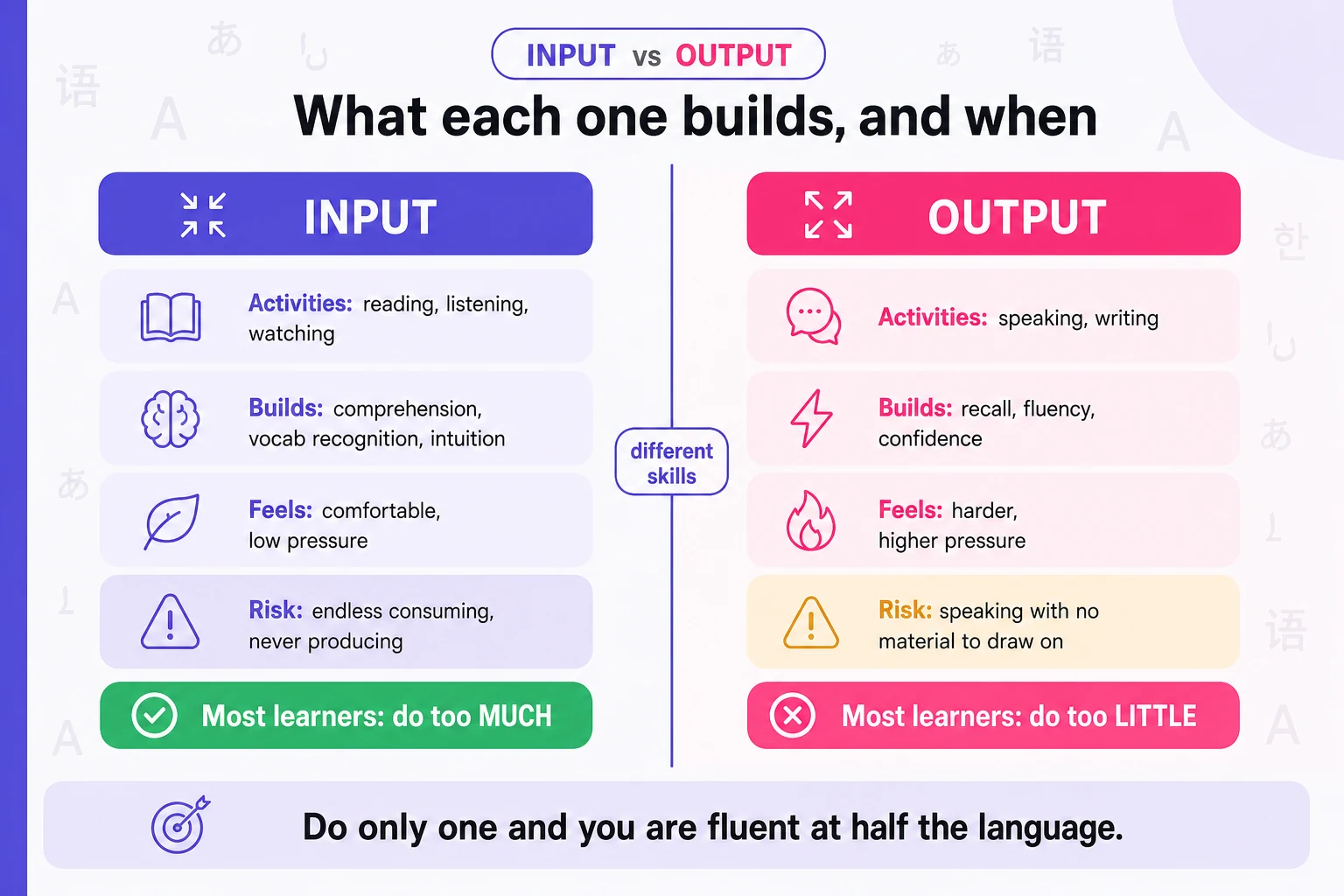
You can reach a high level of understanding through input alone and still be unable to hold a conversation, because comprehension and production are separate skills trained by separate activities. This is why so many learners understand films but freeze when asked to speak.
| Dimension | Input | Output |
|---|---|---|
| Activities | Reading, listening, watching | Speaking, writing |
| Builds | Comprehension, vocabulary recognition, intuition | Recall, fluency, confidence |
| Feels | Comfortable, low pressure | Harder, higher pressure |
| Risk | Endless consuming, never producing | Speaking with no material to draw on |
| Most learners | Do too much | Do too little |
Why Input Feels Better and Output Matters More
Input is comfortable. You understand things, you feel progress, and nobody hears your mistakes. Output is uncomfortable for the opposite reasons, which is exactly why learners avoid it and exactly why it works. The discomfort of retrieving a word under pressure is the moment learning happens; comfort rarely builds new ability. You do need input first. There is no point forcing output with an empty vocabulary. But the common failure is not too little input; it is treating input as the whole plan and never crossing into production.
How to Add Output Without the Fear
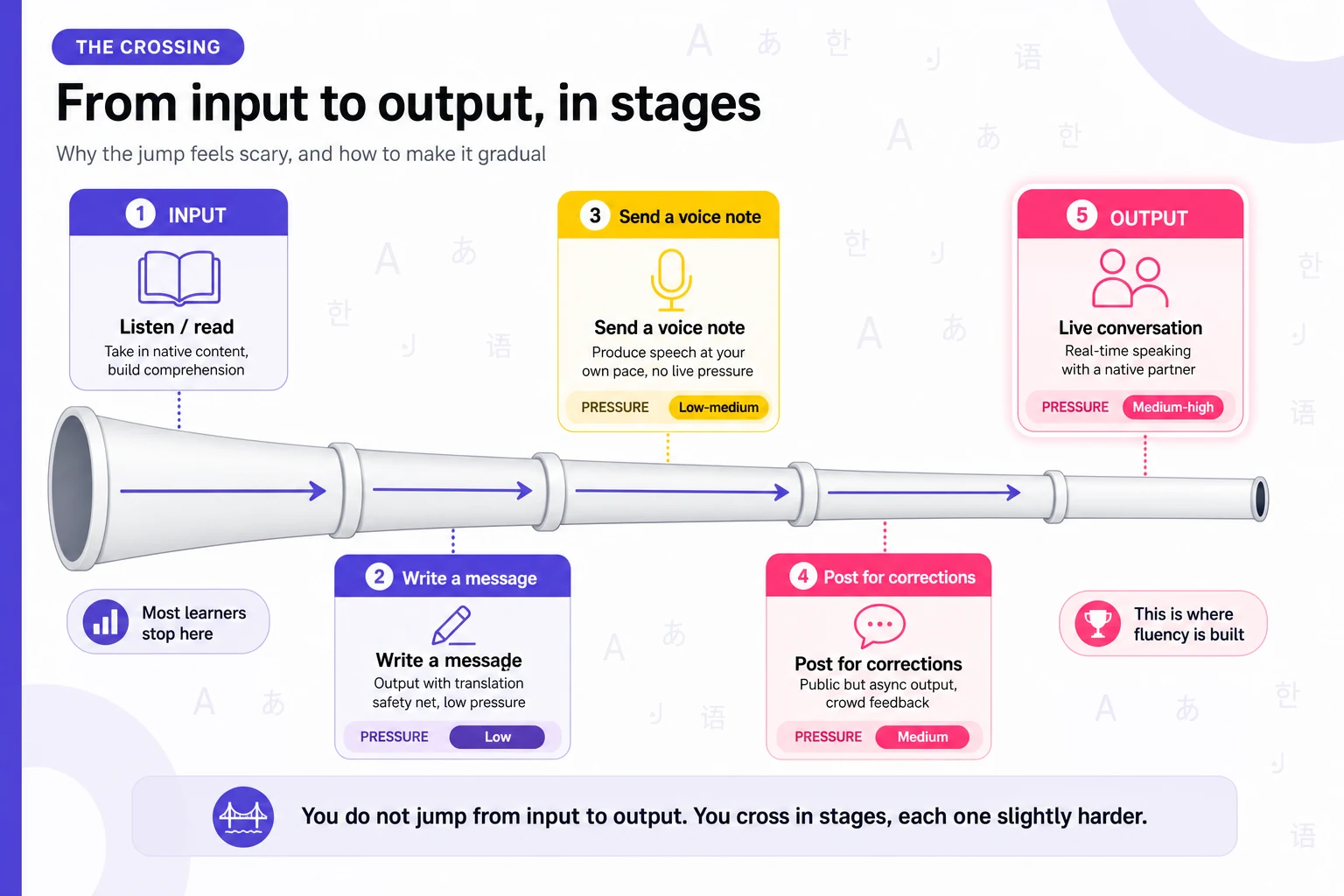
The fix is low-pressure output, early and often, with a patient listener. Language exchange apps are useful because they offer several steps between private study and a live conversation. HelloTalk is one example:
- Text chat provides a low-pressure first form of output, with translation, transcription, and corrections available when needed.
- Community posts allow a learner to test one sentence and compare feedback from more than one speaker.
- Live audio rooms create a gradual transition from listening to speaking rather than forcing an immediate one-to-one call.
- Pronunciation and grammar feedback can support private rehearsal before live output. Voice messages and the free tier make it possible to test this progression without committing to a high-pressure format.
The Balance to Aim For
Early on, weight toward input to build a base, but never at zero output. As you progress, shift toward output, because that is the skill that lags. A practical rule: for every session of pure input, do one small piece of output the same day, even a single voice note. A daily French speaking routine shows how that balance can work in practice, while the 90-day English plan for professionals adapts it to a work goal.
Common Mistakes
Input-only routines. Understanding everything and speaking nothing is the classic plateau. Output with no base. Forcing speech before you have vocabulary just builds frustration. Passive input. Half-watching a show teaches far less than focused listening. Delaying output for months. The longer you wait, the harder the first attempt feels.
Frequently Asked Questions
Is input or output more important for language learning?
Both are needed, but they build different skills. Input builds comprehension, output builds the ability to speak and write. Most learners over-do input and under-do output.
Can I become fluent through input alone?
You can become good at understanding, but speaking is a separate skill that only output builds. Fluency in conversation requires regular production practice.
How much output should I do compared to input?
Early on, more input to build a base, but always some output. As you improve, increase output, since it is usually the skill lagging behind comprehension.
What counts as output practice?
Any producing of the language: speaking, writing messages, recording voice notes, or posting sentences for correction. Conversations with native speakers are the highest-value form.
Why do I understand a language but cannot speak it?
Because you have trained comprehension through input but not production through output. The fix is to start speaking and writing regularly, even at a basic level.
How do I start output if I am nervous?
Begin with low-pressure forms: written messages, voice notes at your own pace, or short posts for correction. A language exchange app makes this gradual and private before it is live.
Balance the Two, Starting Today
Input and output build different halves of a language, and the half many learners neglect is output. Adding one small piece of production to each study day is a reasonable way to test the imbalance. A short message or voice note to a native speaker on HelloTalk is one low-pressure starting point.