These two methods get pitched as rivals, with immersion fans calling flashcards artificial and spaced-repetition fans calling immersion inefficient. Both are half right. Immersion and spaced repetition are not competing methods; spaced repetition builds the vocabulary that makes immersion comprehensible, and immersion gives that vocabulary real context, so each one fixes the other’s weakness. Choosing only one is why learners either forget words or never learn enough to enjoy the content.
This guide explains what each method does, where each breaks down, and how to run them together. For a broader framework, see this realistic guide to learning a language fast.
What Each Method Does Best
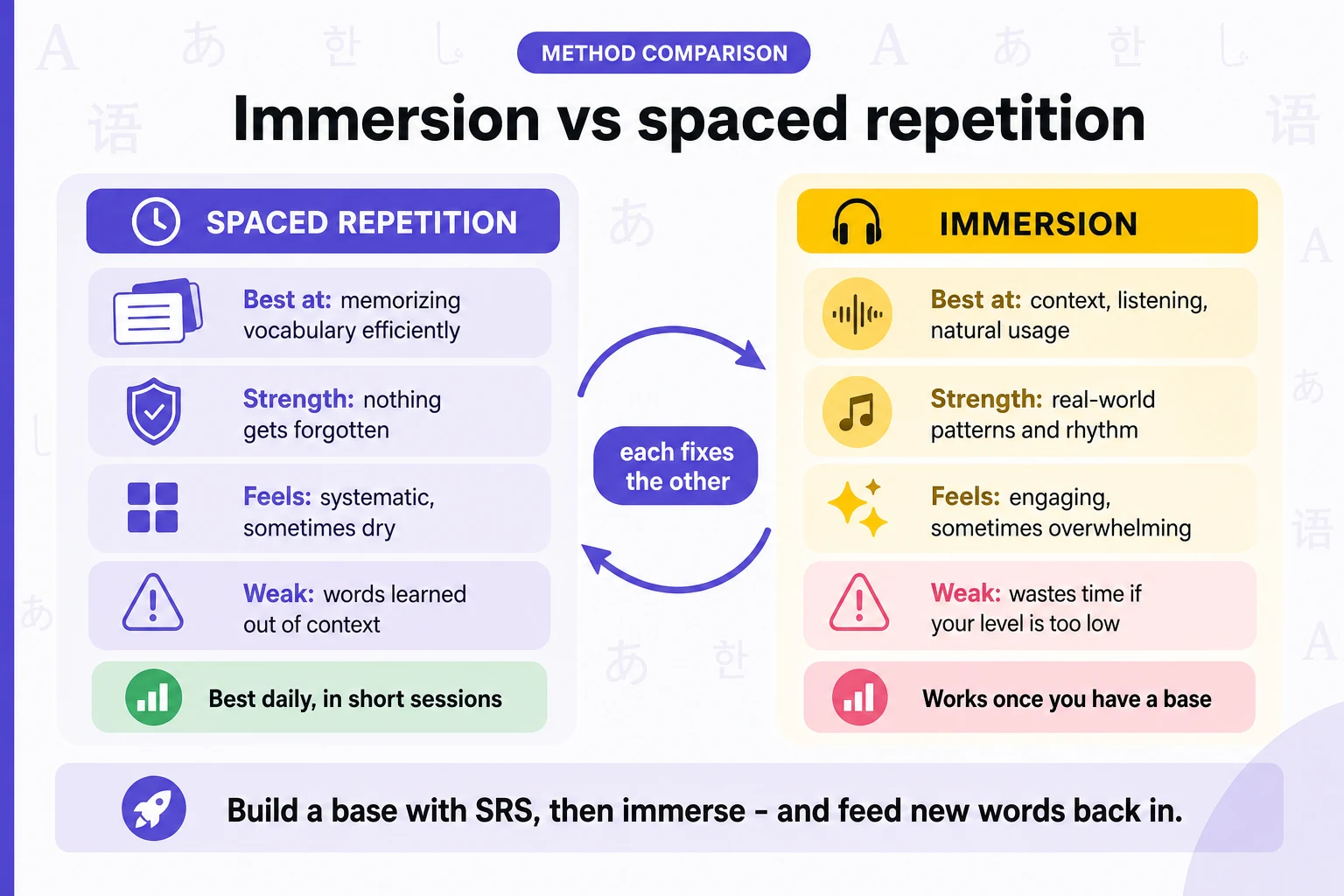
Spaced repetition is the most efficient way to memorize vocabulary, and immersion is the most effective way to make that vocabulary usable; neither does the other’s job. Here is the trade-off laid out.
| Dimension | Spaced repetition | Immersion |
|---|---|---|
| Best at | Memorizing vocabulary efficiently | Context, listening, natural usage |
| How it feels | Systematic, sometimes dry | Engaging, sometimes overwhelming |
| Strength | Nothing gets forgotten | Real-world patterns and rhythm |
| Weakness | Words learned out of context | Wastes time if level is too low |
| Works best | Daily, in short sessions | Once you have a base vocabulary |
Where Each One Fails Alone
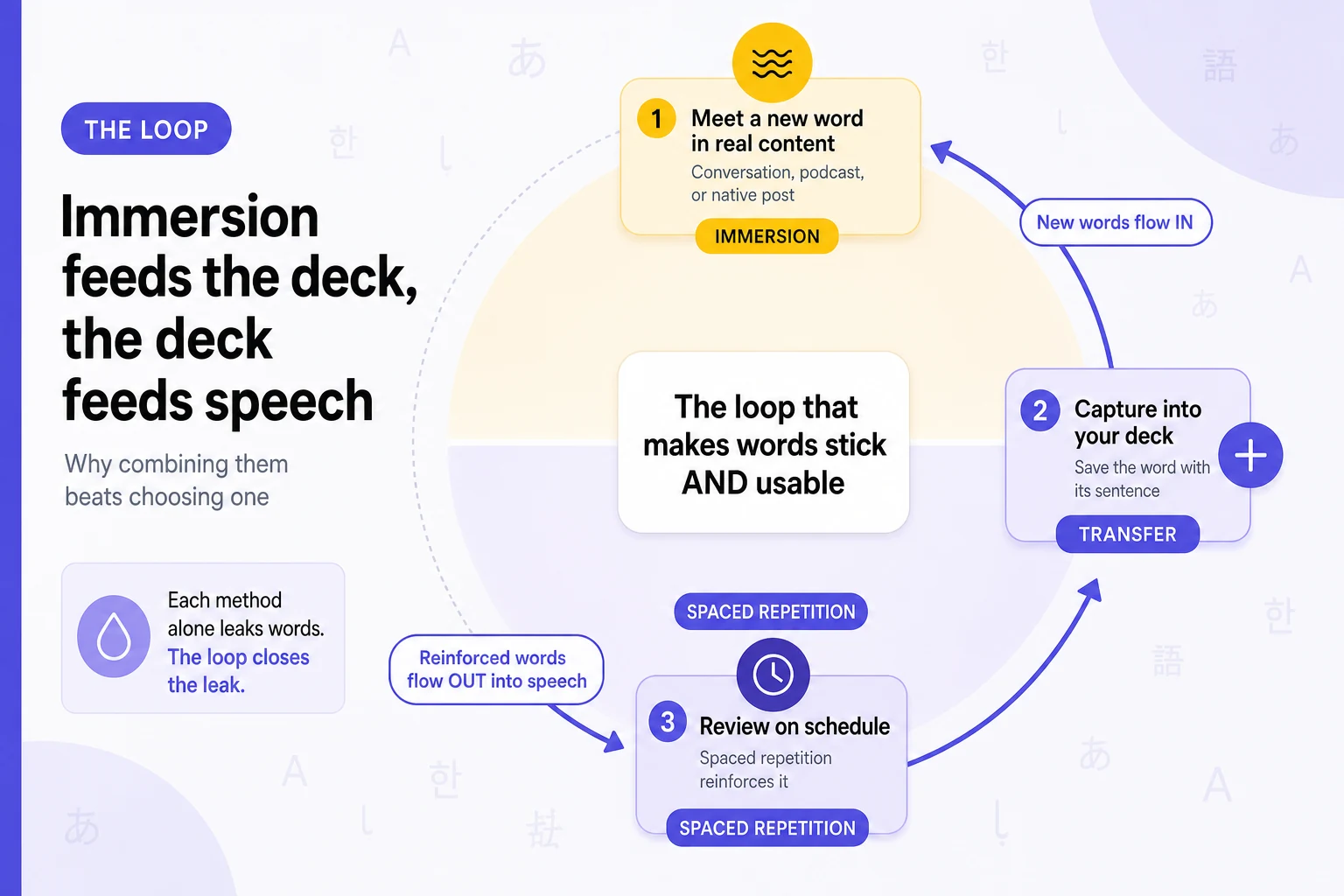
Spaced repetition alone gives you a head full of words you have never used in a sentence, so recall in conversation stays slow. Immersion alone, attempted too early, means staring at content you barely understand, which teaches little and burns motivation. Immersion below your level is not learning; it is decoding, and decoding is exhausting and slow. The sequence matters. Build a vocabulary base with spaced repetition, then immerse in content that is challenging but mostly understandable, and let spaced repetition keep capturing the new words immersion throws at you.
Making Immersion Interactive, Not Passive
Watching shows is passive immersion, and it helps, but the fastest immersion is interactive: real conversation where you have to understand and respond in real time. That combines input and output in one activity. Language exchange apps can make immersion interactive without requiring travel. HelloTalk is one option, and its value for this method comes from the kinds of exposure it provides:
- Text conversations offer real messages slightly above a learner’s level, with translation, transcription, and corrections available as support.
- Community posts provide short samples of everyday language and a chance to respond rather than only consume.
- Live audio rooms add spontaneous speech, hesitation, and turn-taking that edited media usually removes.
- Pronunciation and grammar feedback can help a learner review what surfaced during the interaction. New words from these exchanges can then be added to a spaced repetition deck. The free tier is enough to test whether this feedback loop fits an existing routine.
How to Combine Them
Run spaced repetition daily as your vocabulary engine, and immerse several times a week in content or conversation just above your level. Feed new words from immersion back into your deck. The daily English speaking routine turns that idea into a repeatable schedule, and the German speaking practice guide shows why interaction matters alongside input.
Common Mistakes
- Immersing too early. Content far above your level teaches almost nothing.
- Flashcards without context. Words memorized in isolation are slow to recall in speech.
- Passive-only immersion. Half-watching builds far less than interacting.
- Not feeding immersion back into your deck. New words met in conversation should be captured, or they vanish.
Frequently Asked Questions
Is immersion or spaced repetition better for learning a language?
Neither alone. Spaced repetition memorizes vocabulary efficiently, while immersion makes it usable in context. Combining them fixes the weakness each one has on its own.
When should I start immersion?
Once you have a base of common vocabulary, usually after a few weeks of spaced repetition. Immersing before that turns into slow decoding rather than learning.
Does spaced repetition work without immersion?
It builds memory, but words learned in isolation are slow to use. Immersion or conversation gives them the context that makes recall fast.
What is the best kind of immersion?
Interactive immersion, real conversation where you understand and respond, is the fastest, because it trains input and output at once. Passive watching helps but is slower.
How do I combine flashcards and immersion?
Run spaced repetition daily, immerse in content just above your level several times a week, and add new words from immersion into your flashcard deck so the two reinforce each other.
Can I immerse without traveling?
Yes. Language exchange apps, native content, and live audio rooms bring interactive immersion to you, so you can practice with native speakers from anywhere.
Use Both, in the Right Order
Spaced repetition and immersion work best as parts of one system: one supports vocabulary memory, while the other provides context and retrieval pressure. A conversation with a native speaker on HelloTalk is one way to test interactive immersion and collect useful material for the next review cycle.