There are dozens of English speaking apps, and the app store rankings will not tell you which one fits you, because they rank by downloads, not by whether people actually learn to speak. The right English speaking app is the one that gets you talking with real people most often, not the one with the most features or the highest rating. Once you judge apps by that single measure, the choice gets much simpler.
This guide is a decision framework rather than a ranking. Use the 30-minute daily English speaking routine as a practical test, then judge whether the app supports the routine consistently.
The Features That Actually Matter
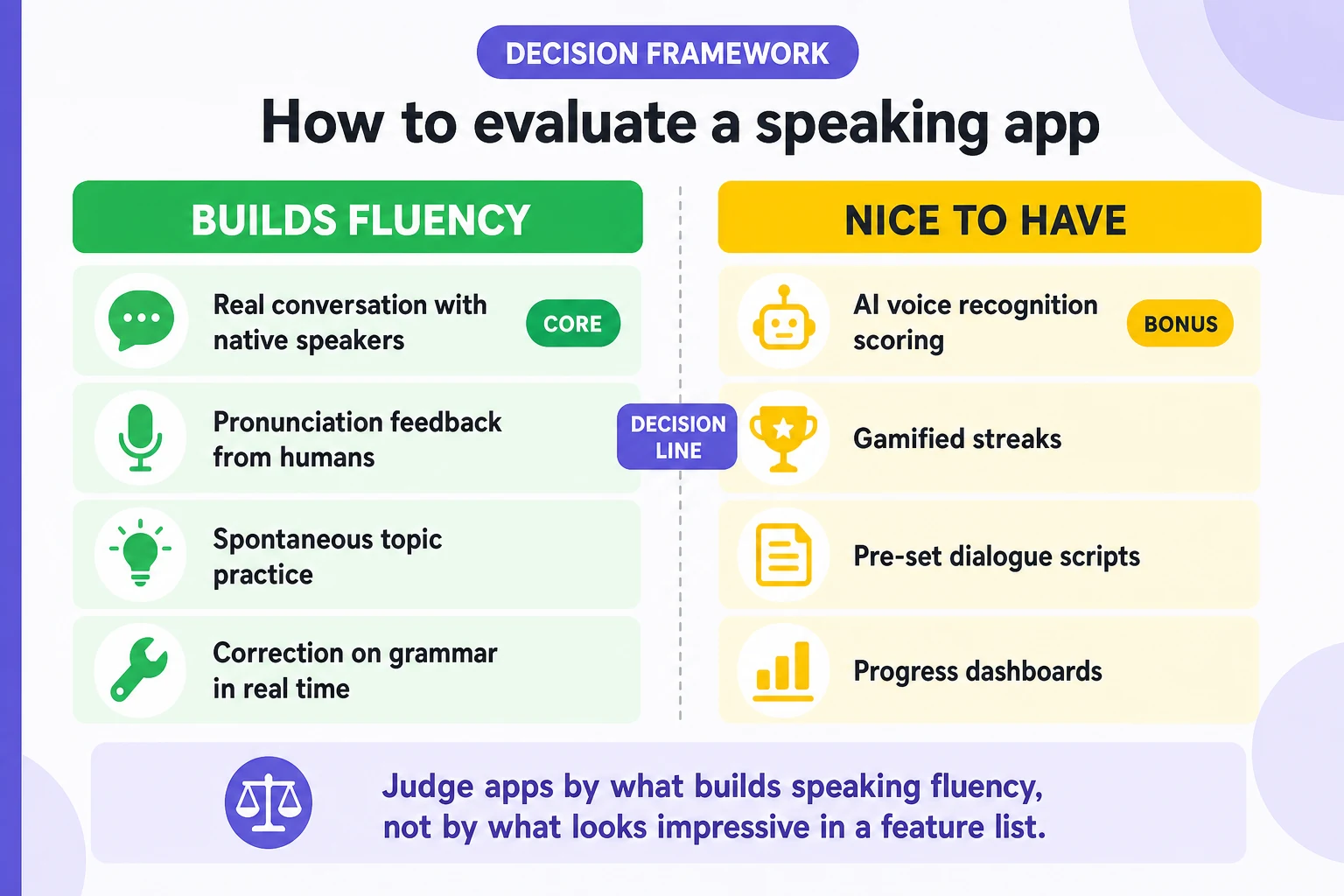
Most app comparisons list features that look impressive and change little. The ones that predict real speaking progress are narrower. An English speaking app is worth your time only if it gives you real speaking output, honest feedback, and enough people or prompts to keep you talking daily. Everything else is secondary.
| Feature | Does it build speaking? | Why |
|---|---|---|
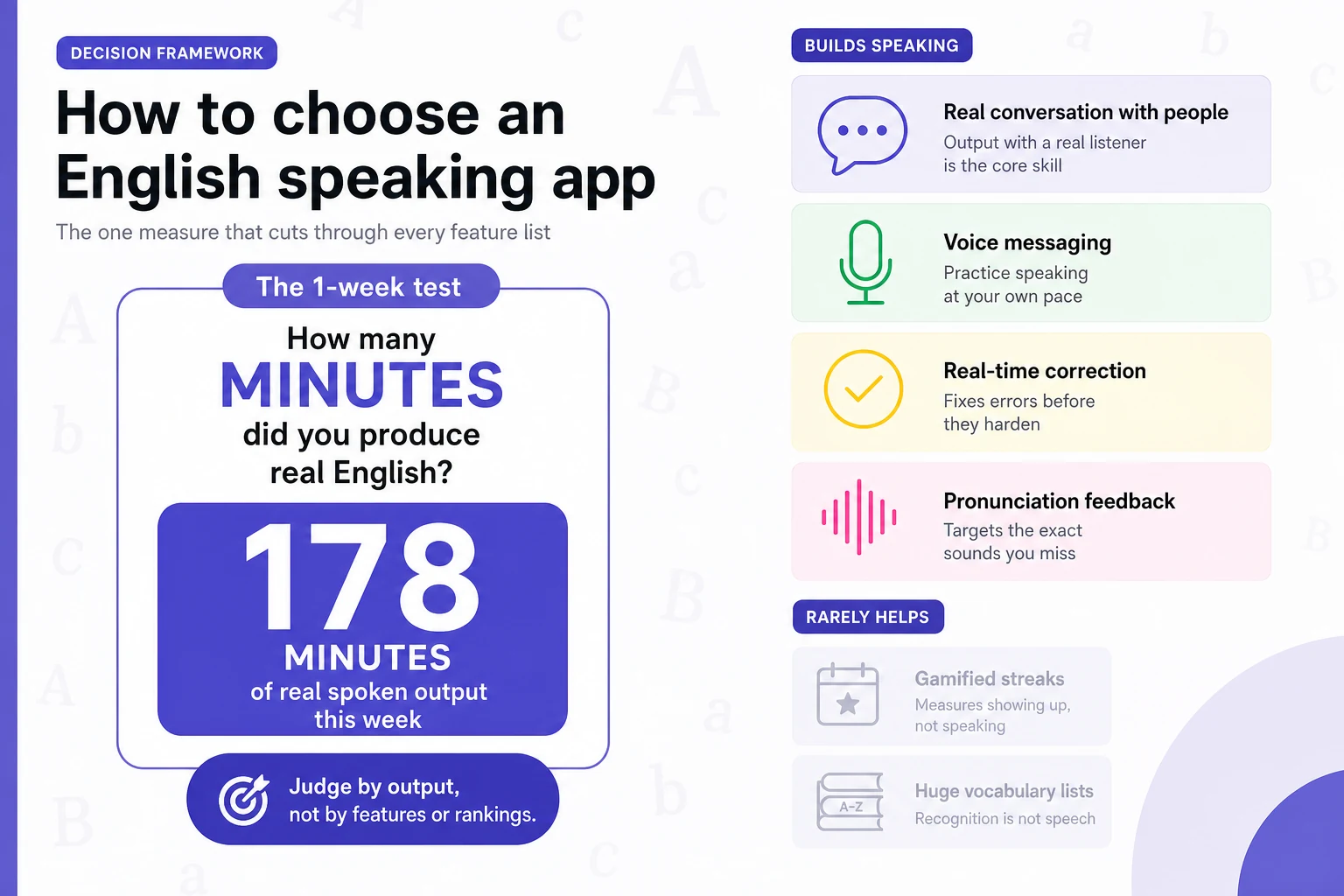
| Real conversation with people | Yes, most | Output with a real listener is the core skill |
| Voice messaging | Yes | Lets you practice speaking at your own pace |
| Real-time correction | Yes | Fixes errors before they harden |
| Pronunciation feedback | Yes | Targets the exact sounds you miss |
| Gamified streaks | Rarely | Measures showing up, not speaking |
| Huge vocabulary lists | Rarely | Recognition is not the same as speech |
How to Test an App in One Week
Do not commit based on marketing. In the first week, measure one thing: how many minutes did you actually spend producing English out loud or in writing to a real person or realistic prompt? An app that keeps that number high is working. An app where you mostly tapped multiple-choice answers is not, however fun it felt. If after a week you have recognized a lot of English but spoken almost none, the app is training the wrong skill, and you should switch. This test cuts through every feature list.
Where Real-People Apps Fit
Apps centered on real interaction tend to generate more output than quiz-based tools because another person creates a genuine reason to respond. HelloTalk is one app that can be evaluated with this criterion:
- Text and voice messages allow output at a self-selected pace, with translation, transcription, and corrections available as support.
- Community posts provide a simple way to compare feedback from several speakers.
- Live audio rooms let a learner observe a conversation before joining it.
- Pronunciation and grammar feedback can support private rehearsal between live exchanges. The free tier is sufficient for a one-week test based on minutes of real English produced rather than the length of a feature list.
Matching the App to Your Situation
If you are a beginner, prioritize an app with gentle prompts and correction. If you are stuck at intermediate, prioritize real conversation volume, since output is your bottleneck. If you are preparing for a specific goal, the 90-day English plan for professionals and daily English speaking routine help you turn the app into a habit.
Common Mistakes
- Choosing by app store rank. Downloads measure popularity, not learning.
- Being won over by streaks. A long streak with no speaking still leaves you unable to talk.
- Collecting apps. One app used daily for real output beats four opened occasionally.
- Judging before you test output. Measure spoken practice in week one, then decide.
Frequently Asked Questions
What is the best English speaking app?
The best one for you is whichever keeps you speaking with real people most often. Apps built around real conversation and voice practice tend to build fluency faster than quiz-based ones.
How do I know if an English app is actually working?
After a week, check how much English you actually produced out loud or in writing to a real person. High output means it works; mostly tapping answers means it does not.
Are free English speaking apps good enough?
Yes. Many language exchange apps offer a free tier for speaking practice with native speakers. Optional paid plans may add convenience features, but they are not required to test the core routine.
Do gamified apps help with speaking?
They help with habit and vocabulary, but streaks and points measure showing up, not speaking. For fluency, prioritize apps that produce real spoken output.
How many English apps should I use?
One for real speaking is the priority. You can add a second for vocabulary, but more than two usually reduces consistency rather than helping.
What features matter most in an English speaking app?
Real conversation with people, voice messaging, real-time correction, and pronunciation feedback. These build spoken skill. Streaks and big word lists matter far less.
Choose by Output, Then Start Talking
The right English speaking app is the one that consistently produces real English use, so judge it by output rather than rankings. A one-week trial that includes a conversation with an English speaker on HelloTalk provides a concrete basis for comparison.