It is a simple question with a complicated answer. Ask ten different English tutors how many sessions per week a child needs and you will get ten different numbers, because the right answer depends on three things that most parents have not been asked to think about separately: the child’s age, the specific learning goal, and how much home practice happens between sessions.
Getting the frequency wrong in either direction costs you. Too few sessions and the forgetting curve erases progress faster than it accumulates. Too many sessions for a young child and you hit fatigue and resistance, which makes every session less effective regardless of how good the teacher is. The goal is to find the minimum effective dose for the specific goal, then add home practice to extend what the live sessions deliver.
This guide gives Saudi parents a practical, age-by-goal framework for deciding how many English sessions their child needs per week. It covers four age groups, four common learning goals, how to calculate total weekly practice time including review, and how to adjust the plan as the child progresses. It uses 51Talk’s 25-minute one-on-one format as the primary example because that is the most common format parents ask about, but the frequency principles apply to any programme.
The Two Variables That Determine the Right Number
Session frequency is not one-size-fits-all. Before deciding on a number, two variables need to be clear.
Variable 1: the child’s age
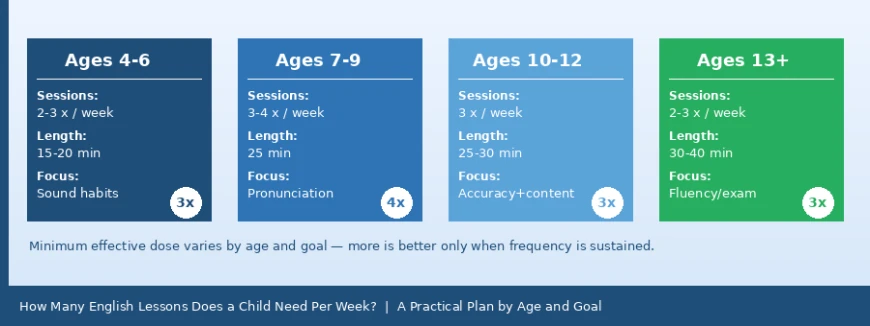
Age determines attention window and motor plasticity. A five-year-old can sustain high-quality focus for roughly 15 minutes and benefits most from short, habit-forming sessions that happen frequently rather than one longer event per week. A twelve-year-old can sustain focus for 25 to 30 minutes, can carry more content per session, and is less dependent on extreme frequency because their working memory is more developed.
Motor plasticity also matters for pronunciation specifically. Children aged seven to nine are in what many researchers describe as a sensitive period for phonological acquisition: the sound system is still actively developing, new phonemic categories form relatively quickly, and errors that are corrected at this age are less likely to fossilise than the same errors corrected at fifteen. This means the return on frequency investment is highest in the seven-to-nine window for pronunciation goals.
Variable 2: the learning goal
Four goals come up most often for Saudi parents choosing an online English programme: fixing specific pronunciation errors, building speaking confidence, preparing for an English exam, and developing general fluency and vocabulary. Each goal has a different optimal frequency, for reasons grounded in how the relevant learning processes work.
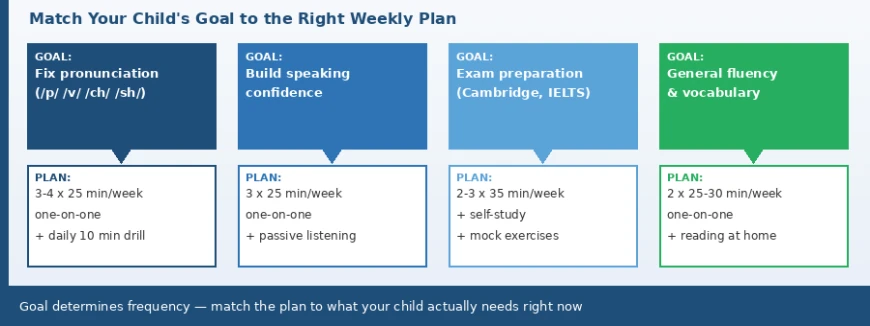
• Pronunciation accuracy requires high frequency because motor memory decays quickly without reinforcement. Three to four sessions per week with review between them is the effective range for children aged seven to twelve.
• Speaking confidence requires enough sessions to build a positive habit without overwhelming the child. Three sessions per week with low-pressure home listening exposure is generally sufficient.
• Exam preparation involves more content volume per session and benefits from targeted home practice between sessions. Two to three sessions per week with structured self-study is typical for children aged ten and above.
• General fluency develops through sustained exposure over time rather than intensive short correction cycles. Two to three sessions per week with reading or conversation exposure at home usually produces steady progress without burnout.
Practical Plans by Age Group
Ages 4 to 6: building the habit before the lesson
At this age, the primary goal is not correction. It is establishing the habit of English as something that happens regularly and feels normal. Children in this range have attention windows of ten to fifteen minutes and benefit most from sessions that feel more like play than instruction. Two to three sessions per week of fifteen to twenty minutes each is the effective range.
The sessions should focus on sound exposure and simple vocabulary, not grammar or reading. Physical activities, songs, picture naming, and simple call-and-response routines work best. Home practice is most effective when it is passive: English songs playing during car rides, English picture books at bedtime, a short English cartoon before school. The child is absorbing the sound system without realising it.
Minimum for meaningful progress: 2 sessions per week.
Strong plan: 3 sessions per week at 15-20 minutes each, with daily passive exposure at home.
Too much: More than four sessions per week at this age often produces resistance rather than acceleration.
Ages 7 to 9: the peak window for pronunciation
This is the age group where session frequency has the highest return on investment for pronunciation specifically. Children in this range are old enough to understand a correction and young enough to build new phonemic categories without the resistance that comes when a pattern has been in place for years. Three to four sessions per week of 25 minutes each, combined with ten minutes of targeted home drills on the same sounds covered in the session, produces the strongest outcomes for Arabic transfer error correction.
The sounds most worth targeting at this age are /p/, /v/, /ch/, and /sh/. A child who has these four sounds stabilised by age nine will enter secondary school with a pronunciation foundation that requires significantly less corrective work later.
Minimum for pronunciation work: 3 sessions per week.
Strong plan: 4 sessions per week at 25 minutes, with 10 minutes of daily home drill targeting session sounds.
Important: Post-class review the same day as each session is as important as the session itself for this age group.
Ages 10 to 12: accuracy alongside growing content load
Children in this range are managing a heavier school curriculum and are beginning to use English for content learning, not just as a subject. Sessions can carry more material per lesson, and the child can engage with written feedback reports in a way younger children cannot. Three sessions per week at 25 to 30 minutes each balances pronunciation accuracy work with the vocabulary and grammar content that becomes increasingly important at this stage.
Pronunciation work should continue if Arabic transfer errors are still present. A child who is still producing /b/ for /p/ at age ten is not in a different situation from a seven-year-old except that the pattern is more entrenched. The correction approach is the same. The timeline may be slightly longer.
Minimum for balanced progress: 2 sessions per week.
Strong plan: 3 sessions per week at 25-30 minutes, with 10-15 minutes of home review after each session.
Ages 13 and above: shifting from correction to performance
Teenagers typically need less session frequency than younger children for pronunciation, because their working memory can hold corrections across longer gaps and their motivation to self-correct is higher when the goal is clear. Two to three sessions per week at 30 to 40 minutes is the effective range, with the higher frequency and shorter sessions applying to pronunciation goals and the lower frequency and longer sessions applying to exam preparation or extended writing work.
For exam preparation specifically, the home practice component becomes more important than the session frequency. A student doing two 35-minute sessions per week with four hours of self-directed exam practice will outperform a student doing four 25-minute sessions with no home study. At this age, the live session is the correction and direction mechanism. The heavy lifting happens outside it.
Minimum for exam-focused work: 2 sessions per week, with structured home study between sessions.
Strong plan for pronunciation: 3 sessions per week at 30 minutes, with self-directed review.
The Master Plan: Sessions Per Week by Age and Goal
This table gives the recommended session frequency for each combination of age group and learning goal. Use it as a starting point, not an absolute prescription. If your child’s attention, motivation, or schedule requires adjusting up or down by one session, that is a reasonable call to make.
| | Age | Pronunciation fix | Speaking confidence | Exam preparation | General fluency | Session length | | 4-6 | 2-3x/week | 2x/week | Not recommended | 2x/week | 15-20 min | | 7-9 | 3-4x/week | 3x/week | Not primary focus | 2-3x/week | 25 min | | 10-12 | 3x/week | 3x/week | 2-3x/week | 2-3x/week | 25-30 min | | 13+ | 2-3x/week | 2x/week | 3x/week | 2x/week | 30-40 min |
Detailed Weekly Plans by Age and Goal
This table sets out what each weekly plan actually looks like in practice, including the live session frequency and the home practice that should accompany it. The home practice column is not optional: it is what converts a session into durable learning.
| Goal | Age 4-6 plan | Age 7-9 plan | Age 10-12 plan | Age 13+ plan | | Pronunciation fix | 2-3x 15-20 min live + 5 min daily sound-spotting | 3-4x 25 min live + 10 min daily drill (/p/ /v/ /ch/) | 3x 25 min live + 10 min minimal pairs | 2-3x 30 min live + self-directed review | | Speaking confidence | 2x 15 min live + English songs or stories | 3x 25 min live + passive English listening | 3x 25 min live + conversation topics prepared | 2x 30 min live + journaling or voice notes | | Exam preparation | Not recommended at this age | Not primary focus; build base first | 2-3x 30 min live + mock exercises at home | 3x 35-40 min live + timed practice tasks | | General fluency | 2x 15 min live + read-aloud at home | 2-3x 25 min live + English reading habit | 2-3x 25 min live + vocabulary journal | 2x 30 min live + reading and discussion |
How to Count Total Weekly Practice Time
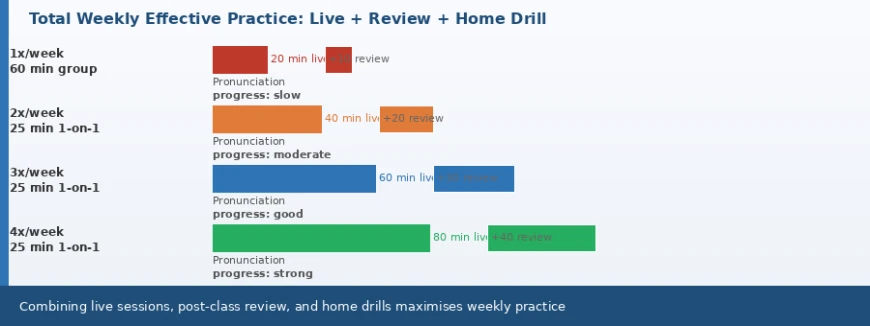
One mistake parents commonly make is treating the live session minutes as the total practice time. They are not. Total effective practice time per week is the sum of three things: live session minutes, post-class review minutes, and home drill minutes. For a child on a three-session-per-week plan at 25 minutes each, the live session contribution is 75 minutes. Add 10 minutes of post-class review after each session and you have 105 minutes. Add 5 minutes of home drill on non-session days and the total reaches 130 minutes.
That difference between 75 and 130 minutes is not incidental. The review and home drill components are what interrupt the forgetting curve between sessions and keep the motor memory active. Without them, the 75 live minutes are doing all the work and the decay runs unchecked for two-plus days between each session.
How the components add up for different plans
• 2 sessions/week at 25 min: 50 min live + 20 min review + 20 min home drill = 90 min total.
• 3 sessions/week at 25 min: 75 min live + 30 min review + 30 min home drill = 135 min total.
• 4 sessions/week at 25 min: 100 min live + 40 min review + 20 min home drill = 160 min total.
• 1 session/week at 60 min: 60 min live + 10 min review + 10 min home drill = 80 min total.
The single 60-minute session produces the lowest total effective practice time of all four scenarios, even though it has the longest individual session. That is the core argument for frequency over duration, and it holds up regardless of which programme you are using.
How 51Talk Structures the Weekly Plan
The question of how many sessions per week is only useful if the sessions themselves are designed to work with frequency rather than against it. A programme where each session is self-contained and the teacher starts fresh every time does not benefit from being scheduled three times a week in the way a programme with carry-over feedback and session-linked review does.
What 51Talk is
51Talk is a live one-on-one English platform for children. Sessions are 25 minutes, delivered by qualified teachers, and structured around CEFR levels and Cambridge English learning goals. The lesson cycle includes a pre-class warm-up that activates content from the previous session, the live lesson with real-time correction, post-class review exercises targeted to that session’s content, a written teacher feedback report, and regular level and unit assessments.
How the structure supports the frequency model
• The pre-class warm-up bridges sessions. Before each 25-minute live lesson, the child reviews vocabulary and sounds from the previous session. This is the mechanism that keeps corrections alive between sessions: the warm-up reactivates the motor patterns from two days ago before the teacher introduces anything new.
• Post-class review is session-specific. The exercises after each lesson are built around the sounds and vocabulary from that lesson, not a fixed template. A child who worked on /p/ and /v/ on Monday gets review exercises on /p/ and /v/ that evening. That is the same-day consolidation event that matters most for pronunciation retention.
• Written feedback guides home practice. The feedback report after each session tells parents specifically which sounds were addressed. That makes the home drill between sessions targeted rather than random: if the report says /ch/ substitution was the focus, the parent knows to run three chip/ship contrasts at the dinner table.
• Teacher session notes carry over. The teacher who runs Wednesday’s session has access to Monday’s feedback report. That means corrections build progressively rather than cycling through the same errors without tracking whether they have moved.
• Multiple sessions per week are designed into the model. The 25-minute format is built for three to five sessions per week. Scheduling three sessions is not an add-on; it is the intended delivery mechanism.
Sample weekly plans with 51Talk
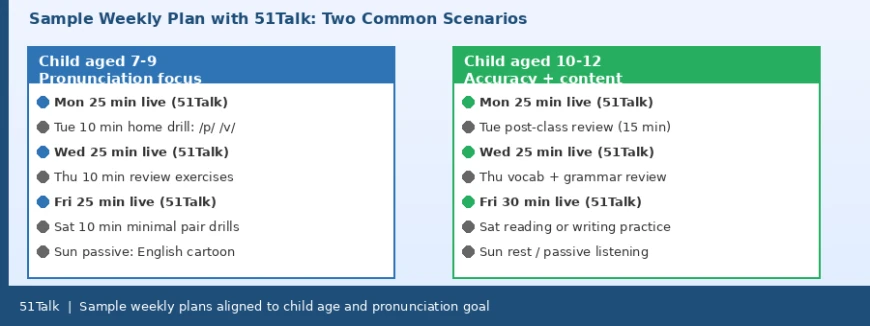
For a child aged seven to nine working on pronunciation: Monday, Wednesday, and Friday at 25 minutes each, with post-class review the same evening and ten minutes of targeted home drill on the days in between. Total effective practice time: approximately 135 minutes per week.
For a child aged ten to twelve balancing pronunciation and content: Monday, Wednesday, and Friday at 25 minutes each, with post-class review after sessions and vocabulary or reading practice on non-session days. Total effective practice time: approximately 130 to 140 minutes per week.
Ask 51Talk before booking whether the teacher has experience with Arabic-speaking learners and whether the post-class review changes with each session or follows a fixed template. A trial lesson is available at 51talk.com to see the session structure in practice.
Parent Checklist: Questions to Ask Before Committing to a Frequency Plan
Before agreeing to a session schedule, use this checklist to verify that the programme’s structure actually delivers the frequency benefits described in this guide.
| Question to ask | Field | What the answer tells you |
| How many sessions per week does this programme support? | Frequency | Less than 2/week for pronunciation work is insufficient for most children |
| What is the maximum gap between sessions under the recommended plan? | Scheduling | Gaps over 3 days weaken motor memory consolidation for young learners |
| Is there a post-class review after every session, or only periodically? | Review | Consistent post-session review is what converts short sessions into durable learning |
| Does the review target the sounds or content from that specific session? | Review quality | Session-linked review outperforms generic review for pronunciation accuracy |
| Can I increase session frequency during school holidays without penalty? | Flexibility | Holiday periods are high-value windows for intensive short-session work |
| Is the same teacher available for all sessions in a given week? | Continuity | Teacher familiarity with your child’s errors compounds week over week |
| What happens to the lesson plan if one session is missed that week? | Policy | A clear make-up or catch-up policy protects the frequency model |
| Does the programme adjust recommended frequency as the child improves? | Progression | A plan that never changes ignores the fact that goals shift over time |
Where to Start
If you are not sure where to begin, use your child’s age and primary goal to pick the right row and column from the master table above. That gives you a starting frequency. Then add the home practice component: post-class review the same evening as every session, and a five-to-ten-minute targeted drill on the specific sounds covered in that session on the days in between.
If three sessions per week is not immediately achievable due to scheduling, start with two and build up. Two well-structured sessions per week with consistent post-session review will produce more improvement than three sessions without review, because the review is what keeps the motor memory active between sessions.
Review the frequency plan after six weeks. If the teacher is spending time re-establishing corrections from two sessions ago rather than advancing from them, the gap between sessions is too long. If the child is consistently fatigued or resistant, the frequency may be too high for their attention window. Adjust in one-session increments and give each adjustment four weeks before evaluating again.
The right number of sessions per week is the one your child can attend consistently, sustain without burning out, and follow up with review that same day. Consistency over time beats intensity in bursts, every time.
Frequently Asked Questions
How many sessions per week does 51Talk recommend for a Saudi child working on pronunciation, and is that built into the pricing?
51Talk’s programme is designed for multiple sessions per week and the 25-minute format makes that practical for most family schedules. The recommended frequency for pronunciation goals depends on the child’s age and current level, and the platform can advise on this when you enquire. Pricing structures and session bundle options are worth confirming directly at 51talk.com before booking. When you do, ask specifically whether the post-class review exercises change with each session and whether teacher session notes are visible to the teacher at the next lesson. Both features determine whether multiple weekly sessions actually compound or simply repeat.
My child has three English lessons at school per week. Does that count toward the total?
It counts for vocabulary, grammar, and reading exposure, but rarely for individual pronunciation correction. In a school class of 25 to 30 students, a child producing Arabic transfer errors like /b/ for /p/ or /f/ for /v/ will almost never have those specific patterns addressed. The teacher is managing too many students to deliver sound-level feedback. One-on-one sessions outside school exist to do what group instruction cannot. Count school English as part of general exposure and plan the one-on-one frequency based on the specific correction goal, not the total class hours.
Is it better to do five short sessions per week or three slightly longer ones?
For pronunciation accuracy in children aged seven to twelve, five short sessions per week with ten minutes of home review each is the most effective structure from a motor memory standpoint. Each session creates a consolidation window, and five windows per week means the decay curve is interrupted almost daily. In practice, five sessions per week is difficult to sustain consistently for most Saudi families. Three sessions at 25 minutes with post-class review is a more realistic and still highly effective plan. The principle is: as frequent as you can reliably sustain, not as frequent as is theoretically optimal.
My child is doing two sessions per week and making slow progress. Should I add a third session or extend the session length?
Add a third session before extending the length. The consolidation argument is clear: three 25-minute sessions per week gives three overnight consolidation windows, which is more effective for pronunciation than two 35-minute sessions regardless of the additional content per session. If adding a third session is not possible, the second most effective change is to introduce daily post-class review on the days between sessions. Ten minutes of targeted drills on the same sounds addressed in the last session adds a consolidation event without requiring a live lesson.
How do I know when to reduce session frequency as my child improves?
Watch for two signals. First, is the teacher spending the opening minutes of each session re-correcting the same errors from two sessions ago, or building directly on the previous correction? If the teacher is building, the frequency is working. If they are repeatedly re-correcting, either the frequency is already too low or the home practice is not happening. Second, has your child started self-correcting in natural conversation without being prompted? Self-correction is the sign that a pattern has shifted from effortful to automatic. Once a target sound is consistently self-corrected for four to six weeks without regression, the session frequency for that sound can be reduced and the time redirected to the next target.
What is the minimum number of sessions per week that produces any measurable improvement?
For pronunciation accuracy, one session per week is generally below the threshold for measurable improvement over a consistent period, because the forgetting curve between sessions erases too much of what was built. Two sessions per week is the practical minimum, provided post-class review happens consistently after both sessions and home practice targets the same sounds in between. Below two sessions per week, the programme is providing exposure and general English input, which has value, but is unlikely to shift a specific phoneme error that has been in place for years.