Your child loves the English game platform you signed them up for. They ask to play it. They earn badges, complete levels, click through activities happily. But three months in, their spoken English has not noticeably changed. They can match words to pictures. They still hesitate when asked to say a sentence.
This is the most common gap in game-based English learning. Games are excellent at building vocabulary recognition and lowering anxiety. They are weak at building spoken fluency, because speaking requires a listener who responds, corrects, and adapts in real time. A game cannot do that.
This page explains when games genuinely help English learning, when they replace it, and what to look for in a platform that uses play purposefully rather than decoratively.
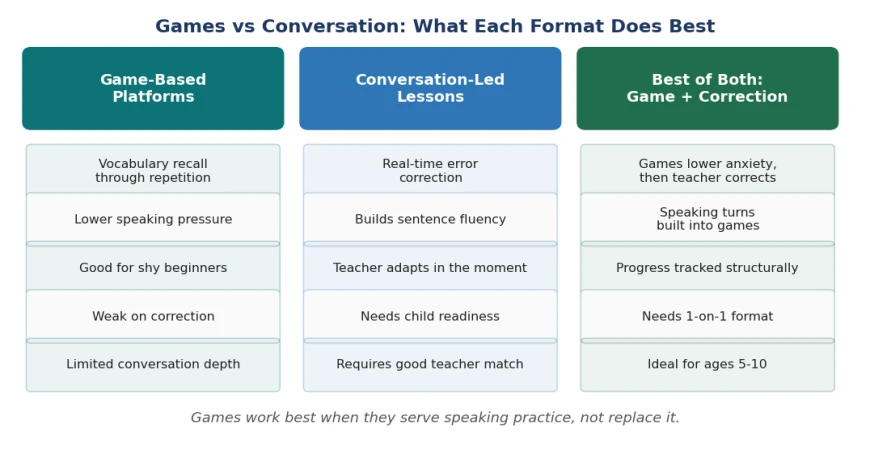
What game-based, conversation-led, and combined formats each do best
What Games Do Well in English Learning
Games reduce speaking anxiety. A child who is embarrassed to produce English sounds in a direct speaking context will often attempt the same sounds when embedded in a game. The game frame lowers the stakes. That is genuinely useful, especially for beginners and shy children.
Games also create repetition without boredom. Encountering the same vocabulary item across multiple game rounds builds recognition faster than a vocabulary list. For younger learners, this is the most effective way to move a word from unfamiliar to automatic.
What Games Cannot Do
• Correct pronunciation errors in real time. A game can flag a wrong answer. It cannot hear that your child said /b/ instead of /p/ and demonstrate the correct lip position.
• Adapt to a specific child’s gaps. A live teacher notices that this child consistently drops the final consonant. A game does not notice. It moves to the next level.
• Build extended speaking skills. Games typically require word-level or short phrase responses. Sentence fluency, turn-taking in conversation, and extended response practice require a human interlocutor.
• Provide the social motivation of a real relationship. A child who wants to impress a teacher, make a teacher laugh, or get a teacher’s specific approval will try harder than they will for a badge.
What to Look for in a Platform That Uses Games Well
• Games tied to the lesson’s language goal. If the teacher taught /p/ sounds today, the game reinforces /p/ today. A game about unrelated vocabulary is entertainment, not reinforcement.
• Games that require the child to produce spoken language, not just click. Pointing, choosing, and dragging are not speaking. Ask whether the child has to say words or sentences during game activities.
• Games as one component, not the entire session. A lesson that is entirely game-based is a gamified app. A lesson that uses a game as one activity within a structured teacher-led session is a different thing entirely.
• A live teacher who observes and corrects during the game. A game supervised by a teacher who pauses when the child makes an error is fundamentally different from an unsupervised game.
Where 51Talk Fits In
What 51Talk is
51Talk is a live one-on-one English platform for children offering 25-minute sessions with qualified teachers, CEFR-aligned materials, and a lesson cycle that includes pre-class warm-up, live interactive teaching, post-class review games, teacher feedback, and unit assessments. Visit 51talk.com.
Why the game-plus-correction structure matters
51Talk’s post-class review exercises include game-style activities tied to the specific vocabulary and sounds from that lesson. This places the game correctly in the learning sequence: after the teacher has introduced and corrected the language, the game reinforces it. The game does not substitute for the teacher. It follows the teacher.
During the live lesson itself, teachers use visual games and interactive activities as speaking stimuli rather than entertainment. The distinction is whether the child has to produce language as part of the game or only click to advance it.
What to keep in mind
How effectively games are used within lessons depends partly on the individual teacher. During a trial lesson, watch whether the teacher uses games as a correction and speaking opportunity, or as a transition filler. Ask the teacher directly how they use interactive activities in a typical class.
Before You Enrol: Questions to Ask Any Platform
• Are the games tied to that session’s vocabulary and language goals? Ask for an example of the game used in a recent lesson and what it reinforced.
• Does the child have to produce spoken language during the game? Clicking and tapping are not speaking.
• Is there a live teacher present and correcting during game activities? Unmonitored game time is app time with a teacher in the background.
• What percentage of the lesson time is game-based? A strong lesson uses games purposefully for 20 to 30 percent of the session. More than that tips into entertainment.
Frequently Asked Questions
Does 51Talk use games in its lessons, and are they connected to the curriculum?
51Talk’s lesson cycle includes post-class review exercises that use game-style activities tied to the specific content of each lesson. During live lessons, teachers use interactive visual activities as speaking prompts. The degree to which games are integrated into correction and speaking practice depends on the individual teacher. A trial lesson at 51talk.com lets you observe this directly.
My child is more motivated by games than by conversation practice. Should I use a game-only platform?
Use the game-based platform as a supplement, not as the primary programme. Games build vocabulary recognition and lower anxiety effectively. They do not build spoken fluency. A child who spends two years on a vocabulary game app will arrive at a conversation lesson with strong word knowledge and limited ability to produce sentences under social pressure.
Can games replace a live teacher for a shy child?
Games reduce the anxiety that makes shy children reluctant to speak. That is valuable. But a shy child who never practises speaking with a real human does not become less shy when speaking with humans. The games lower the floor. The live teacher is still needed to raise the ceiling.
What is the difference between a game that teaches and a game that entertains?
A game that teaches produces language output from the child and connects to a specific vocabulary or grammar goal. A game that entertains produces clicks and badge rewards. The quickest way to tell the difference is to ask your child what English they used during the game. If the answer is “none” or “a few words”, the game was entertainment.
What to Do Next
Observe the trial lesson specifically for how games are used. Ask yourself: does the game require the child to speak, or only click? Does the teacher pause to correct during the game, or watch passively? Does the game content match the vocabulary the teacher introduced? If all three answers are yes, the games are working as a vehicle for speaking. If the answers are no, the games are a feature selling the platform, not a tool serving the learning.