Not every good English teacher is a good teacher for a shy child. A teacher who is energetic, fast-paced, and highly engaging for a confident learner can be overwhelming for a hesitant one. The qualities that work for a shy child are specific, observable, and different from general teaching quality.
This page identifies eight indicators of a teacher who is genuinely suited to working with shy or hesitant children. All eight are visible in a single 25-minute trial lesson if a parent knows what to look for.
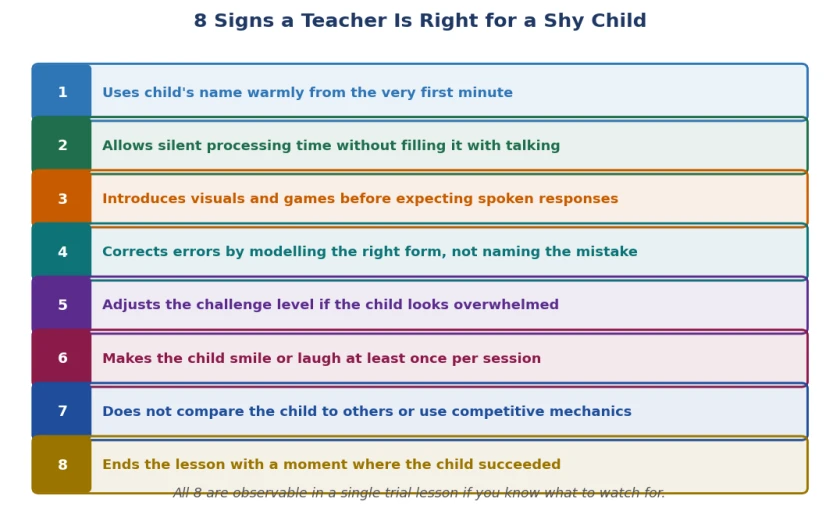
Eight teacher behaviours that signal suitability for shy or hesitant learners
Why Teacher Suitability Matters More for Shy Children
For a confident child, a mediocre teacher who follows the curriculum will still produce some progress. The child’s own motivation and resilience carry a significant portion of the learning. For a shy child, the teacher’s specific approach is the primary determinant of whether any learning happens at all. A shy child with the wrong teacher disengages and stops attending. A shy child with the right teacher often outperforms expectations.
The eight indicators below are not about warmth in general. Warmth is necessary but not sufficient. They are about specific, teachable behaviours that the teacher either displays or does not.
The Eight Indicators
• Uses the child’s name warmly from the first minute. Not just to address them, but to establish a personalised connection. “Welcome, Layla” communicates presence. “Hello” does not.
• Allows silent processing time. Five or more seconds of waiting after a question before speaking again. Counting this silently during the trial is one of the most informative things a parent can do.
• Introduces visuals or games before asking for spoken responses. The sequence matters: show, then ask. Not: ask, then show after the child has already failed.
• Corrects by modelling, not by naming the mistake. “Say it like this: PEN” versus “That’s wrong, it’s PEN not BEN.” Both achieve the correction. One creates shame. One creates practice.
• Adjusts the challenge level when the child looks overwhelmed. Does the teacher notice stress or withdrawal signals and immediately move to something less demanding? This adaptive responsiveness is rare and critical.
• Creates at least one moment of genuine smile or laughter. Not forced, not performative. A natural moment of lightness in the lesson. This signals that the teacher has found a way into the child’s emotional world.
• Avoids comparison and competition. No “in my other lessons, children can already say this.” No game mechanics where the child sees how they compare to an imagined standard. Shy children are already comparing themselves; the teacher should not add to it.
• Ends the lesson on a success. Deliberately structures the final two to three minutes around something the child can do well. The lesson’s last emotional memory should be competence, not struggle.
How to Score the Trial
| Indicators visible | What it suggests |
| 7-8 out of 8 | Teacher highly suited to shy children |
| 5-6 out of 8 | Good fit; note which two are missing and discuss with platform |
| 3-4 out of 8 | Partial fit; hesitant children may eventually warm up but will take longer |
| Below 3 out of 8 | Mismatch; request a different teacher before purchasing |
Where 51Talk Fits In
What 51Talk is
51Talk is a live one-on-one English platform for children with 25-minute structured sessions, qualified teachers, and CEFR-aligned curricula. Trial at 51talk.com.
How to use these eight indicators with a 51Talk trial
51Talk’s one-on-one trial reflects the teacher’s standard approach rather than a specially staged demonstration. This makes the eight indicators above reliable signals of how the teacher will behave across all subsequent lessons. Before the trial, request a teacher with experience in hesitant learners. During the trial, observe specifically for the eight behaviours. After the trial, score the teacher and use the table above to decide whether to continue.
What to keep in mind
A teacher who scores well on lesson quality but poorly on the eight indicators above is not the right teacher for a shy child, even if other parents rate them highly. The eight indicators are specific to this learner profile. General quality and shy-child suitability are not the same thing.
Before You Enrol: Questions to Ask Any Platform
• Can I request a teacher experienced specifically with hesitant or shy children? Ask before booking.
• If the trial teacher scores poorly, can I try a different teacher? This should always be possible.
• Does the teacher use structured games and visuals in lessons, or primarily verbal prompts? The answer predicts Indicators 3 and 4.
Frequently Asked Questions
How do I use this checklist with a 51Talk trial for my shy child?
Before the trial, tell the platform your child is hesitant and request an experienced teacher. During the 25-minute trial, count the waiting time after the first question (Indicator 2) and note whether errors are corrected by modelling or by naming the mistake (Indicator 4). Score the teacher on all eight after the lesson. Arrange a trial at 51talk.com.
Can a teacher learn these behaviours, or are they innate?
All eight are learnable. Most experienced children’s English teachers develop them naturally. Less experienced teachers may have the warmth but not the specific techniques. The waiting time indicator, for example, can be explicitly coached. A platform with strong teacher training is more likely to produce all eight consistently.
What if my child only shows improvement after 10 or 15 lessons?
For very shy children, a settling-in period of 8 to 12 lessons before visible comfort emerges is normal. The indicators above tell you whether the teacher is creating the conditions for the child to eventually open up. If the teacher scores 6 or above, trust the process for 10 lessons before reassessing.
My child was shy in the trial but less shy by lesson 4. Is that typical?
Yes, and it is exactly the pattern a well-matched teacher-shy child relationship produces. Lesson 1 is unfamiliar. Lesson 4 is predictable. Predictability reduces the anxiety that drives shyness in learning contexts. A shy child who knows what is coming speaks more than one facing an unknown structure each time.
What to Do Next
Request a trial with a teacher experienced in shy children. Observe all eight indicators. Score the teacher against the table above. If the score is 5 or above, proceed with that teacher. If below 5, request a different one before purchasing. One well-matched teacher for a shy child produces more English output in 8 weeks than three mismatched teachers over the same period.