You are looking at two teacher profiles. One says TEFL certified. The other says CELTA-trained. You want to know which one is better qualified to teach your 8-year-old English. The honest answer is that the names alone do not tell you enough. What matters is the quality of the programme behind the name, how it was assessed, and whether the teacher has experience with children specifically.
This page explains the practical differences between TEFL, TESOL, and CELTA for parents evaluating online English teachers for children. It covers what each term means, why CELTA is more consistently verifiable, and what questions to ask regardless of which credential a teacher holds.
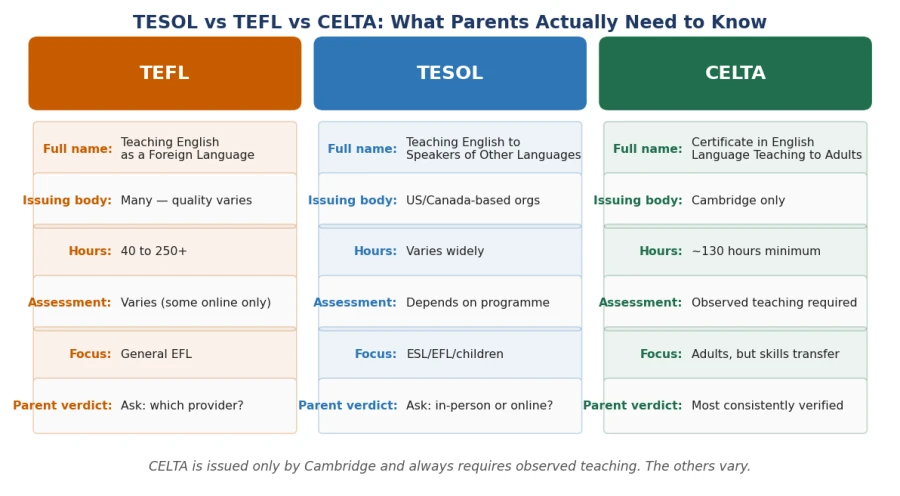
TEFL, TESOL, and CELTA compared on the dimensions parents need to understand
The Core Distinction: Category vs Specific Qualification
TEFL and TESOL are category names. They describe a type of teaching orientation: English as a Foreign Language and English to Speakers of Other Languages, respectively. Many different organisations issue TEFL and TESOL certificates, and the quality varies enormously between providers. A 40-hour self-paced online TEFL course and a 200-hour university-delivered TESOL programme both produce a certificate in the same category.
CELTA is different. It stands for Certificate in English Language Teaching to Adults and is issued only by Cambridge. There is one CELTA, one issuing body, one set of standards. It always involves a minimum of 130 hours and always includes a mandatory assessed teaching component evaluated by an external examiner. There is no short or self-paced version of CELTA. That consistency is why it is the most reliably comparable credential when reading teacher profiles.
What Each Qualification Covers
• TEFL. Teaching English as a Foreign Language. Quality depends entirely on the provider. Ask which organisation issued the certificate, how many hours the programme involved, and whether the teacher taught real students under observation. Without those answers, TEFL is a category without a standard.
• TESOL. Teaching English to Speakers of Other Languages. Broadly similar to TEFL in how it is used on profiles, and similar in the range of quality across providers. More common in North American contexts. The same verification questions apply as for TEFL.
• CELTA. Certificate in English Language Teaching to Adults, Cambridge. The most consistently rigorous of the three because it is issued by one body, always requires 130+ hours, and always includes assessed teaching with real students. The word “Adults” in the title refers to the target learner cohort in training, not a restriction on who the teacher can subsequently teach. Ask separately about child-specific experience.
| Qualification | Issuing Body | Hours | Observed Teaching | Verified By Parent? |
| CELTA | Cambridge (only) | 130+ minimum | Always required | Cambridge cert. check |
| TEFL | Many providers | 40 to 250+ | Depends on provider | Ask the provider |
| TESOL | Many providers | Varies widely | Depends on programme | Ask the provider |
Why These Distinctions Matter for a Child’s Teacher
A parent choosing between a CELTA-trained teacher and a TEFL-certified teacher is not automatically choosing between a better and worse teacher. They are choosing between a teacher whose qualification has a known, consistent standard and one whose qualification may range from excellent to minimal depending on the provider.
For a child’s English teacher specifically, the qualification is one factor. Child-specific experience, the correction method, and the ability to engage a young learner are equally important and not guaranteed by any of the three credentials. A CELTA-trained teacher who has only worked with adult corporate clients needs additional assessment for child teaching, just as a TEFL-certified teacher who has spent five years teaching primary-age children has relevant experience that the certificate alone does not capture.
How to Use These Distinctions When Reading Profiles
• For CELTA. The credential is consistently rigorous. The remaining questions are: when was it obtained, what child-specific experience does the teacher have, and has the credential been verified on the platform?
• For TEFL. Ask: which provider issued it, how many hours did it involve, and was there assessed teaching with real students? A TEFL from a reputable 200-hour programme with observed teaching is meaningfully different from a 40-hour online course.
• For TESOL. The same verification questions as TEFL. Confirm the issuing organisation and the programme structure before weighting the credential.
Where 51Talk Fits In
What 51Talk is
51Talk is a live one-on-one English platform for children with 25-minute structured lessons, qualified teachers, CEFR-aligned curricula, and a lesson cycle that includes teacher feedback and unit assessments. Teacher profiles at 51talk.com.
How to apply this framework to 51Talk teacher profiles
51Talk works with teachers who are trained and evaluated before being assigned to students. Before booking, use the profile and the support team to confirm: which qualification the specific teacher holds, which organisation issued it, how many hours the programme involved, and what child-specific experience the teacher has. These questions are answerable for any teacher on a serious platform.
What to keep in mind
51Talk teachers come from diverse professional backgrounds. The combination of a strong English teaching qualification and documented child-specific experience is the standard worth looking for. The trial lesson is the most direct way to verify whether the teaching method reflects the qualification claimed.
Before You Enrol: Questions to Ask Any Platform
• Which specific certificate does the teacher hold? CELTA, TEFL (provider?), TESOL (provider?).
• How many hours did the programme involve? And was there observed, assessed teaching?
• How long has this teacher been working with children? Specifically, not “experience teaching.”
• Has the qualification been verified by the platform? Self-reported vs independently confirmed.
• Can I see a sample lesson or trial with this teacher? Direct observation is the most reliable signal.
Frequently Asked Questions
Does 51Talk require its teachers to hold CELTA, TEFL, or TESOL qualifications?
51Talk works with qualified teachers and has an internal training and evaluation process. To confirm the specific qualification standard required and how it is verified for teachers on the platform, contact 51Talk’s support team directly before booking. Visit 51talk.com for platform details and teacher profiles.
Is CELTA more valuable than TEFL for a child’s English teacher?
CELTA is more consistently rigorous because it comes from a single issuing body with fixed standards. TEFL can range from minimal to rigorous depending on the provider. For a parent comparing profiles, CELTA from Cambridge is easier to assess than TEFL without knowing the provider. That said, the quality of child-specific teaching experience matters alongside the qualification, and neither credential guarantees it.
Can a non-native English speaker with CELTA be a better teacher than a native speaker without qualifications?
Yes. Teaching qualification and language background are independent. A non-native speaker who has completed rigorous teacher training, has experience with children, and understands the specific phonological gaps of the target learner group is more prepared to teach effectively than a native speaker who has not. Both native speaker status and qualification quality are useful but separate factors.
How do I independently verify whether a teacher’s CELTA is genuine?
Cambridge offers a certificate verification service. To use it, you need the teacher’s name, certificate number, and date of issue. Ask the teacher or platform to provide the certificate number. If either refuses without a clear reason, that is informative. For TEFL and TESOL, contact the issuing organisation directly with the same information.
My child’s current teacher says they are “trained.” What should I ask?
“Trained” is one of the vaguest words in English teaching profiles. Ask specifically: trained in what, by whom, for how many hours, and assessed how? A teacher who can answer all four questions clearly has something documentable behind the word. A teacher who cannot is using the word as a general claim.
What to Do Next
When reading any teacher profile that names a qualification, apply the distinction above. CELTA from Cambridge is verifiable and consistent. TEFL and TESOL require follow-up questions about the provider and the programme. Ask those questions before booking. Then take a trial lesson and observe the teacher’s correction method directly. A well-trained teacher names errors specifically, demonstrates the correct form, and structures the child’s attempt to improve. That behaviour is the practical evidence of meaningful training, regardless of which acronym appears on the profile.