Three terms appear repeatedly in the terms and conditions of children’s online English platforms: refund, cancellation, and rescheduling. They are used interchangeably in casual conversation but mean very different things in a platform’s formal policy. Confusing them when contacting customer support can result in the wrong process being applied, which may cost the parent a lesson credit or delay a financial recovery by weeks.
This article gives a plain-language explanation of all three, shows how they interact in common real-world situations, and gives parents a framework for knowing which term applies to their situation before they contact the platform.
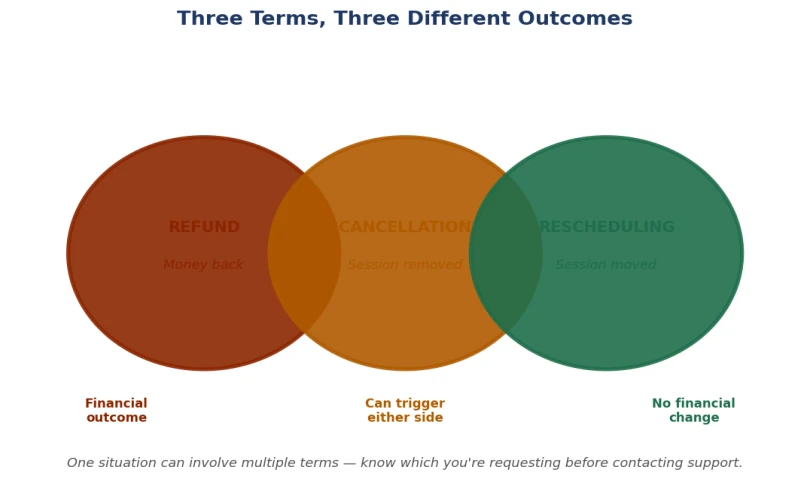
Three terms, three different outcomes — how they compare
The Plain-Language Definitions
Starting with the clearest possible version of each before adding the practical details.
| Term | What It Means |
| Fee refund | Money already paid is returned to the parent — in full, or for the portion covering unused lessons. A refund reverses the financial transaction, partially or wholly. It is a financial outcome. |
| Lesson cancellation | A specific scheduled lesson session is removed from the calendar. Whether the credit for that lesson is preserved, forfeited, or transferred depends on when the cancellation was made and what the platform’s policy says. Cancellation does not automatically produce a refund. |
| Rescheduling | A specific scheduled lesson is moved to a different time. The lesson will still happen — just at a different point. Rescheduling involves no financial transaction and does not permanently remove the lesson from the package. It is a logistical change, not a financial one. |
How They Relate to Each Other
The three terms are connected in ways that create most of the confusion. A refund can happen without any cancellation: a parent who purchases a package and immediately decides it is not right can request a refund before any lessons are scheduled. A cancellation can lead to either a rescheduled lesson or a forfeited one, depending on when it was submitted and what the platform’s notice period requires. And rescheduling is neither a cancellation nor a refund — but if a lesson is rescheduled outside the package’s validity window, it may effectively expire and become a de facto cancellation.
These interactions explain why platform disputes so often involve terminology confusion. A parent who asks for a ‘reschedule’ when they mean a ‘cancellation with credit’ may receive a different response than intended. A parent who expects a financial refund after a cancellation may receive only a lesson credit unless the refund conditions specifically apply. Knowing which term is accurate before contacting support puts the parent in a much stronger position.
Six Real Situations and Which Term Applies
| Situation | Applicable Term | What to Check |
| Purchased yesterday, want to stop | Fee refund (full) | Cooling-off window, full refund conditions, any deductions |
| Used 10 of 30 lessons, want to stop | Fee refund (partial) | Pro-rata calculation, admin fees, refund method (cash vs credit) |
| Child cannot attend Tuesday’s booked lesson | Cancellation or rescheduling | Required notice period; whether lesson is credited or forfeited |
| Want to move Tuesday’s lesson to Thursday | Rescheduling | Required notice, teacher availability, monthly reschedule limit |
| Teacher did not show for the lesson | Platform-initiated cancellation | Automatic credit policy; whether parent must request the credit |
| Need a 3-week break for school holidays | Package freeze or pause | Whether a freeze is available, maximum duration, validity extension |
How Understanding These Terms Helps When Using 51Talk
What 51Talk Is
51Talk is a one-on-one English platform for children offering 25-minute structured lessons with trained teachers and CEFR-aligned materials. Lesson packages are purchased in advance, and the platform’s documented policies govern how unused lessons, cancellations, and rescheduling requests are handled.
Why Knowing the Terminology Matters When Contacting 51Talk
When contacting 51Talk’s customer support about a lesson change, using the correct terminology reduces the likelihood of being processed under the wrong policy. A parent who asks to ‘cancel’ a session without specifying whether they want a rescheduled alternative or simply a credit may receive either response. A parent who says ‘I need to reschedule Tuesday’s session to Thursday’ is making a specific logistical request that the support team can act on directly.
How to Confirm 51Talk’s Current Terms for Each Scenario
Before purchasing any 51Talk package, ask the support team to confirm the current policy for each of the three terms: the cancellation notice period and credit conditions, the rescheduling notice requirement and monthly limits, and the refund calculation method and conditions for unused lessons. Ask in writing and save the responses. These answers define exactly what your options are in each of the six real-world situations above.
Frequently Asked Questions
On 51Talk, if I cancel a lesson with less than the required notice, do I lose the lesson credit?
This depends on 51Talk’s current cancellation policy and the notice period required. The specific threshold and credit conditions should be confirmed directly with 51Talk before purchasing. Ask: what is the minimum notice required to cancel a lesson and retain the credit, and what happens to the lesson if I cancel with less notice than required?
Is rescheduling always free on children’s English platforms?
Not necessarily. Some platforms impose a fee for rescheduling beyond a certain number of times per month. Others restrict the total number of free reschedules within a package validity period. Check whether there is a monthly limit and whether any fee applies before assuming that rescheduling is always costless.
If I request a partial refund for unused lessons, does the number of cancelled sessions affect the calculation?
It may, depending on how the platform’s refund policy is written. Some platforms calculate refunds based on attended lessons only. Others base the calculation on all scheduled lessons, including those that were cancelled but for which a credit was not rebooked. The actual policy wording determines this, which is why reading the specific terms rather than relying on a general summary matters.
Can I submit a partial refund request and a rescheduling request at the same time?
These are separate processes and should generally be submitted as separate requests. Submitting them simultaneously may create confusion about whether you intend to stop using the platform or continue with some lessons. Contact the platform’s support team to understand whether a partial refund request affects the status of remaining lessons that you still plan to attend.
What if the platform uses different terminology from what this article uses?
The platform’s own terminology in its published terms governs. This article uses common terms for clarity, but always cross-reference with the specific language in the platform’s actual documentation. If a platform uses ‘lesson credit’ instead of ‘lesson cancellation’, or ‘booking change’ instead of ‘rescheduling’, the substance is the same — what matters is how the platform defines the outcome of each request, not what word it uses.
What to Do Next
Before contacting any platform about a lesson change, identify which of the six situations above applies. Find the relevant section of the platform’s published policy and confirm the specific terms for that situation. If you are uncertain which situation applies, describe it factually to the platform’s support team and ask which policy governs before taking any action. That sequence — identify the situation, find the policy, confirm in writing, then act — is the most reliable way to avoid losing a lesson credit or receiving a lesser outcome than you are entitled to.