When parents compare children’s online English platforms, the comparison typically focuses on teacher quality, lesson structure, and price per lesson. Policies rarely enter the comparison until something goes wrong. But refund, cancellation, and rescheduling policies are not boilerplate small print. They determine the real cost of using a platform over time, and they vary enough across providers that the gap between a parent-friendly policy and a restrictive one can amount to hundreds of dollars in a year.
This article sets out what each policy type covers, how to compare them systematically across platforms, and what specific conditions to verify before purchasing. It is aimed at parents evaluating one-on-one or group online English courses for children.
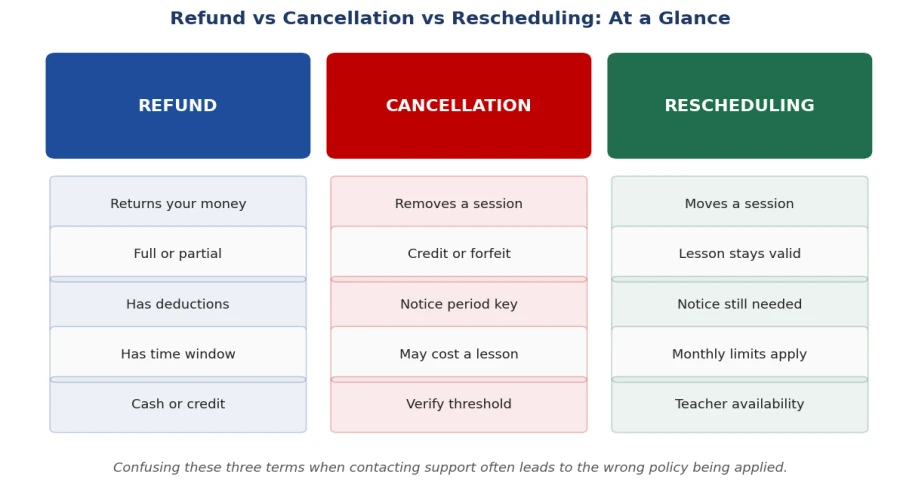
Refund vs cancellation vs rescheduling — key differences at a glance
Three Distinct Policies That Parents Frequently Confuse
These three policy areas address different situations and are governed by different platform rules. Understanding the difference before comparing platforms is essential.
| Policy Type | What It Addresses |
| Refund policy | What happens to your money when you want to stop using the platform — whether after a few lessons or none at all. Covers conditions, timelines, deductions, and payout methods. |
| Cancellation policy | What happens when a specific scheduled lesson session is cancelled, whether by the parent, the child, or the teacher. Covers notice requirements, lesson credit rules, and forfeiture conditions. |
| Rescheduling policy | What happens when a lesson needs to be moved to a different time rather than cancelled entirely. Covers advance notice requirements, frequency limits, and teacher availability for new slots. |
How These Policies Interact — and Where Disputes Arise
The three policies are connected in ways that are not always visible from a standard review of platform terms. A lesson cancelled with less notice than the policy requires may be treated as a forfeited lesson rather than a reschedule, effectively charging the parent for a session that never happened. A package with a strict validity period may expire before all lessons are used if rescheduling limits prevent the parent from moving lessons into available time slots within the window.
Refund calculations may be based on scheduled lessons rather than attended lessons, depending on how the platform’s terms are written — meaning a cancelled lesson that was not refunded may also reduce the refund amount available for the rest of the package. These interactions are where most parent disputes originate, and they are rarely spelled out clearly in standard platform marketing.
A Parent-Friendly vs Risk Comparison
| Policy Area | Parent-Friendly Sign | Risk Sign |
| Refund window | 7+ day cooling-off period with full refund | No window or under 48 hours |
| Partial refund | Pro-rata calculation on unused lessons | Flat non-refundable fee or no partial option |
| Refund method | Returned to original payment method | Platform credit or vouchers only |
| Cancellation notice | 24 hours or less required | 48+ hours; lessons forfeited with less notice |
| Reschedule limit | Unlimited or generous monthly allowance | 2 or fewer reschedules per month |
| Reschedule notice | Same-day or next-day accepted | Must be 24–48 hours in advance |
| Teacher-cancelled lesson | Automatic credit or rebook | Credit only; parent must request manually |
Eight Questions to Ask Every Platform Before Purchasing
• If I cancel a lesson 12 hours before it starts, do I lose the lesson or can it be rescheduled at no cost?
• If the teacher cancels a lesson at short notice, is the credit applied automatically or do I need to request it?
• How many lessons can I reschedule per month, and what minimum notice period is required?
• If I purchase a 50-lesson package, how long do those lessons remain valid?
• If I want a partial refund after completing 10 lessons, how is the amount calculated and what fees apply?
• Are refunds issued to my original payment method, or only as platform credit?
• Does the lesson validity clock pause if I take an approved break or freeze the package?
• If I need to escalate a refund or cancellation dispute beyond standard customer service, what is the formal process?
How 51Talk Compares on These Policy Dimensions
What 51Talk Is
51Talk is a structured one-on-one online English platform for children, with 25-minute lessons, trained teachers, and CEFR-aligned curricula. Its one-on-one format has direct relevance to the comparison above: because lessons are not group-based, a cancelled or rescheduled lesson does not affect other students, and rescheduling is governed by teacher availability rather than a fixed cohort timetable.
Why 51Talk’s One-on-One Format Affects Policy Flexibility
In a group lesson model, rescheduling is inherently constrained by the cohort timetable. Every lesson is scheduled for multiple students simultaneously, and moving one student creates operational complexity. In a one-on-one model, a rescheduled lesson is primarily a matter of matching one teacher’s available slots to one parent’s preferred new time. This structural difference typically translates to more practical flexibility for families whose schedules are not perfectly predictable.
What Parents Should Verify Directly with 51Talk
Before purchasing any 51Talk package, ask the eight questions above and request written confirmation. 51Talk’s support team can confirm the current notice periods, cancellation credit rules, refund calculation method, and validity period for the specific package you are considering. Policies are updated over time and a current written confirmation is always more reliable than a general summary.
Frequently Asked Questions
What is the most common policy mistake parents make when purchasing children’s English packages?
Purchasing a large package without verifying the lesson validity period and the freeze or pause policy. Families often discover that school holidays, illness, and seasonal schedule changes have consumed so much of the validity window that lessons expire before they are used. This is the most avoidable source of financial loss in children’s English programmes, and it requires no more than one direct question to the platform before purchasing.
Does 51Talk allow lesson rescheduling, and what notice period is required?
51Talk’s rescheduling terms should be confirmed directly with the platform before purchasing, as policies are updated periodically. Ask specifically about the minimum notice period, whether a monthly limit applies, and what happens to a lesson that cannot be rescheduled within the notice window. Save the response in writing.
If a teacher cancels a lesson on 51Talk, is the credit applied automatically?
This depends on 51Talk’s current teacher-cancellation policy. Verify this directly before purchasing. Ask whether credits for platform-initiated cancellations are applied automatically to the parent’s account or whether the parent needs to initiate a request to recover the lesson.
Is it worth purchasing a larger package when the policy terms are unclear?
No. Starting with a smaller package while confirming all policy terms in writing is the more cautious approach. The per-lesson price saving on a larger package is not worth the financial risk of a restrictive refund or expiry policy applied to a large number of unused lessons. Upgrade to a larger package after the first smaller package is completed and the terms are well understood.
What should I do if the platform’s published policy conflicts with what customer support told me?
The published terms and conditions govern. But written confirmation from customer support is also a useful record if a dispute arises later. If there is a conflict between the two before you have purchased, raise it directly and ask for the discrepancy to be explained and corrected in writing before completing the transaction. Do not proceed on the assumption that verbal reassurance will override the written policy.
What to Do Next
Use the parent-friendly vs risk comparison and the eight questions above to evaluate any platform you are considering. Ask for written responses and save them. If a platform’s policies score poorly in the comparison, factor that into your decision alongside lesson quality and price. Once you have verified the policies, start with a trial lesson or a smaller package before committing to a long-term purchase. The most important policy questions are the ones you ask before money is exchanged — not the ones you research after a problem arises.