Comparing online English platforms as a Muslim parent involves more variables than most platform reviews cover. Lesson quality and price are on every comparison chart. What is rarely discussed is whether the trial experience was designed to showcase the platform or to genuinely test fit, whether content is age-appropriate in the specific sense that matters to your family, and what the platform actually does with your child’s data.
This page sets out four dimensions worth comparing directly across platforms before enrolling. It covers what to look for in each, gives a comparison framework, and explains how one-on-one formats compare to group options on the dimensions most relevant to Muslim families. It applies to children aged 4 to 14 in live or structured online English programmes.
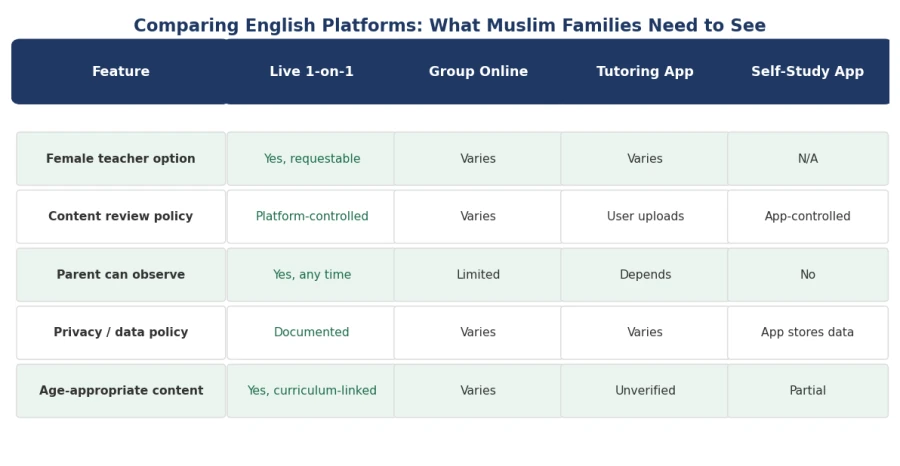
How platform types compare on dimensions that matter to Muslim families
Dimension 1: Trial Experience
A trial lesson tells you different things on different platforms. On some platforms, the trial is a curated demonstration delivered by a specially selected teacher. On others, it is a genuine first lesson with the teacher who would run regular sessions. The second type is far more valuable.
For Muslim families, the trial is also an opportunity to observe teacher presentation, lesson content, and how the teacher handles the child’s first encounter with English correction. Ask before booking: is this trial with the same teacher who would teach regular lessons? Is it the same curriculum and format as paid lessons? Can I observe without the teacher knowing in advance?
Dimension 2: Age Suitability
Age suitability is not only about language difficulty. For Muslim families it also includes the themes of story content, the visual representation of characters, and the social scenarios presented in lessons. A curriculum designed for a broad international audience may include content that feels inconsistent with a family’s values even when the language level is correct.
• For ages 3 to 7. Request sample materials. Specifically check: are the characters dressed appropriately? Are the family scenarios depicted consistent with your values? Are any topics introduced that the family would prefer to address at home rather than in a lesson?
• For ages 8 to 12. Ask about reading passages and discussion topics. Platforms that use general media content as reading material may include topics about music, entertainment, or mixed social settings that not all families find suitable.
• For ages 12 and above. Ask specifically about discussion topics and whether students can decline topics they are uncomfortable with.
Dimension 3: Lesson Format
The lesson format has direct implications for a Muslim family’s specific concerns. One-on-one lessons eliminate mixed-group peer interaction. Group lessons introduce unknown children. This is a structural difference, not a quality difference, and the right answer depends on what the family prioritises.
| Format | Privacy of Interaction | Content Control | Female Teacher Option |
| Live 1-on-1 | Only teacher and child | Platform-controlled | Requestable consistently |
| Group online | Unknown peers present | Partially controlled | Not guaranteed per lesson |
| Tutoring marketplace | Teacher-only | Teacher’s own materials | Depends on listing |
| Self-study app | None (automated) | App-controlled | Not applicable |
Dimension 4: Privacy Standards
Privacy for Muslim families carries specific considerations: whether the child’s image is stored or shared, whether session recordings are used for purposes beyond lesson delivery, and whether the platform’s data practices are consistent with the family’s preference for discretion.
• Session recordings. Ask: are sessions recorded? For how long are recordings kept? Who can access them?
• Child’s image. Ask: is the child’s video feed stored, and under what conditions?
• Third-party sharing. Ask: is any personally identifiable data shared with analytics, advertising, or research partners?
• Data deletion. Ask: can you request deletion of all data associated with your child’s account when you leave the platform?
Where 51Talk Fits In
What 51Talk is
51Talk is a live one-on-one English platform for children with 25-minute structured lessons, CEFR-aligned curricula, teacher feedback reports, and unit assessments. Details and trial lesson at 51talk.com.
Why the one-on-one format addresses Muslim family concerns structurally
The one-on-one format removes mixed-group peer interaction entirely. Every lesson is between one teacher and one child, with materials controlled by the platform rather than selected by the teacher independently. Female teachers can be requested and maintained consistently. Parents can observe at any time.
The structured curriculum means content is predictable and reviewable before purchase. Parents can request sample materials for their child’s age and level and compare them against their family’s standards before committing.
What to verify directly
Contact 51Talk before purchasing to confirm: female teacher availability at your required times, the session recording policy, and whether any child data is shared with third parties. Save the responses. These answers determine fit before any money is exchanged.
Before You Enrol: Questions to Ask Any Platform
• Is the trial with the same teacher who would teach regular lessons? A demo teacher is not the same thing.
• Can I see sample materials for my child’s age group before enrolling? A confident platform shares these readily.
• Does the lesson format involve group interaction with unknown peers? One-on-one eliminates this.
• Are sessions recorded, and for how long? Ask specifically.
• Is any child data shared with third parties? Review the privacy policy, not just the summary.
Frequently Asked Questions
Is 51Talk’s trial lesson representative of what regular lessons look like for Muslim families?
51Talk’s trial uses the same structured curriculum format as paid lessons rather than a specially staged demo. This makes the trial a reliable indicator of what regular classes involve, including teacher tone, content type, and lesson pacing. Contact 51talk.com to arrange a trial and specify any preferences regarding teacher gender.
How do I verify that a platform’s content is age-appropriate for my child?
Request sample lesson materials for your child’s specific age group and CEFR level before enrolling. Review the vocabulary categories, story themes, and visual content. If a platform does not share actual lesson materials before purchase, ask why. A platform that is confident in its content will show you.
Are there any English platforms designed specifically for Muslim families?
Most mainstream children’s English platforms are not designed specifically for Muslim families but can accommodate the relevant preferences through teacher selection, content review, and one-on-one format. The key is asking the right questions before enrolling rather than assuming the platform will raise these issues proactively.
Can I request the same female teacher for every lesson?
On a one-on-one platform with a large teacher pool, consistent teacher assignment is typically possible. On group platforms, the teacher assigned per session depends on scheduling. Confirm this specifically with any platform before purchasing a package.
What should I do if I find content in a lesson that conflicts with my family’s values?
Raise it with the platform immediately and ask how it is addressed. A platform with a genuine content review process will have a mechanism for this. Save a record of the specific lesson and your report. If the response is inadequate, use it as a basis for a refund request and factor it into your decision about continuing.
What to Do Next
Compare platforms against all four dimensions above before booking a trial. When you take the trial, observe all four simultaneously: was the teacher appropriate, was the content suitable for your child’s age, was the format compatible with your family’s preferences, and was the lesson conducted in a private environment? Save your notes. The most important decision happens before the first paid lesson, not during it.