Your child has a live English lesson three times a week and an app they enjoy using. The lessons are going well. The app scores are rising. But you are not sure whether the two are actually reinforcing each other, or whether they are just happening in parallel without much connection.
That question matters more than it sounds. A live lesson and an app that work together, where the app reviews vocabulary introduced in the lesson and the lesson builds on what the app covered, produce measurably better retention than the same activities done in isolation. The weekly schedule is the mechanism that makes the connection.
This page covers how to build that schedule around a Saudi family’s specific constraints: school hours, prayer times, the AST time zone, and the preferred lesson windows available through platforms like 51Talk. It applies to children aged 5 to 14. It does not cover holiday periods or exam preparation schedules specifically.
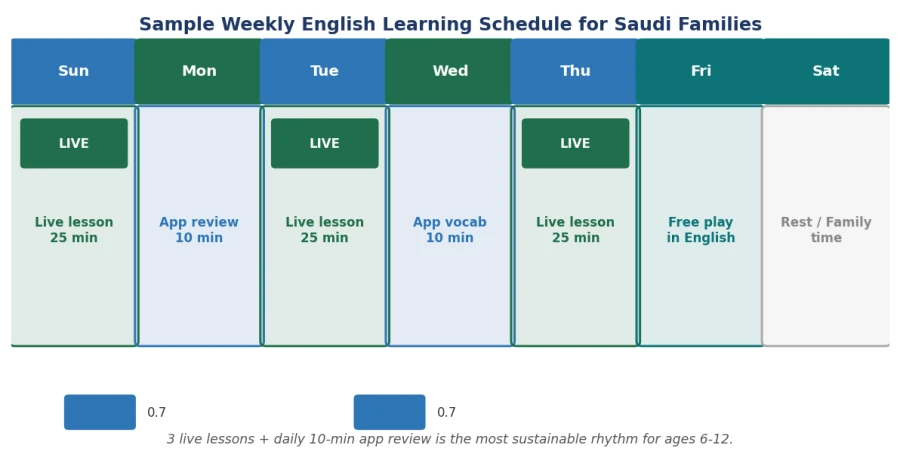
A sample weekly schedule combining live lessons and app practice for Saudi families
Why the Schedule Is the Most Underrated Part of English Learning
Most parents focus on finding the right teacher and the right app. Far fewer think carefully about when each activity happens relative to the other. But timing is the mechanism behind retention. A live lesson on Sunday that is followed by app review on Sunday evening produces better recall on Tuesday than the same lesson followed by app review on Monday morning.
The reason is consolidation. Language memory consolidates most efficiently within a few hours of first exposure, and again during sleep. A review activity in the evening of a lesson day catches both windows. A review the following morning catches only one. Over weeks, that difference compounds into a visible gap in how much the child retains.
The Saudi Family’s Scheduling Constraints
Saudi children attending school typically have lessons available in after-school windows from around 4:00 PM AST onward on school days. Weekend availability is broader. Prayer times create natural breaks in the afternoon and evening that most families work around rather than through.
• Best live lesson windows. 4:00 to 6:00 PM after school, or 7:00 to 9:00 PM for older children. Saturday and Sunday mornings offer flexibility for families who prefer daytime sessions.
• Platform time zone overlap. Teachers based in the Philippines (UTC+8) have afternoon and evening availability that maps well to Saudi AST evenings. A 9:00 PM Philippine slot is 2:00 PM AST, which suits families who prefer earlier sessions.
• App practice slots. Ten minutes immediately after the live lesson. An additional five minutes before the next lesson as a warm-up. Both of these fit naturally into gaps that most children already have in their daily routine.
A Practical Weekly Schedule Framework
| Day | Activity | Duration | Purpose |
| Sunday | Live lesson + app review | 25 min + 10 min | New input, same-day consolidation |
| Monday | App vocabulary practice | 10 min | Reinforce Sunday’s lesson words |
| Tuesday | Live lesson + app review | 25 min + 10 min | Build on Sunday, add new content |
| Wednesday | App speaking practice | 10 min | Mid-week retrieval check |
| Thursday | Live lesson + app review | 25 min + 10 min | Third exposure to weekly vocabulary |
| Friday | Free English activity | 15-20 min | Low-pressure reading or English TV |
| Saturday | Rest or family English | Optional | Incidental exposure only |
This framework is a starting point. Families where school days run to 5:00 PM may shift all lesson times an hour later. Families with younger children may reduce to two live lessons and daily 5-minute app sessions. The key principle does not change: live lesson and review happen on the same day.
Where 51Talk Fits In
What 51Talk is
51Talk is a live one-on-one English platform for children offering 25-minute sessions with qualified teachers, CEFR-aligned curricula, and a lesson cycle that includes pre-class warm-up, post-class review exercises, teacher feedback, and unit assessments. Scheduling details and trial lessons at 51talk.com.
Why 51Talk works within the Saudi schedule
51Talk’s 25-minute one-on-one format is well-suited to the after-school window available to most Saudi children. The session is short enough to fit between school arrival and the evening prayer, or between dinner and bedtime for older children. The post-class review exercises provided after each lesson are the app-side component of the schedule framework above, targeting the same vocabulary and sounds covered in the live session that day.
Because teachers are available across multiple time slots, Saudi parents can find consistent weekly slots that match the family’s specific routine rather than adjusting the family routine around a fixed class timetable.
What to confirm before scheduling
Before purchasing a package, confirm with 51Talk that your preferred time slots have consistent teacher availability across the validity period. Ask whether a freeze option is available during school holiday periods in Saudi Arabia, including Eid and the summer break. Get the answer in writing alongside your purchase confirmation.
Before You Enrol: Questions to Ask Any Platform
• Are lesson slots available in the AST evening window? 4:00 to 9:00 PM on school days.
• Can the same time slots be booked consistently each week? Routine is what makes habit.
• Is the post-lesson review content connected to that day’s lesson? Generic review is weaker than session-specific review.
• What happens to the schedule during Saudi school holidays? Ask specifically about Eid and summer.
• Can the schedule be adjusted if school times change? Mid-year timetable changes are common.
Frequently Asked Questions
Does 51Talk offer lesson slots that fit the Saudi AST evening schedule?
51Talk has teachers available across a range of time slots. Saudi families typically find that the 4:00 to 9:00 PM AST window offers the most consistent options. Confirm specific availability for your preferred days and times before purchasing. Arrange a trial at 51talk.com to test the scheduling process before committing to a package.
Should the app review happen before or after the live lesson?
Both. A brief 5-minute app warm-up before the lesson activates vocabulary from the previous session and reduces lesson startup time. A 10-minute app review immediately after the lesson reinforces that day’s new content while it is still fresh. The pre-lesson warm-up prepares. The post-lesson review consolidates. The sequence matters.
What app works best alongside a 51Talk lesson for Saudi children?
The most useful app is the one that reviews the vocabulary and sounds covered in the live lesson that day. 51Talk provides post-class review exercises for exactly this purpose. For supplementary app practice, any vocabulary-focused app that allows parents to set the word list is more effective than one with a fixed generic sequence.
How do I handle the schedule during Ramadan?
Many Saudi families shift evening routines during Ramadan. If live lesson slots move later in the evening, inform the platform in advance and confirm whether the teacher can accommodate the new time. If the schedule cannot be maintained, ask about the freeze or pause policy so that lessons do not expire during the adjustment period.
How many live lessons per week are needed for visible progress?
Two lessons per week is the minimum for measurable progress in most children aged 5 to 12. Three lessons per week, combined with daily 10-minute app review, produces noticeably faster retention consolidation. Fewer than two live sessions per week creates a retention gap between lessons that limits cumulative progress.
What to Do Next
Map your family’s daily routine against the schedule framework above. Identify the three best live lesson windows for the school week. Confirm those slots are available on your chosen platform before purchasing. Build the app review into the same day as each live lesson, not the following morning. Start with the schedule, not with the platform. The habit comes from the routine. The routine comes from the plan.