Your child has been through three different online English platforms in a year. Each one looked engaging in the demo. Each one lost their attention within a few weeks. The problem is not your child. It is that most platforms are designed to look engaging to parents rather than to keep children genuinely involved lesson after lesson.
Genuine engagement is not the same as enjoyment. A child can enjoy a lesson without learning much. They can be entertained by animations without producing a single English word. Real engagement means the child is producing language, responding to the teacher, and returning with something they remember. That combination is more specific than most platform comparisons capture.
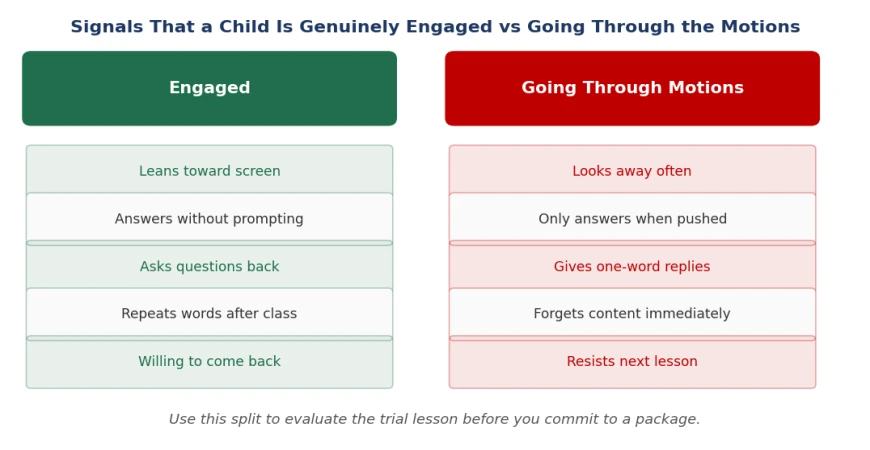
Genuine engagement vs passive participation: the observable difference
What Genuine Engagement Looks Like During an Online Lesson
The most reliable way to assess engagement is to watch the child, not the interface. A child who is genuinely engaged leans toward the screen, answers before being asked twice, uses words from the lesson spontaneously, and asks the teacher questions. A child who is passively present waits for prompts, gives minimal responses, and remembers little after the screen closes.
For younger children, physical signals matter too. Do they move, point, or reach toward the screen during picture activities? Do they repeat a word without being asked? Do they laugh at a joke the teacher made? These are not trivial. They indicate that the child is processing rather than watching.
Five Features That Sustain Engagement Across Multiple Weeks
• Consistent teacher. A child who sees the same teacher each week builds familiarity that lowers anxiety and raises participation. Rotating teachers require the child to warm up repeatedly.
• Short, repeatable sessions. For children under 10, 25-minute sessions three times a week sustain engagement better than 60-minute weekly classes that feel like an obligation.
• Curriculum that builds visibly. When a child can hear themselves using words they learned last week in this week’s lesson, they feel progress. That feeling drives continued participation.
• Activity variety within structure. A lesson with a predictable shape but varied activities keeps the child alert. Predictability reduces anxiety; variety prevents boredom.
• Teacher who responds to the child specifically. A teacher who references something the child said last session, remembers a name they mentioned, or adjusts based on what struggled last time creates a relationship, not just a transaction.
Where 51Talk Fits In
What 51Talk is
51Talk is a live one-on-one English platform for children. Sessions are 25 minutes, structured around CEFR levels, and built on a lesson cycle that includes pre-class warm-up, live interactive teaching, post-class review, teacher feedback, and unit assessments. More at 51talk.com.
Why the one-on-one format supports sustained engagement
In a group class, a child who loses focus can hide. In a one-on-one lesson, the teacher notices immediately and can redirect. That structural accountability is the most reliable driver of sustained engagement across many weeks. The child cannot disappear into the background.
Post-class review exercises also reinforce engagement between sessions: the child returns to lesson vocabulary the same evening, which makes the next class feel familiar rather than starting from scratch each time.
What to keep in mind
Engagement depends heavily on the specific teacher assigned. A 51Talk trial lesson gives you direct evidence of whether your child responds to that teacher’s style before you purchase a package. Watch your child during the trial, not the platform interface.
Before You Enrol: Questions to Ask Any Platform
• Can the same teacher be booked consistently? Rotating teachers is a known engagement killer for young learners.
• How does the platform handle a child who stops responding mid-lesson? A good teacher has specific strategies. Ask what they are.
• Is there a post-class activity that connects to the lesson? Same-day review while the lesson is fresh significantly improves retention.
• What is the cancellation and rescheduling policy? Irregular attendance is the fastest way to lose momentum and engagement.
• Can I observe a lesson before committing? Not a demo. A real lesson with your child.
Frequently Asked Questions
Does 51Talk help children stay engaged across multiple weeks of lessons?
51Talk’s one-on-one format, consistent teacher assignment, and structured lesson cycle are all designed to sustain engagement rather than spike it. Whether a specific child stays engaged depends on teacher fit, lesson frequency, and how much review happens at home. A trial lesson at 51talk.com is the most direct way to assess engagement before committing.
My child was excited for the first two weeks and then lost interest. What changed?
This is the most common pattern in online English learning. Early novelty drives engagement. What sustains it is a sense of measurable progress and a teacher the child genuinely likes. If either is missing, interest fades. Check whether the curriculum is showing visible progress and whether the teacher relationship has formed.
How do I tell if my child is engaged or just compliant?
Compliance means they sit through the lesson because they have to. Engagement means they would choose to. After the lesson, ask your child to show you something they learned. A compliant child changes the subject. An engaged child demonstrates.
Does lesson length affect engagement?
Significantly, especially for children under 10. A 25-minute focused lesson with full teacher attention typically produces more speaking output and better retention than a 50-minute lesson where the child’s concentration wanders in the second half.
Are games a reliable way to keep children engaged?
Games lower anxiety and create speaking opportunities without pressure. They work well as part of a lesson. They do not sustain engagement on their own without the correction and progress structure that live teaching provides.
What to Do Next
Take a trial lesson with the engagement checklist in mind. Watch your child, not the platform. Note whether they lean in or pull back, whether they answer before being prompted, and whether they mention anything from the lesson afterward. A single trial lesson observed carefully tells you more about real engagement than any platform comparison.