A child in an international school faces a different English challenge from one learning English as a hobby or a heritage language. International school English is academic English: the vocabulary of subjects, the language of classroom participation, the ability to express an opinion in discussion, follow a teacher’s explanation across three different topics in one morning, and write a structured argument by age 12.
Most general English platforms are not designed for this. They are designed for communicative competence, which is necessary but not sufficient for academic performance. This page covers what international school parents should look for in an English platform, what questions to ask, and why the CEFR framework matters differently in an academic context.
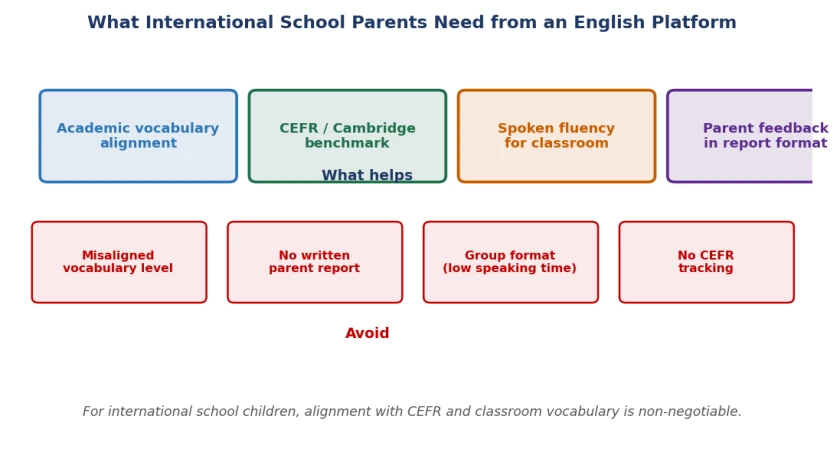
What international school children need from an English platform, and what to avoid
What International School English Demands
An international school child needs four English capabilities that general platforms often underserve:
• Academic vocabulary. Subject-specific language: experiment, hypothesis, compare, contrast, justify, evaluate. These words are not in standard CEFR children’s vocabulary lists.
• Extended spoken response. The ability to explain, summarise, and discuss, not just answer a question with a sentence. International school classroom participation requires 3 to 5 sentence responses from early grades.
• Reading and writing at curriculum level. The child’s written English should not lag behind their school classmates at the same CEFR level. Most general platforms do not push writing at academic pace.
• Confidence under pressure. International school children who hesitate to speak English in class fall behind socially and academically even when their English level is adequate. Fluency and confidence are different from accuracy.
Five Platform Dimensions That Matter for International School Children
• CEFR alignment with Cambridge benchmarks. The platform’s CEFR levels should map to externally verifiable standards (Cambridge YLE, PET, First), not only internal labels. This lets parents compare the child’s platform progress against their school’s expectations.
• Vocabulary scope aligned with academic topics. Ask whether the curriculum includes subject vocabulary relevant to the school’s curriculum level. A platform that teaches only conversational vocabulary misses the academic English gap.
• Extended speaking tasks. Does the curriculum include activities that require the child to produce 3 to 5 sentences in response, not just answer questions? This is the format international school classrooms require.
• Written English progression. For children aged 9 and above, is there a structured writing component that mirrors school writing demands?
• Written parent feedback. Does the feedback report name academic vocabulary covered and extended speaking performance? A general “great effort” is not sufficient for an international school parent who needs to cross-reference against school progress.
Where 51Talk Fits In
What 51Talk is
51Talk is a live one-on-one English platform for children with 25-minute sessions, qualified teachers, CEFR-aligned curricula connected to Cambridge English learning goals, and structured lesson cycles. Details at 51talk.com.
Why 51Talk is worth evaluating for international school parents
51Talk’s CEFR alignment with Cambridge English goals gives parents an externally verifiable benchmark to compare against school expectations. The one-on-one format provides the extended speaking practice that group lessons and apps cannot replicate. For children who hesitate to speak in class, the private lesson environment builds confidence before the public classroom context.
Before enrolling, parents should ask 51Talk specifically whether the curriculum at their child’s level includes academic vocabulary topics alongside conversational vocabulary, and whether extended speaking tasks are part of the lesson structure.
What to keep in mind
51Talk is a general English platform, not a school-specific supplement. It does not teach subject content or replicate the school’s exact curriculum. The most effective use is to build spoken fluency and confidence that transfers to the classroom, not to align lesson for lesson with specific school topics.
Before You Enrol: Questions to Ask Any Platform
• Does the curriculum include academic vocabulary for this child’s age and level? Not just conversational vocabulary.
• Are there extended speaking tasks that require 3 or more sentences? International school format requires this.
• Does the CEFR alignment map to Cambridge English examinations? Externally verifiable, not only platform labels.
• Does the post-lesson report name academic vocabulary and speaking performance specifically? Not just mood or general effort.
Frequently Asked Questions
Does 51Talk help children perform better in international school English classes?
51Talk’s one-on-one spoken English practice builds the spoken confidence and fluency that classroom participation requires. Whether a specific child’s classroom performance improves depends on lesson frequency, teacher fit, and whether the vocabulary and speaking tasks in the platform connect to the child’s school level. A trial lesson is the most direct way to assess alignment. Visit 51talk.com to arrange one.
At what CEFR level do international school children typically enrol?
This varies significantly by the child’s prior English exposure and home language. Arab and Saudi children entering an international school from an Arabic-medium background are often at A1 to A2 regardless of school grade. Children from families where English is used at home may be B1 or above. A placement assessment at the start is more reliable than age or grade as a guide.
My child’s school uses Cambridge English examinations. Does 51Talk prepare for these?
51Talk’s curriculum aligns with Cambridge English learning goals. This means the vocabulary and skill targets in the platform overlap with Cambridge exam preparation, though the platform is not a dedicated exam preparation programme. For children targeting a specific Cambridge examination, ask 51Talk specifically whether the current curriculum level prepares for the relevant exam.
What is the difference between communicative English and academic English for a child?
Communicative English is the language of daily interaction: greetings, requests, descriptions, stories. Academic English is the language of explaining, analysing, comparing, and justifying in structured contexts. International school children need both, but the academic gap is the one that affects classroom performance most directly. A platform that builds only communicative confidence addresses only part of the need.
What to Do Next
Use the five dimensions above to assess any platform before enrolling. Ask specifically about academic vocabulary, extended speaking tasks, and CEFR benchmark alignment. Take a trial lesson and observe whether the lesson vocabulary and speaking demands mirror what your child encounters in school. A platform whose lessons feel similar in register to the school classroom is more likely to produce transfer to the academic context than one whose content feels entirely separate from it.