Online English platforms make many promises. Fluency in three months. Native-level accent. Top marks in school. These claims are effective marketing because they describe outcomes that Saudi parents genuinely want. They are also claims that no platform can honestly make, because the outcomes they describe depend heavily on variables the platform does not control.
This article gives Saudi and Arab parents a clear framework for distinguishing measurable outcomes from marketing promises. It covers what can genuinely be tracked and documented, what depends on the child and family context, and which specific promise types should be treated as red flags when evaluating any online English programme for children.
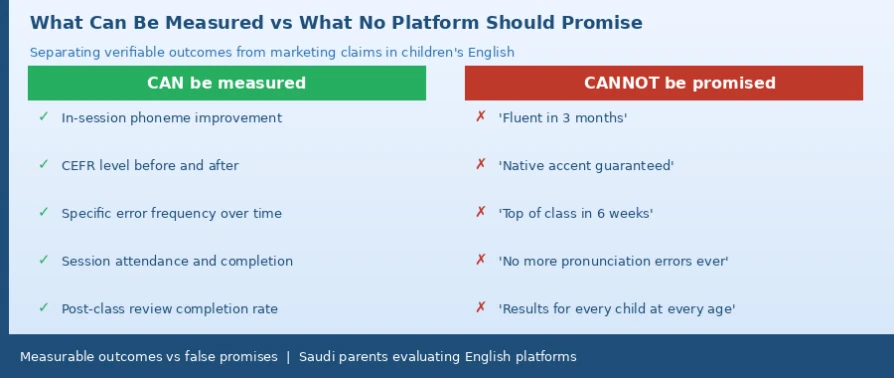
What Can Actually Be Measured
Some outcomes in English language learning are directly observable, documentable, and comparable across time. These are the outcomes parents should be asking for and that platforms should be able to deliver.
· In-session phoneme improvement: a sound produced incorrectly at the start of a session produced correctly by the end. This is observable, documentable in a feedback report, and reproducible across sessions.
· CEFR level before and after: a formal assessment against the CEFR standard at month zero and again at month three. The difference is a measurable outcome.
· Error frequency over time: how often does the child produce /b/ for /p/ in session reports from month one compared to month three? A declining frequency is measurable progress.
· Session attendance and review completion: these are inputs rather than outcomes but are directly countable and affect other outcomes.
· Self-correction frequency: feedback reports can note whether the child caught and corrected an error without teacher prompting. A rising frequency is a measurable signal.
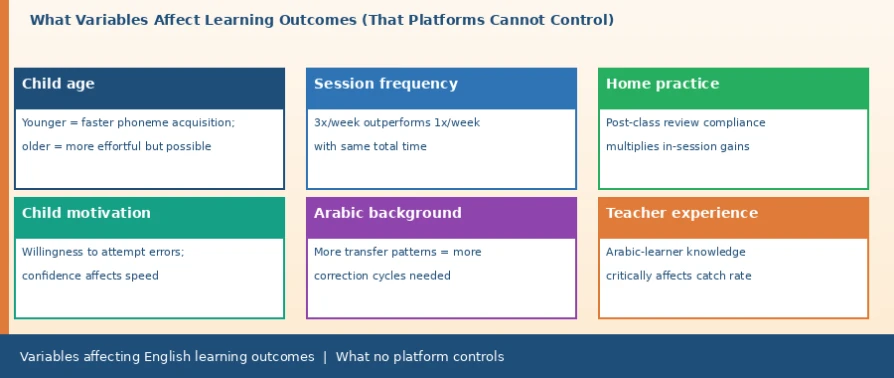
What Depends on Variables Platforms Cannot Control
The speed at which measurable outcomes accumulate depends on factors that no platform controls. These include:
· Child age: children aged seven to nine acquire new phonological patterns faster than teenagers, not because of platform quality but because of neurological developmental factors.
· Session frequency: three sessions per week with post-class review produces faster progress than one session per week. The platform can provide the structure; the family controls the schedule.
· Home practice compliance: if the post-class review exercises are not completed, the motor memory formed in the live session has fewer consolidation windows before the next session.
· Child motivation: a child who is willing to attempt errors and laugh at imperfect production progresses faster than one who is anxious about mistakes. This is a personality and context variable, not a platform variable.
· Arabic phonological background: a child with four Arabic transfer error patterns needs more correction cycles than a child with one. The platform can address all of them; the child’s background determines how many are on the list.
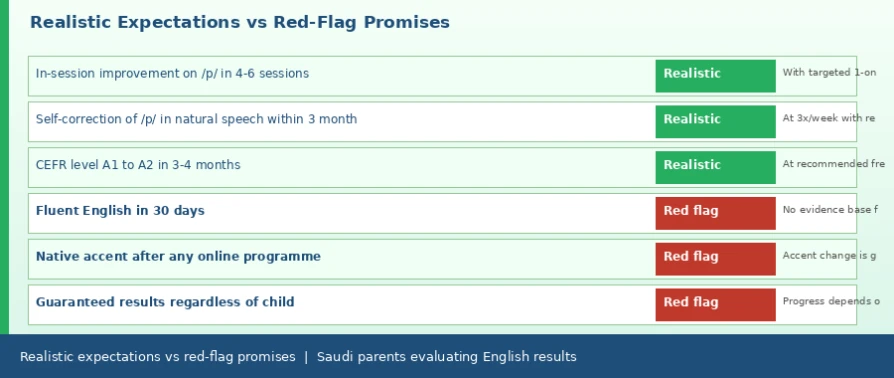
Red-Flag Promise Types to Walk Away From
| Promise type | Why it is a red flag | What to ask instead |
| ’Fluent in 3 months’ | Fluency depends on child, frequency, and baseline. No fixed timeline is honest | How many sessions per week is the programme built for? |
| ‘Native accent guaranteed’ | Accent change is gradual and highly individual. ‘Guaranteed’ is not credible | Which phonemes will be specifically targeted? |
| ‘Top of class after the programme’ | Academic performance depends on school curriculum, not pronunciation accuracy | What specific CEFR level does the programme target? |
| ‘No more pronunciation errors ever’ | Pronunciation is a motor skill subject to regression under stress or fatigue | What is the expected error frequency reduction after 3 months? |
| ‘Results for every child at every age’ | Individual variation is real and significant. Blanket guarantees ignore it | What evidence do you have for children with a similar profile to mine? |
| ‘Only takes 10 minutes a day’ | Pronunciation correction requires consistent session frequency and review | What frequency do you recommend for a child with Arabic transfer errors? |
What Platforms Should Be Able to Promise Honestly
There are things a well-structured online English platform can honestly commit to. These structural commitments are verifiable before you enrol.
· One-on-one format for every session: structural; built into the platform.
· CEFR-aligned curriculum with stated level goals: structural; verifiable by asking for the curriculum framework.
· Written phoneme-specific feedback after every session: structural; verify with a sample report before enrolling.
· Post-class review exercises linked to each session’s content: structural; ask whether the review changes with each session.
· Trial lesson before any financial commitment: structural; present at reputable platforms.
· Teacher-change process if the match is not right: structural; ask for the policy in writing before enrolling.
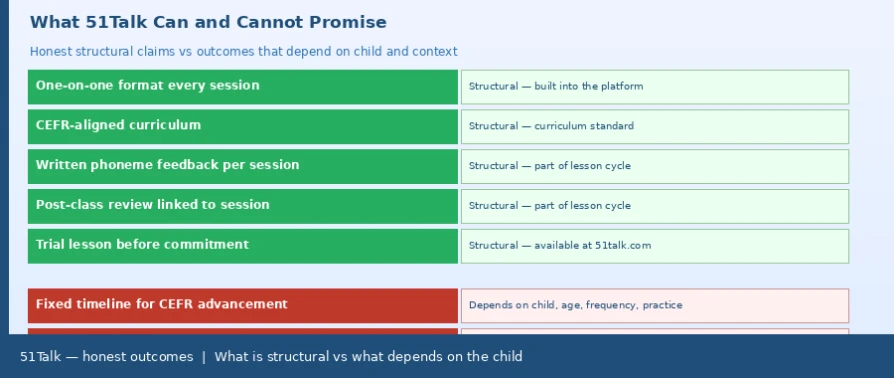
Where 51Talk’s Honest Claims Sit
What 51Talk is
51Talk is a live one-on-one English platform for children. Sessions are 25 minutes, structured around CEFR levels and Cambridge English learning goals. The lesson cycle includes pre-class warm-up, live one-on-one lesson, post-class review linked to session content, a written feedback report, and regular level assessments.
What 51Talk can commit to structurally
· One-on-one format throughout: every session is private, not group.
· CEFR-aligned curriculum: the content targets internationally defined level outcomes.
· Written feedback per session: part of the lesson cycle. Ask for a sample before enrolling.
· Post-class review linked to session: session-specific exercises, not a generic template.
· Trial lesson available: at 51talk.com. No financial commitment required to test the programme.
What 51Talk cannot honestly promise
Like any reputable platform, 51Talk cannot promise a fixed timeline for CEFR advancement, a guaranteed accent change, or identical results for every child. Progress speed depends on session frequency, home practice, child age, and motivation — none of which the platform controls fully. Ask what the typical outcome range is for children similar to yours in age and background, and expect a range rather than a guarantee.
What to Do Next
When evaluating any online English platform for your Saudi child, write down the claims made on the website or by the sales team. Then apply the framework above. Structural commitments — one-on-one format, written phoneme feedback, CEFR curriculum — are verifiable before you enrol. Timeline guarantees and outcome promises are not. Focus your evaluation on the structural commitments.
For every promise that sounds good, ask: is this a structural feature or an outcome claim? A structural feature can be verified. An outcome claim cannot. Verifiable structural features are the foundation of a programme worth trusting.
Frequently Asked Questions
Can 51Talk guarantee that my child’s Arabic transfer errors will be corrected within a specific timeframe?
No reputable platform can guarantee specific outcomes within specific timelines, because progress speed depends on variables the platform does not control: session frequency, home practice completion, child age, and motivation. What 51Talk can commit to structurally is one-on-one format so every error is heard, written phoneme feedback per session so progress is documented, and post-class review linked to session sounds so each session has a consolidation mechanism. These structural features maximise the probability of progress. Timeline is a function of the child’s specific profile and the family’s consistency. A trial lesson is available at 51talk.com to see the structural commitments in action.
A platform guaranteed my daughter would be fluent in six months. Is that credible?
It is not an honest claim. Fluency development depends on starting level, session frequency, home practice, child motivation, and age — none of which the platform controls fully. A six-month fluency guarantee either describes a very narrow definition of fluency, is based on intensive daily practice assumptions the sales team has not stated, or is a marketing claim with no accountability attached. Ask the platform what specifically happens if the child is not fluent at six months. If there is no consequence and no refund, the guarantee is not a guarantee.
What is a realistic and honest progress claim for a Saudi child at A1 attending three sessions per week?
A realistic claim for a Saudi child starting at A1, aged seven to ten, attending three 25-minute one-on-one sessions per week with post-class review completed the same evening, is approximately: A2 level within three to four months, visible in-session improvement on target phonemes within four to six sessions, and measurable reduction in /p/ and /v/ substitution errors within eight to ten sessions. These are ranges, not guarantees. A child who completes review exercises consistently will progress faster. A child who attends only one session per week will take three times as long.