Two of the most common reasons families stop using a children’s English platform mid-package have nothing to do with lesson quality. One is that the child never settled into the lessons. The other is that the family’s schedule changed: a new school term, a house move, an illness, a shift in a parent’s working hours. Both situations raise the same practical question — what does the platform actually allow you to do when things do not go to plan?
This article covers what to look for in a platform’s policy before purchasing, what to do if your child is struggling to adapt, and what questions to raise if your schedule can no longer fit the lessons you have already bought. It does not offer legal advice or policy interpretations for any specific jurisdiction.
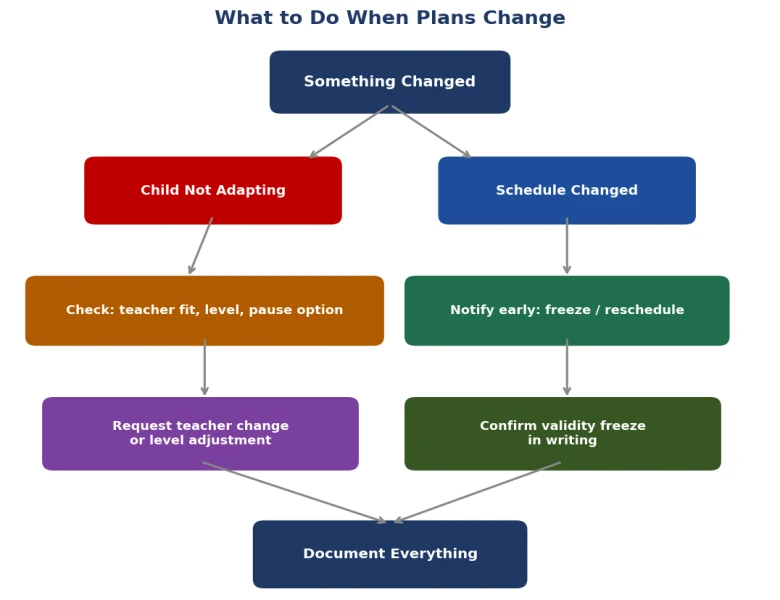
Decision flow: what to do when your child or schedule changes
The Two Scenarios and Why They Need Different Responses
Child adaptation issues and schedule changes are distinct situations, but they share a common policy mechanism: both may require rescheduling, pausing, or in some cases refunding a package that the family can no longer use as planned.
Child adaptation issues arise when a child refuses to attend, shows persistent distress before lessons, disengages visibly after several weeks, or asks to stop. This may be a temporary settling-in issue that resolves with a teacher change or level adjustment. Or it may signal that the format is not right for the child’s current developmental stage and temperament. Distinguishing between the two matters before drawing any conclusions.
Schedule changes arise when the original lesson time no longer works: school term starts, travel, illness, or a parent’s work hours shift in a way that makes the booked slots unreachable. The lessons themselves may be fine. The family simply cannot attend them as planned.
Both scenarios require the same policy knowledge: whether lessons can be rescheduled, whether packages can be paused or frozen, and under what conditions unused lessons can be refunded.
Seven Policy Questions to Verify Before Purchasing Any Package
| Policy Area | What to Ask the Platform |
| Rescheduling | Can individual lessons be moved to different times? How much notice is required, and is there a monthly limit on reschedules? |
| Package freeze | Can the whole package be paused if the family cannot attend for several weeks? What is the maximum freeze duration? |
| Teacher change | If the child has not settled with one teacher, can a different one be requested without losing paid lessons? |
| Level adjustment | If lessons are too hard or too easy, can the curriculum level be changed within the existing package? |
| Lesson validity | When do lessons expire? Does a freeze or pause extend the expiry date, or does the clock run regardless? |
| Refund for unused lessons | Under what specific conditions can unused lessons be refunded, and how is the amount calculated? |
| Documentation | Does the platform require proof of illness, travel, or school circumstances to approve schedule adjustments? |
If Your Child Is Not Adapting: What to Do Step by Step
A child who resists the first few lessons is not necessarily in the wrong programme. Some settling-in discomfort is normal for children starting any new structured activity, particularly one that involves speaking in a second language to a stranger on a screen. The relevant question is whether the resistance is decreasing over time or increasing.
If the child is still visibly reluctant or distressed after four to six sessions, treat that as a signal to investigate the cause before deciding whether to continue or exit the programme.
• First, distinguish between shyness and genuine aversion. A shy child who smiles during lessons but prefers not to speak aloud is different from a child who cries before every session or refuses to sit at the screen.
• Contact the platform and describe the specific behaviour, not just a general concern. ‘My child won’t speak’ and ‘my child cries before every lesson’ are different problems that require different responses.
• Ask whether a teacher change is possible. A personality mismatch between child and teacher is more common than curriculum mismatch in young learners, and a different teacher’s pace and tone can make a significant difference within two or three sessions.
• Ask whether the curriculum level can be reviewed. A bored child may be under-challenged. A frustrated child may be over-challenged. Both look like resistance from the outside.
• Ask whether a short pause is available while you assess the situation, without losing lessons already purchased.
• Keep written records of all communications about adaptation issues. If a refund request becomes necessary later, those records are important.
If Your Family Schedule Changes: What to Do
Schedule changes are more common than adaptation issues, and most platforms can accommodate them if the parent acts early. Late action is the most common cause of avoidable lesson loss.
• Notify the platform as soon as you know the schedule will change. Most rescheduling policies require advance notice, and a late notice may result in lesson forfeiture rather than a credit.
• Ask whether a lesson freeze or package pause is available for the period in question, and what the maximum freeze duration is.
• If illness or travel is involved, ask whether the platform has an emergency rescheduling provision and what documentation, if any, is required.
• Check the lesson validity period carefully. A large package with a 6-month validity window can expire before all lessons are used if the family takes two or three separate breaks without pausing the clock.
• If the schedule change is permanent rather than temporary, ask what options exist for lessons that cannot be used within the original validity window.
How 51Talk’s Model Supports Schedule Flexibility
What 51Talk Is
51Talk is a structured one-on-one English platform for children offering 25-minute lessons with trained teachers and CEFR-aligned materials. Because lessons are one-on-one rather than group-based, they are not tied to a fixed cohort timetable, which has direct implications for rescheduling flexibility.
Why One-on-One Format Matters for Schedule Changes
In a group lesson model, rescheduling is inherently constrained by the cohort. In a one-on-one model, moving a lesson is primarily a matter of matching teacher availability to a new time slot. This means rescheduling requests on 51Talk can in principle be accommodated with more flexibility than on group-based platforms, subject to the platform’s current notice requirements and the teacher’s available slots.
For adaptation issues, the one-on-one format also means that a teacher change is a direct fix: a new teacher is assigned to the same curriculum materials, and the child’s progress within the package is not reset. A child does not need to go back to the beginning of the curriculum because the teacher changed.
What Parents Should Verify Directly with 51Talk Before Purchasing
Before buying any package, confirm the current rescheduling notice period, the lesson validity period, the maximum freeze duration and frequency, and the refund conditions for unused lessons. Ask for written confirmation. Policies are updated over time, and written answers at the point of purchase are the most reliable reference you have if a dispute arises later.
Frequently Asked Questions
Does 51Talk allow parents to change teachers if a child is not adapting?
51Talk’s one-on-one model allows for teacher changes. The process and any applicable conditions should be confirmed directly with 51Talk’s customer support before purchasing a package. Knowing the process in advance means a teacher change, if needed, can be handled quickly and without stress.
What happens to unused lessons if the family needs to take a long break?
This depends entirely on the platform’s lesson validity period and whether a freeze or pause policy exists. Unused lessons that expire during a break are typically not refunded by default. This is one of the seven pre-purchase questions above — verify it before buying, not after a break leaves you with expired lessons.
How long is it normal for a child to take to settle into online English lessons?
For children under 7, four to six sessions is a reasonable settling-in window for most. Some children settle in one or two; others take a little longer. Persistent reluctance after six sessions is usually a signal to investigate teacher fit, level difficulty, or lesson timing — not to push through and hope things improve on their own.
What documentation do most platforms require for emergency rescheduling?
This varies by platform. Some accept a parent’s written statement; others require documentation such as a medical certificate, travel booking confirmation, or school schedule. Ask the specific platform before assuming your circumstances qualify. It is better to have the documentation prepared than to discover the requirement after the lessons have already lapsed.
Can adaptation difficulties be used as grounds for a refund?
Whether adaptation difficulties qualify for a refund depends on the platform’s specific terms. Most platforms distinguish between choosing not to continue and being unable to continue for reasons outside the parent’s control. Review the refund policy carefully before purchasing, and if you are uncertain about a specific scenario, ask the platform’s support team directly and save the response.
What to Do Next
Before buying any lesson package, ask the seven policy questions in the table above and request written answers. Save the responses alongside the platform’s current published terms. If your child has not adapted after several lessons, work through the step-by-step process above before concluding that the platform has failed. And if your schedule changes, act early — most rescheduling and freeze options are only available with timely notification.