“Certified teacher.” It is on almost every teacher profile in online English education. It sounds reassuring. But without knowing which certificate, issued by whom, assessed how, and relevant to what, the word certified means very little in practice.
A 40-hour self-paced online course from an unaccredited provider can produce a TEFL certificate. A 130-hour programme with observed live teaching and external assessment from Cambridge can also produce a TEFL-equivalent credential. Both teachers are certified. The preparation is very different.
This page gives parents seven specific questions to ask when a teacher’s profile says “certified,” and explains what each question reveals. It covers online English teachers for children specifically, not adult or academic language programmes.
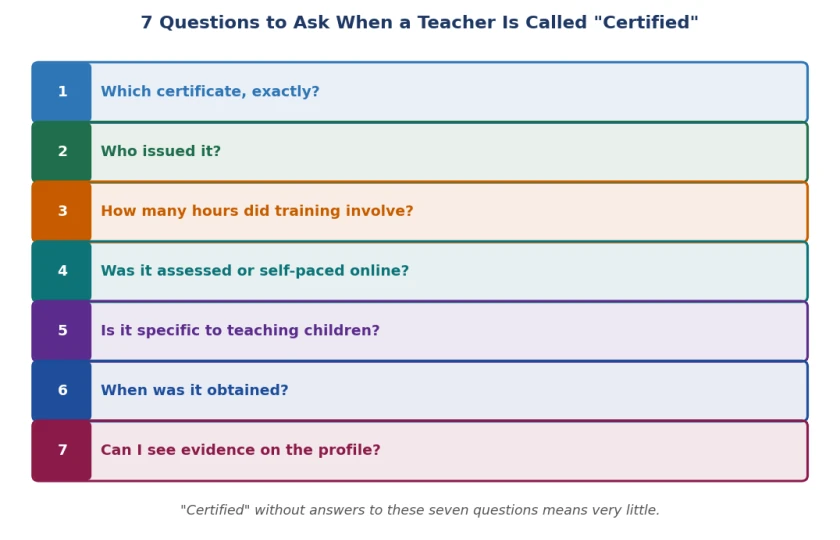
Seven questions that turn “certified teacher” into a verifiable standard
Why “Certified” Has Become a Low-Signal Word
The word certified once signified a specific, verifiable standard. In online English education, it has become a default descriptor used by platforms regardless of the actual qualification held. This happens partly because parents associate certification with quality, and partly because there is no single governing body for English teaching qualifications internationally.
The result is a market where “TEFL certified” can describe anything from a short online course to a rigorous university programme, and parents have no way of telling the difference from the word alone.
Seven Questions That Make “Certified” Verifiable
• Which certificate, exactly? CELTA, TEFL, TESOL, DELTA, or something else? Ask for the full name, not the abbreviation. If the teacher says “an English teaching certificate,” that is not an answer.
• Who issued it? Cambridge for CELTA and DELTA. A named university or accredited provider for TEFL and TESOL. If neither the teacher nor the platform can name the issuing body, the certificate has not been meaningfully verified.
• How many hours did the training involve? 40 hours and 200 hours are not equivalent. Anything under 100 hours is unlikely to have included meaningful assessed teaching practice.
• Was the programme assessed or self-paced? A self-paced online course produces a certificate on completion of tasks. An assessed programme includes external evaluation of actual teaching. The second is more meaningful for predicting teaching quality.
• Is the certificate specific to teaching children? CELTA is designed for adult learners. TEFL and TESOL programmes vary. Ask whether the teacher holds any supplementary qualification or training specifically in young learner methodology.
• When was the certificate obtained? A certificate from 15 years ago combined with no ongoing professional development is a different picture from a recent qualification with current practice. Ask when and whether any training has been updated since.
• Can you see evidence on the teacher’s profile? Does the platform display the certificate name and issuing body, or only the word “certified”? Can you see a credential date? For CELTA, Cambridge offers a certificate verification service.
What These Questions Reveal
A teacher who can answer all seven questions clearly and specifically is a teacher whose qualification is real and whose platform has verified it. A teacher or platform that answers with generalities, evasions, or resistance to the questions is not meeting the transparency standard that should be expected before a parent commits their child to a programme.
Most parents never ask any of these questions. Most platforms therefore never need to have clear answers ready. Asking them is not aggressive. It is due diligence for a service you are paying for on behalf of your child.
Where 51Talk Fits In
What 51Talk is
51Talk is a live one-on-one English platform for children with 25-minute structured lessons, CEFR-aligned curricula, trained teachers, and post-lesson feedback reports. Teacher profiles and platform details at 51talk.com.
How to apply these seven questions to 51Talk
51Talk works with teachers who complete platform training and evaluation before being assigned to students. Parents can view teacher profiles on the platform. Before booking, use the seven questions above with the support team: ask what specific qualification is required, whether it is named on profiles, who verified it, and what child-specific teaching experience is expected.
What to keep in mind
The answers you receive should be specific and documentable, not reassurances. Save any written responses alongside your purchase confirmation. If a question cannot be answered clearly, ask why before proceeding.
Before You Enrol: Questions to Ask Any Platform
• What is the minimum qualification required, and is it named on every profile? Required means every teacher.
• Who specifically issued the certificate? Platform-verified or self-reported?
• How many hours did the qualification involve? Under 100 hours is typically a short course.
• Was there assessed, observed teaching in the programme? This is the strongest predictor.
• Does the teacher have child-specific training or experience? Beyond general EFL.
Frequently Asked Questions
How do I know whether a 51Talk teacher’s certification is genuine and meaningful?
Use the seven questions above when reviewing teacher profiles or contacting 51Talk’s support team. Ask specifically which certificate is required, who issued it, and how it was verified by the platform. For teachers holding CELTA, Cambridge offers an independent certificate verification service. Visit 51talk.com to view profiles and access support.
Is a “native English speaker” certification the same as an English teaching qualification?
No. Native speaker status is not a qualification. It describes the teacher’s first language. An English teaching qualification describes their preparation to teach the language to others. The two are independent. A native speaker without a teaching qualification is not certified. A non-native speaker with a rigorous CELTA and five years of child teaching experience is more meaningfully prepared.
Should I prioritise a teacher with CELTA over one with TEFL?
CELTA is more consistently rigorous because it is always issued by Cambridge and always requires assessed teaching. However, a TEFL qualification from a serious programme with 200 hours and observed teaching may be more relevant if it includes child-specific methodology components that CELTA does not. Ask both questions: how rigorous was the programme, and does it include child-focused teaching?
What should I do if a teacher’s profile cannot tell me which certificate they hold?
Contact the platform’s support team and ask directly. If neither the profile nor the support team can name the specific certificate and issuing body, the qualification has not been meaningfully verified. That is important information for your decision.
Does the number of stars or reviews on a teacher profile substitute for qualification verification?
Reviews reflect parent satisfaction, which correlates with teaching quality but is not the same thing. A teacher can be warm, punctual, and enjoyable while correcting poorly. A teacher can also be technically excellent and less personable. Both dimensions matter. Qualifications and reviews together are more informative than either alone.
What to Do Next
Before booking any English lesson for your child, ask the seven questions above for the specific teacher you are considering. If the platform’s profile page does not answer them, ask the support team directly. Save the responses. Then take a trial lesson and observe whether the teacher’s actual correction behaviour reflects the qualification they hold. A well-trained teacher names errors specifically, models the correct form, and gives the child a structured opportunity to repeat. That behaviour is the practical evidence of meaningful certification.