Your child’s school reports say they are working at B1 in English. An English platform advertises CEFR-aligned lessons. A Cambridge exam preparation centre offers B2 preparation courses. All three are using CEFR, but none of them explain what it actually means in plain terms for a parent trying to make a decision.
This page explains what CEFR levels mean in practice for children in international schools, how they connect to Cambridge English examinations, and what questions to ask when a platform claims to be CEFR-aligned. It does not cover adult language learning or academic IELTS preparation.
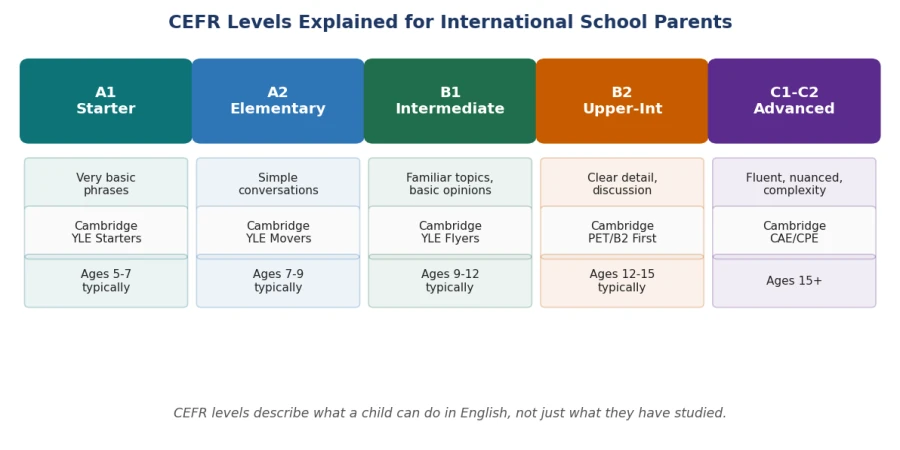
CEFR levels, what children can do at each level, and the corresponding Cambridge examinations
CEFR in Plain Language
CEFR stands for Common European Framework of Reference for Languages. It describes language ability on a six-level scale from A1 (complete beginner) to C2 (mastery). Each level describes what a person can do in the language, not what they have studied. A child at A2 can hold a simple conversation about familiar topics, not just recite vocabulary lists.
For international school children, CEFR provides a common reference that allows parents to compare the child’s school assessment against their performance on an external platform and against Cambridge English examination results. This cross-referencing is only possible because all three systems use the same scale.
What Each Level Means for a School-Age Child
| CEFR Level | What the child can do | Typical school grade | Cambridge exam |
| Pre-A1 | Name objects, colours, numbers, family | Preschool to Year 1 | Cambridge Starters |
| A1 | Simple phrases about school, food, daily life | Year 1 to Year 3 | Cambridge Movers |
| A2 | Short conversations, describe experiences | Year 3 to Year 5 | Cambridge Flyers |
| B1 | Express opinions, follow most class discussion | Year 5 to Year 8 | Cambridge PET/B1 |
| B2 | Discuss complex topics, write structured essays | Year 8 to Year 11 | Cambridge First/B2 |
| C1+ | Near-native classroom performance | Year 11 and above | Cambridge Advanced |
The age ranges above are approximate. A child’s CEFR level depends on their prior English exposure and the quality of instruction they have received, not on their age. Arab children entering an international school from an Arabic-medium background are often A1 or A2 regardless of grade level.
What “CEFR-Aligned” Actually Means on a Platform
When a platform says its lessons are “CEFR-aligned,” this can mean different things. At minimum, it means the curriculum has been mapped to CEFR level descriptors. At best, it means the vocabulary targets, skill activities, and assessment checkpoints are specifically benchmarked against published CEFR standards or Cambridge English examination syllabuses.
Parents should ask specifically: which CEFR levels does the curriculum cover for this child’s age, does the curriculum connect to Cambridge English examination standards, and how is level advancement determined and recorded?
Where 51Talk Fits In
What 51Talk is
51Talk is a live one-on-one English platform for children with 25-minute lessons, CEFR-aligned curricula connected to Cambridge English learning goals, and unit assessments that track level progress. Details at 51talk.com.
Why CEFR alignment matters for international school families using 51Talk
51Talk’s alignment with Cambridge English learning goals means that the vocabulary and skill targets in the lessons correspond to the same scale your child’s international school uses for its English assessments. This allows a parent to cross-reference the platform’s level assessment against the school’s own report, and to use the unit assessment results to track progress toward the next CEFR level.
For Arab children in international schools who are working on closing a gap between their home language background and their school’s English expectations, this benchmarking function is particularly useful. The platform gives a structured measurement of where the child is relative to the school’s demand.
What to keep in mind
CEFR alignment does not guarantee that the curriculum covers the academic vocabulary and extended speaking formats that international school classes specifically require. Ask 51Talk specifically whether the curriculum at your child’s level includes academic vocabulary topics and extended speaking tasks alongside standard communicative English.
Before You Enrol: Questions to Ask Any Platform
• Does the curriculum connect to Cambridge English examination levels? This is the most verifiable form of CEFR alignment.
• How is the child’s CEFR level assessed before starting? Placement should be based on performance, not age.
• How often are level assessments conducted? A static placement that never changes is a known platform problem.
• Does the curriculum for this level include academic vocabulary? International school children need subject language, not only conversational vocabulary.
Frequently Asked Questions
Does 51Talk’s CEFR alignment help international school parents track their child’s progress against school expectations?
Yes. 51Talk’s alignment with Cambridge English learning goals means that level assessments on the platform correspond to the same CEFR scale your child’s school uses. This allows parents to compare the platform’s assessment against the school’s report. Visit 51talk.com for details on the curriculum structure and assessment system.
My child is in Year 4 at an international school and assessed at A2. Is that typical?
For a child with limited prior English exposure, A2 at Year 4 is common and correctable. For a child who has attended English-medium schooling since Year 1, A2 at Year 4 may indicate a gap worth addressing. The important question is whether the child is progressing from A2 to B1 within a reasonable timeframe, not whether the current level is at grade expectation.
What is the difference between a CEFR level label and genuine level performance?
A label describes what the curriculum covered. Performance describes what the child can actually produce. A child can complete an A2 curriculum without being able to perform at A2 in a live conversation. Cambridge examinations independently assess performance, which is why external examination results are more informative than curriculum completion records.
Can a child improve by two CEFR levels in one school year?
Moving from A1 to A2 in one year is achievable with consistent one-on-one instruction at three sessions per week. Moving from A2 to B1 in one year is possible for a motivated child with high lesson frequency and strong home practice support. Moving across two full levels in one year is ambitious and depends heavily on starting age and language background.
What to Do Next
Ask your child’s international school for their current CEFR level assessment and what level is expected by the end of the school year. Use that gap as the basis for choosing a platform’s entry level and lesson frequency. A platform that conducts a placement assessment and connects its curriculum to Cambridge English levels gives you the clearest path for tracking whether the gap is closing.