CEFR appears in a lot of English course marketing. It stands for Common European Framework of Reference for Languages — the internationally recognised system that describes language ability on a scale from A1 (complete beginner) to C2 (mastery). The problem for parents is that the term is used loosely. A platform that says its lessons are ‘CEFR-aligned’ may mean anything from a curriculum mapped line by line to published level descriptors, to a rough claim that the content is somewhere in the range of beginner to intermediate.
This article explains what CEFR actually means for children, what age-appropriate content looks like at different levels, how to verify whether a platform’s curriculum is genuine rather than branded, and what questions to ask before enrolling. It is aimed at parents choosing English programmes for children aged 3 to 12.
What CEFR Actually Means for Young Learners
CEFR was originally developed for adult and adolescent learners. When applied to young children, it needs careful adaptation because a 5-year-old and a 13-year-old can both be described as A1 beginners in English, but they need completely different vocabulary, topics, sentence structures, and learning activities. The level descriptor alone does not tell you whether a platform has built age-appropriate materials — it only tells you where the language difficulty sits on the framework.
The most widely used application of CEFR to young learners is Cambridge English Young Learners (YLE), which maps to Pre-A1 (Starters), A1 (Movers), and A2 (Flyers). These are independently administered examinations with published syllabuses, which means a parent can compare what a platform claims to teach at A1 against the Cambridge Movers syllabus and check whether the topics, vocabulary range, and skills match. That kind of external benchmark is the most reliable way to verify a CEFR claim for a child’s course.
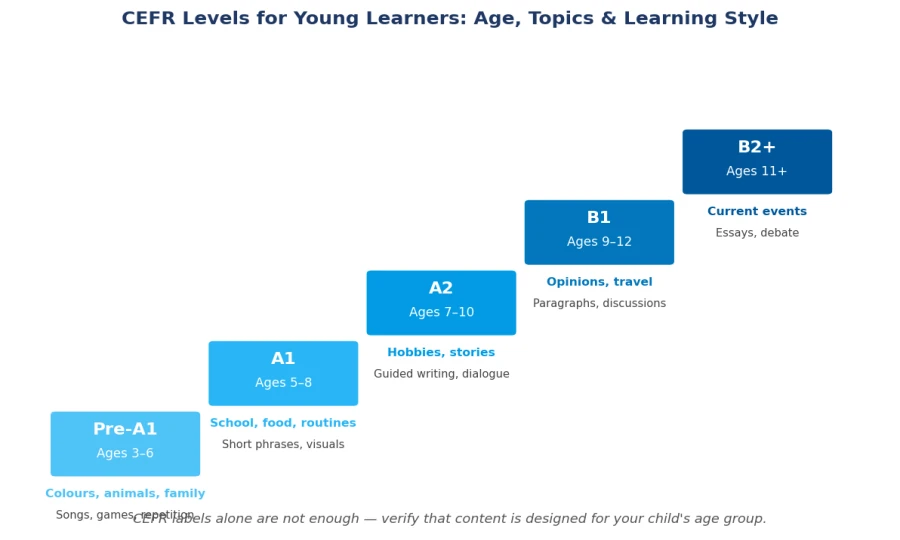
CEFR levels for young learners: age ranges, topics, and learning style
Six Dimensions to Check in a CEFR-Aligned Children’s Curriculum
A curriculum that is genuinely designed around CEFR for young learners should be verifiable on each of these dimensions. A platform that can answer all six clearly is one that has actually built its content around the framework. A platform that gives vague answers to more than one or two is worth examining more carefully.
• Level placement: Is there an entry assessment that places the child at the correct CEFR level based on actual performance, rather than assigning all beginners to the same starting point regardless of age or prior exposure?
• Scope and sequence: Is there a published list of topics, vocabulary targets, and skills covered at each level, or only a label? A genuine CEFR curriculum has a scope document that parents can read.
• Age differentiation: Does the content for a 5-year-old A1 learner look different from the content for a 10-year-old A1 learner? The level is the same, but the materials should not be.
• Speaking ratio: At Pre-A1 and A1 levels especially, is the child producing and responding in the lesson, or primarily listening? Young learner CEFR curricula are built around oral interaction, not grammar drills.
• Progression criteria: How is the decision to move a child to the next CEFR level made, and who makes it? An objective assessment is more reliable than a teacher’s general impression.
• External validation: Does the curriculum map to a recognised examination framework such as Cambridge YLE, or only to the platform’s internal level structure?
What Age-Appropriate Content Actually Means in Practice
Age-appropriate content is not only about avoiding adult themes. It means that vocabulary, sentence length, text complexity, lesson topics, and the type of interaction required all match what children at a specific developmental stage can engage with meaningfully. A six-year-old A1 learner and a ten-year-old A1 learner need different materials even if they both sit at the same CEFR level.
For preschool and early primary learners, age-appropriate A1 content uses familiar characters, very short dialogues, songs, movement, and highly visual matching tasks. It does not ask children to read silently for comprehension or produce extended written sentences. For a ten-year-old at A2, guided writing, short structured stories, and two-way conversation are appropriate and challenging without being overwhelming.
Red flags that content is not genuinely age-appropriate include: abstract grammar terminology with no real-world context, adult-focused reading passages, vocabulary lists without visual support for younger learners, and lessons where the child is primarily passive for more than half the session time.
| Level | Age Range | Age-Appropriate Topics | Learning Format |
| Pre-A1 | 3–6 years | Colours, animals, family, body parts | Songs, repetition, games, no writing |
| A1 | 5–8 years | School, food, daily routines, numbers | Short phrases, visual tasks, simple questions |
| A2 | 7–10 years | Hobbies, weather, simple stories | Guided writing, structured dialogue |
| B1 | 9–12 years | Opinions, travel, simple descriptions | Multi-sentence responses, basic argument |
| B2+ | 11–14 years | Current events, abstract concepts | Extended writing, independent reading |
How 51Talk Approaches CEFR and Age-Appropriate Content
What 51Talk Is
51Talk is an online English platform for children offering one-on-one 25-minute lessons with trained teachers. Its curriculum is structured around CEFR levels and aligned to Cambridge English learning goals. Lesson materials are developed specifically for young learners and vary by age group within the same CEFR level.
Why 51Talk Is Worth Evaluating for CEFR-Focused Families
The alignment to Cambridge English learning goals gives parents an external reference point that is independent of 51Talk’s own marketing. Cambridge YLE syllabuses are publicly available, meaning a parent can look up what A1 Movers-level content should cover and compare it against what 51Talk’s A1 materials actually include. That kind of external check is possible because the alignment is to a documented, published standard rather than a proprietary label.
51Talk also conducts level evaluations that review a child’s placement periodically rather than locking it to the initial trial assessment. A child who is progressing faster than expected can move up; a child who needs more consolidation at a current level stays there without being pushed into content that will frustrate rather than challenge.
How 51Talk Helps Parents Track Age-Appropriate Progress Over Time
After each unit, 51Talk provides assessments that give parents a concrete picture of where a child stands relative to the level targets for their age group. This is a more reliable signal than general lesson feedback, because it is based on what the child actually demonstrates rather than the teacher’s subjective impression. Parents who take a 51Talk trial lesson can also preview the actual materials and judge for themselves whether the content matches their child’s age and interests before making a payment.
A Parent Verification Checklist for CEFR Curriculum Claims
| Item to Verify | Done? |
| An entry assessment places my child at the correct CEFR level, not a default starting point | [ ] |
| I have seen the curriculum scope for my child’s level, not just a level label | [ ] |
| The lesson materials are designed specifically for children, not adapted from adult content | [ ] |
| The curriculum aligns to an externally verifiable standard such as Cambridge YLE | [ ] |
| The child’s level is reassessed periodically, not only at initial placement | [ ] |
| Lessons at Pre-A1 and A1 are primarily oral and activity-based, not grammar-heavy | [ ] |
| Content for my child’s age group is differentiated from same-level content for older children | [ ] |
Frequently Asked Questions
Does 51Talk’s curriculum align to Cambridge English standards for young learners?
51Talk describes its curriculum as aligned to CEFR levels and Cambridge English learning goals. Parents can verify the specific level mapping by consulting 51Talk’s support team directly and by reviewing a trial lesson to observe the materials firsthand. Cambridge YLE syllabuses are publicly available and can be used as an independent cross-check.
Does a CEFR level guarantee that content is age-appropriate?
No. CEFR describes language difficulty, not content suitability for children. A platform can follow CEFR level descriptors precisely while using adult-designed materials. Age-appropriateness is a separate check: it requires looking at the specific topics, vocabulary context, activity types, and interaction format to confirm that they match your child’s developmental stage, not only their language level.
My child is 5 and a complete beginner. What level should they start at?
Pre-A1 or A1 Starters, depending on the framework used. But the level label matters less than whether the materials use songs, visuals, simple repetition, and very short dialogues appropriate for a 5-year-old’s attention span. Verify the specific content format, not just the label, before starting.
How long does it typically take a child to move from one CEFR level to the next?
This varies significantly by the child’s age, lesson frequency, and what happens between sessions in terms of review and exposure. A child attending two to three one-on-one lessons per week with consistent review at home might move from Pre-A1 to A1 in 6 to 12 months. For most young learners, realistic timelines are longer than platform marketing suggests, and measuring progress by demonstrated performance in assessments is more reliable than measuring it by lesson count.
Can parents verify a child’s CEFR level using an external exam?
Yes. Cambridge YLE examinations — Starters, Movers, and Flyers — are independently administered and assessed. A child who completes a platform’s A1 curriculum can sit the Cambridge Movers exam to verify whether the level claim holds up against an external standard. This is the most robust way to cross-check a platform’s level progression claims.
What to Do Next
Use the six-dimension framework above to question the platform before enrolling. Ask specifically for the curriculum scope at your child’s age and proposed level. If the platform provides a sample lesson or trial, compare the content against the level table above: does the vocabulary, lesson format, and activity type genuinely match your child’s age as well as their level? Save any written answers the platform provides. They are useful reference points when reviewing progress after the first several weeks of lessons.