You booked the trip. You have the grammar book. You downloaded an app. And still, when you imagine yourself in a Roman trattoria trying to order something other than “the usual,” the words simply do not come.
That gap — between knowing Italian and being able to use it — is where most learners get stuck. It is not a failure of effort. It is a failure of method. Grammar drills and vocabulary lists train you to recognize language; they rarely train you to produce it under pressure, at conversation speed, with a real person on the other end.
This guide covers a different approach: one built around real-life situations, daily exchange with native speakers, and the kind of gradual exposure that turns vocabulary into instinct.
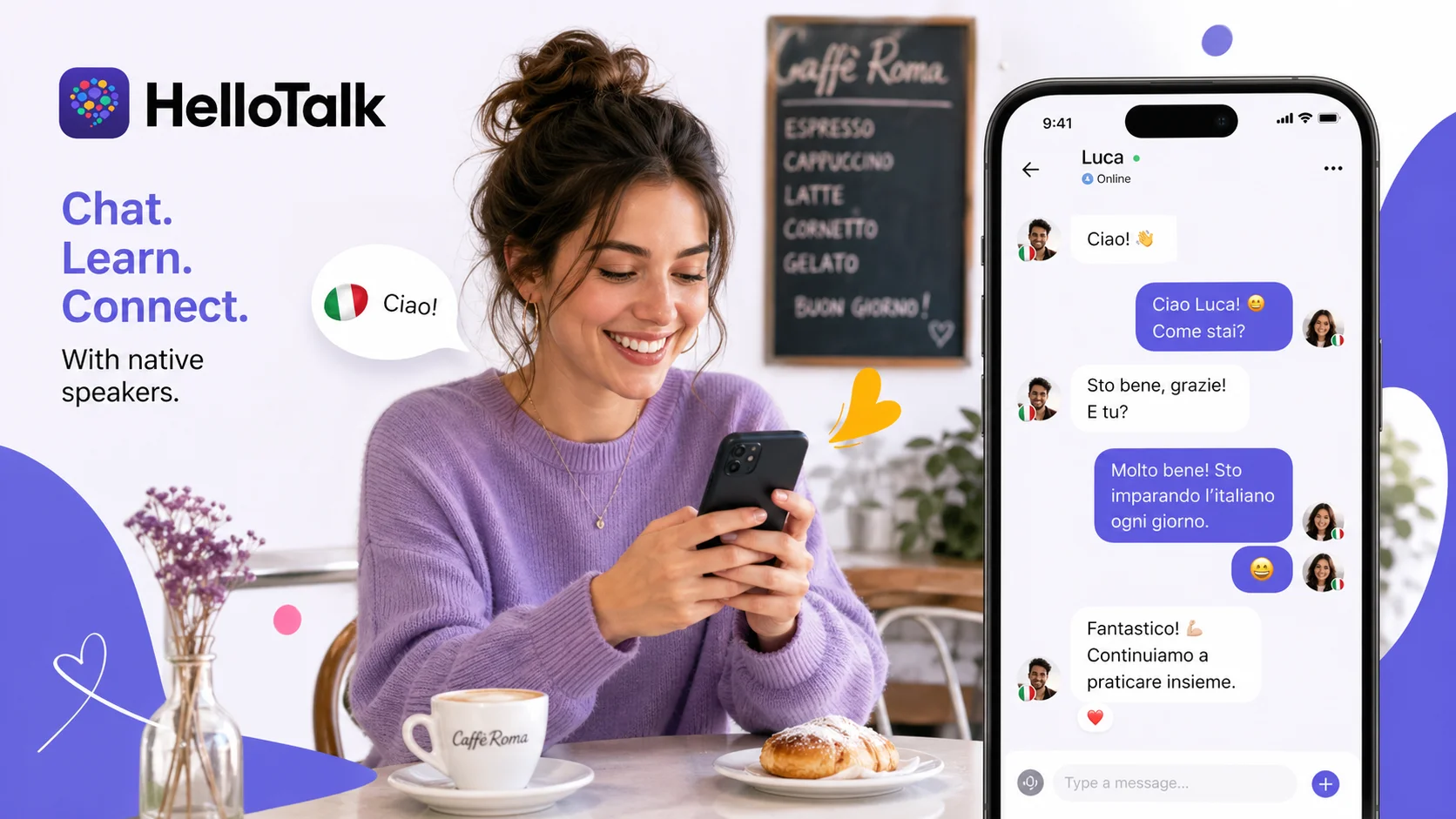
Why traditional Italian study tends to plateau
The pattern is familiar. A learner spends weeks on travel vocabulary, then walks into a restaurant in Milan and cannot parse the waiter’s rapid-fire specials. They study business email conventions, then receive a casual Slack-style message from an Italian colleague and find half the expressions unrecognizable. They grind listening exercises, then watch a Serie A post-match interview and give up after thirty seconds.
The problem is structural. Standard resources — textbooks, grammar apps, classroom instruction — are built around controlled, formal input. Real Italian, the kind spoken over coffee or typed out between friends, follows different rhythms and borrows freely from register, slang, and context. No amount of drill-based study closes that gap on its own.
A second issue: solo study has no feedback loop. You can write a sentence with a subtle error every day for a year and never know it. Without a native speaker flagging the awkwardness, the mistake becomes a habit.
The practical alternative: anchor language learning to real situations
Efficient language acquisition happens when input is tied to scenes you will actually encounter. Ordering at a bar in Naples sounds different from presenting a sample to a buyer in Milan, which sounds different from chatting about the weekend’s match. Each context has its own vocabulary, register, and rhythm.
The most reliable way to acquire these differences is through repeated, low-stakes interaction with people who navigate them naturally. This does not require moving to Italy. It requires consistent access to native speakers and the willingness to make mistakes in front of them — which is, for many learners, the harder part.
A few practical scenarios worth targeting early:
- Travel: airport and hotel check-in, restaurant ordering, street navigation, ticket booths, and market bargaining
- Work: formal business email tone, meeting greetings, negotiation phrases common in Italy’s fashion, furniture, and food export sectors
- Exams: oral interview simulations, situational Q&A, listening comprehension at normal speaking pace
- Daily life and interests: football discussion, food culture, art and cinema, regional expressions from different Italian cities
Mapping your study to the situations you care about most keeps motivation alive and ensures the language you learn is immediately applicable.
Building listening and speaking through scenario-based practice
Finding the right conversation partners
One of the more underrated aspects of language exchange is specificity. A conversation partner who happens to be Italian is useful; a partner who is a Florentine student interested in design, or a Milanese professional in logistics, is far more useful if those are the contexts you need.
Apps like HelloTalk let you filter by location, profession, and interest, which means you can match with people whose everyday Italian actually maps to your goals. A learner preparing for a cross-border trade role can connect with Italian professionals; someone planning a Tuscany road trip can find locals from the smaller towns they plan to visit.
The exchange format is low-pressure: you help your partner with your language, they help you with Italian. Daily chats about ordinary life — local food habits, public holidays, city quirks — build vocabulary far more durably than memorizing word lists, because the context makes the words stick.
Progressing through communication formats
A sensible progression for learners who are shy about speaking:
- Text chat — compose at your own pace, simulate simple scenarios (booking a room, asking about a menu item, following directions). The low stakes let you experiment with sentence structure without anxiety.
- Voice messages — record and send short audio, listen back to yourself, and compare your intonation and connected speech to your partner’s replies. Pronunciation shifts faster here than in any other format.
- Live voice and video calls — simulate real-time conversation pressure. This is where fluency actually develops: the ability to produce language without a editing window.
Language exchange platforms often include themed group audio rooms where you can listen to native speakers in real conversation before you feel ready to join. Listening to how Italians actually talk about food, football, or travel — full speed, with all the filler words and colloquialisms intact — is more useful for comprehension than any engineered listening exercise.
Correction and feedback
Getting corrections on what you write and say is essential, but the type of feedback matters. A native speaker can tell you not just that a sentence is wrong, but which version sounds like someone from Rome versus someone who learned Italian from a textbook. That register awareness is difficult to acquire any other way.
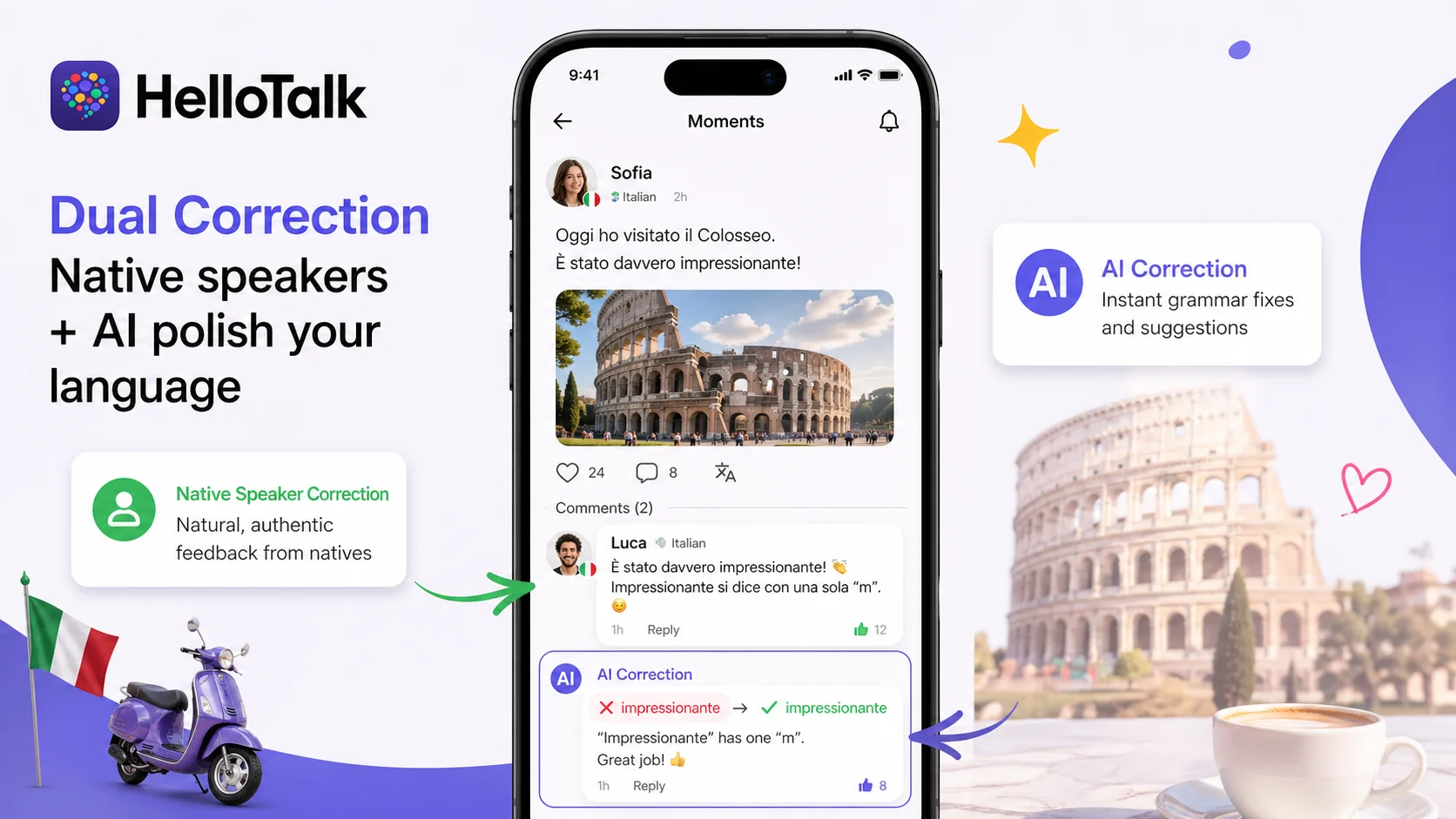
AI-assisted tools can catch spelling, punctuation, and grammar issues in real time and are especially useful for learners who are not yet confident enough to send anything to a human. Phonetic feedback on pronunciation — stress placement, liaison, vowel length — helps address accent issues early before they fossilize.
Combining the two: use AI correction for the mechanical layer (spelling, sentence structure), use native speaker feedback for the cultural and register layer (what actually sounds natural in this situation).
Four scenarios worth building out deliberately
Travel
Practice the exchanges most likely to come up before they come up. Airport arrivals, hotel check-ins, asking for a table, confirming a reservation, navigating public transport, duty-free shopping — these are all short, high-frequency conversations with predictable vocabulary. Running them with a native speaker before the trip means that when the actual moment arrives, you are retrieving language you have already used, not constructing it from scratch.
Italian restaurant etiquette alone is worth a dedicated practice session: the structure of a meal, how to flag a server, how to ask about ingredients, and how to pay. Tourists who know these routines move through them with ease; those who do not tend to default to English or frustrated pointing.
Cross-border professional use
Italian is a significant working language in fashion, furniture manufacturing, luxury goods, food and beverage export, and parts of the arts sector. If your professional life touches any of these industries, functional Italian — particularly the ability to write a credible email and hold a basic call — is a genuine competitive advantage.
The register here is specific. Italian business communication tends to be more formal than equivalent English exchanges; tone and politeness conventions matter. Practicing with someone who works in the relevant industry helps calibrate both vocabulary and register in ways a generic language course cannot.
Exam preparation
Whether the goal is a CILS/CELI certification or a university language assessment, oral exams reward naturalness. Learners who have had regular conversation practice tend to perform better than those who memorize model answers: they can handle unexpected questions and speak at a pace that sounds fluent rather than recited.
Simulating exam scenarios — timed oral responses, comprehension questions, situational role-plays — with a native speaker partner provides the closest available approximation to test conditions.
Hobbies and cultural interests
Interest-driven conversation is where many learners make their fastest progress, because they are genuinely curious about the topic and forget to be self-conscious about the language. Italian football supporters have a vocabulary and a conversational style all their own; the same is true of opera enthusiasts, food nerds, cinema fans, and people obsessed with regional cooking traditions.
Following your interests into Italian means you accumulate niche vocabulary naturally, and the conversations are enjoyable enough to sustain long-term practice habits.
How major learning tools compare
Different tools serve different purposes, and it is worth being clear about what each does well — and where each falls short for learners who need conversational fluency.
| Tool | Primary focus | Limitation for fluency |
|---|---|---|
| Duolingo | Gamified vocabulary and grammar drills | No real social interaction; content stays at a surface level |
| Busuu | Structured courses with some community features | Core scenario content and advanced material sit behind a paywall |
| Speaky | Basic chat matching | Limited filtering; no translation or correction tools; partner quality inconsistent |
| Language exchange apps (e.g., HelloTalk) | Native speaker interaction, scene-based practice | Requires more self-direction than a structured course |
The practical answer for most learners is a combination: use a structured course or app to build your initial vocabulary and grammar foundation, then shift as quickly as possible to conversation practice with native speakers. The structured tools give you raw material; interaction is where that material becomes fluency.
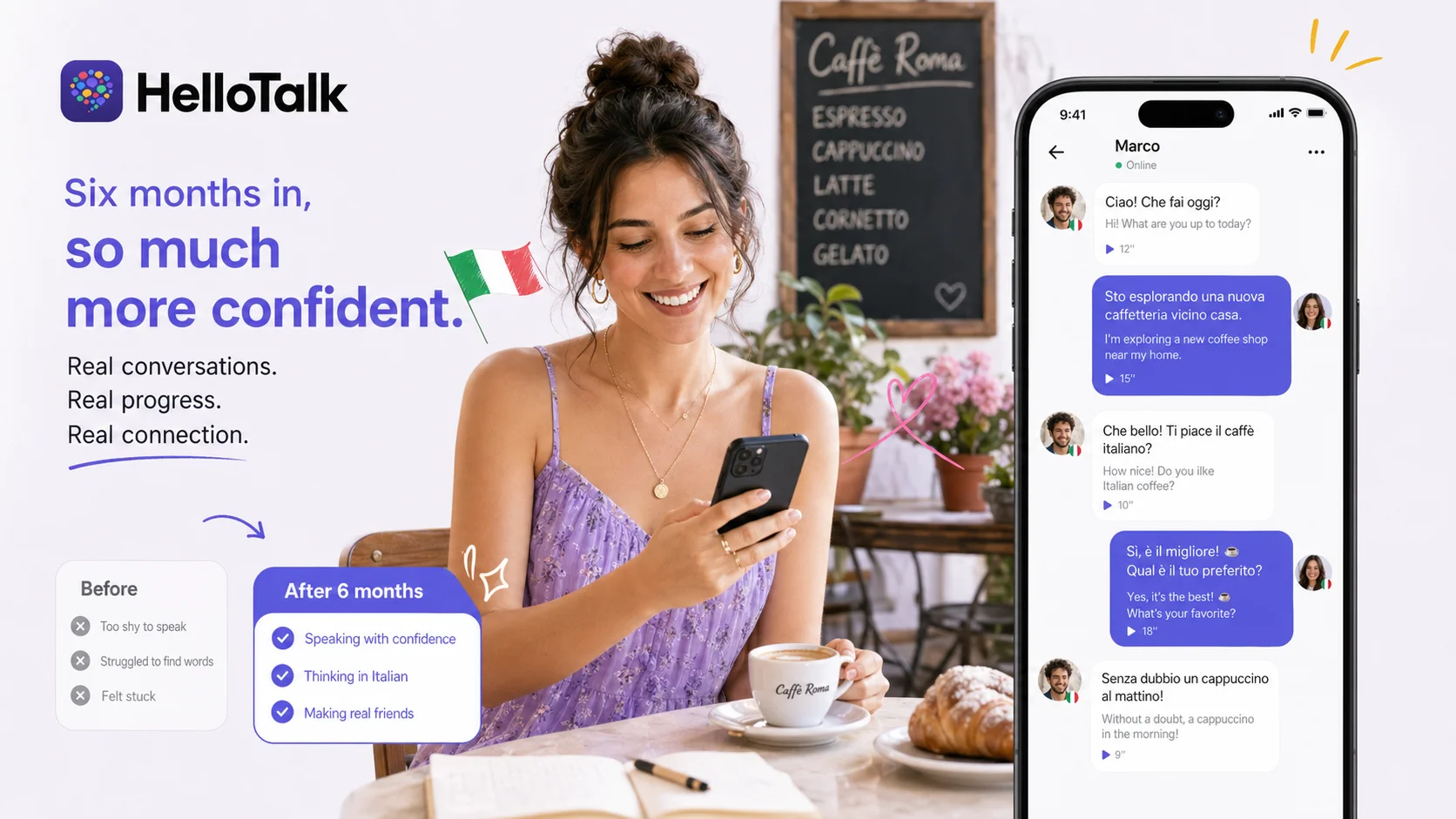
What a six-month conversation-first learning arc looks like
Here is an illustrative progression from a learner who used scenario-based exchange as the core of their practice:
Months 1–2: Focused entirely on two or three travel scenarios — ordering food, asking for directions, checking in somewhere. Text-based exchange only, with real-time translation as a safety net. Basic greetings and functional short phrases. Errors everywhere, none of them fatal.
Month 3: Able to complete travel scenario conversations independently. Started exchanging voice messages. Noticed a significant improvement in understanding natural speech rhythm. Began recognizing phrases in context rather than having to decode them word by word.
Months 4–6: Comfortable discussing everyday topics at normal speed — food, city life, weekend plans, TV and football. Began basic business-level exchanges. Could follow normal-speed audio without subtitles in familiar topics.
The key throughout: no isolated grammar study. Every grammar pattern was absorbed through actual conversation. This makes the progress slower in the first few weeks (there is no shortcut through the basics) and dramatically faster afterward, because nothing learned in context gets forgotten the way flashcard vocabulary does.
Getting started: a practical checklist for beginners
You do not need to figure out everything at once. A focused first month looks like this:
- Set up a profile that specifies your goals. “Travel to Sicily in August” or “working in the Italian textile trade” will attract far better partners than a blank profile.
- Pick one or two scenarios and go deep. Do not try to cover everything. Master ordering at a restaurant before you move to navigating a train station.
- Spend at least 20 minutes a day. Consistency matters more than session length. Twenty minutes of real conversation beats two hours of passive review.
- Keep a phrases file. When you encounter an expression that is native-sounding and situation-specific, write it down with context. Review it weekly.
- Join a topic-based audio room and just listen first. Before you feel ready to speak, spend time absorbing natural conversation rhythm. The speaking will follow.
A few common questions:
Can I start with zero Italian? Yes. The first exchanges will be slow and heavily supported by translation tools, and that is fine. Native speakers who do language exchange are accustomed to beginners and are generally patient.
Do I need to pay for this kind of practice? Language exchange is inherently reciprocal — you offer your language in return for theirs — so core conversation practice through exchange apps is typically free. Structured courses and premium features vary by platform.
Closing thought
Italian is not a difficult language for English speakers to get started with — the phonetics are consistent, the grammar has clear rules, and a huge amount of vocabulary shares Latin roots with English. What makes it hard is the standard approach: too much passive study, not enough real use.
If you have been grinding through exercises without making the conversational progress you expected, the obstacle is probably not your Italian. It is the method. Shifting toward scene-based practice with native speakers — messy, imperfect, occasionally confusing — is the change that tends to unlock things.
Pick a scenario that matters to you, find a conversation partner, and start there. Everything else follows.