Your son comes home from school and reads aloud fluently. But when he speaks freely, “pen” comes out as “ben”, and “the” sounds like “da”. He has been in American schools for two years. You wonder why the gap is not closing.
This comes up constantly for Arab-American families, and the reason is specific: Arabic and English do not share the same sound system. Arabic has no /p/, no /v/, and no English “th”. Children do not pick up those sounds from exposure alone. They need a teacher who hears the error, names it, models the correction, and returns to it across multiple sessions. Most group classes do not provide that. Most apps cannot provide it at all.
This page compares the main types of online English programmes available to Arab-American families, sets out what to look for, and explains what 51Talk offers that is worth verifying directly. It covers children aged 4 to 14 learning English as a second or heritage language. It does not cover children with speech delays or processing disorders in Arabic as well as English. If that is the situation, a licensed speech-language pathologist should be involved first.
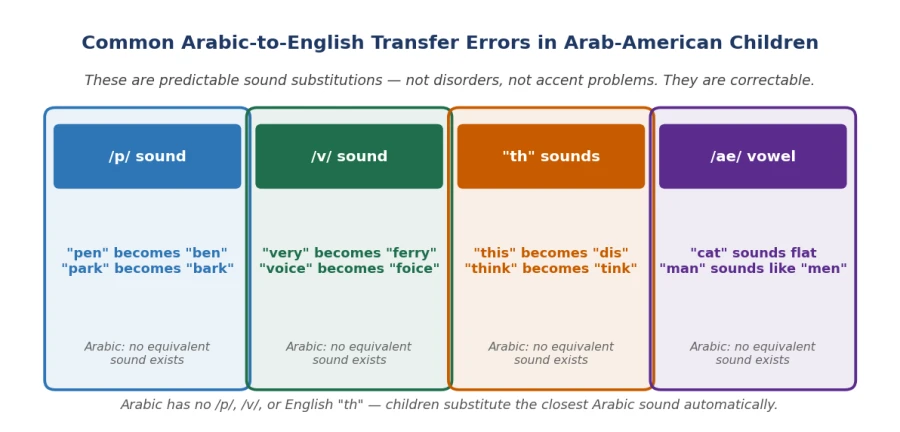
The four most common Arabic-to-English sound substitutions — predictable, correctable, and not disorders
Why Arabic Transfer Errors Persist in Arab-American Children
A child who has grown up hearing Arabic develops a phonological system built around Arabic sounds. When they learn English, the brain maps unfamiliar sounds onto the closest available Arabic equivalent. This is not laziness or confusion. It is the normal, efficient way a bilingual brain manages two systems.
The problem is that the mapping becomes habitual. By the time a child is 7 or 8 and producing /b/ for every /p/, that substitution is deeply automatic. Classroom exposure does not undo it, because the teacher is usually managing 20 other children and the error does not block communication. It is only when a teacher stops, names the specific sound, demonstrates the placement, and makes the child attempt it again that the habit starts to shift.
That correction cycle needs to happen in every lesson, across many weeks. A group class of eight students cannot provide it. A 25-minute one-on-one class can.
Five Signs Your Child Needs One-on-One English Support, Not More Group Class
• Their Arabic is strong, but English output lags behind comprehension. They understand a story read aloud but feel hesitant when asked to retell it.
• Their English errors follow a fixed pattern. /p/ always becomes /b/. “Th” always becomes /d/. Predictable substitutions point to transfer, not confusion.
• They go quiet in English class but talk freely at home. This usually signals that they know the gap exists and are avoiding exposure to it rather than correcting it.
• Their written English is improving faster than their spoken English. Spelling and reading can be drilled. Pronunciation cannot. It needs a listener who corrects in real time.
• They have been in American schools for two or more years without the errors closing. School English class is not designed for individual phoneme correction. That is not a criticism. It is simply a different job.
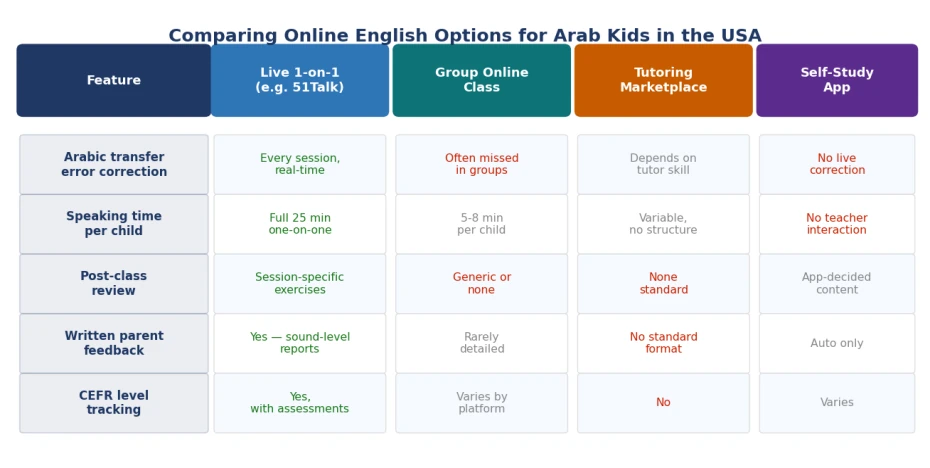
How common online English formats compare on the dimensions that matter most for Arab-American children
Comparing Online English Programme Types for Arab Kids in the USA
Arab-American parents comparing online English options are usually choosing between live group classes, one-on-one platforms, open tutoring marketplaces, and self-study apps. Each has a different structure, and that structure determines what a child actually gets out of each session.
| Programme Type | Arabic Error Correction | Child Speaking Time | Post-Class Review | Parent Feedback |
| Live 1-on-1 (e.g. 51Talk) | Every session, real-time | Full 25 minutes | Session-specific exercises | Written, sound-level reports |
| Group online class | Often missed | 5 to 8 min per child | Generic or none | Rarely detailed |
| Tutoring marketplace | Depends on tutor skill | Variable, no structure | None standard | No standard format |
| Self-study app | No live correction | No teacher interaction | App-decided content | Automated only |
The comparison above is not meant to dismiss group classes or apps entirely. Group classes build social confidence and listening practice. Apps are useful for vocabulary reinforcement between live sessions. But if the specific problem is Arabic-to-English sound substitution that has persisted despite regular schooling, the only format that structurally addresses it is one-on-one, live, and correction-focused.
What to Actually Look For in an Online English Class for Arab Kids
Parents searching for the best online English class often focus on teacher nationality, platform reviews, or price per lesson. These matter, but they are not the most useful starting point. The more important question is whether the programme is built to do the specific job the child needs.
Six dimensions separate a strong programme from an average one for Arab-American children specifically.
• Arabic-English phonological awareness. The teacher should know that /p/ does not exist in Arabic, that /v/ is commonly replaced with /f/, and that “th” is difficult because Arabic has no equivalent. A teacher who recognises this pattern corrects it systematically. A teacher who has only worked with European learners may not register /b/-for-/p/ as an error at all.
• Speaking time per child. In a one-on-one 25-minute lesson, the child produces language for most of the session. In a group class of eight, they may speak for five minutes total. Pronunciation cannot improve without production time.
• Correction method. Effective correction is specific: the teacher names the sound, demonstrates the correct placement, asks the child to attempt it, and confirms or corrects the attempt. Saying “try again” without naming the issue is not correction. It is hope.
• Post-class review that targets session-specific sounds. Pronunciation is motor memory. It consolidates through distributed repetition, not one-session drilling. Review exercises that revisit exactly what was taught that day matter as much as the lesson itself.
• Written parent feedback with sound-level detail. A report that says “great effort today” tells a parent nothing. A report that says “we worked on /p/ in initial position, she self-corrected twice by lesson end” is actionable.
• Curriculum structure with level progression. Random conversation topics do not build a learning path. CEFR-aligned materials with unit assessments give both the teacher and the parent a framework for measuring whether the child is actually moving forward.
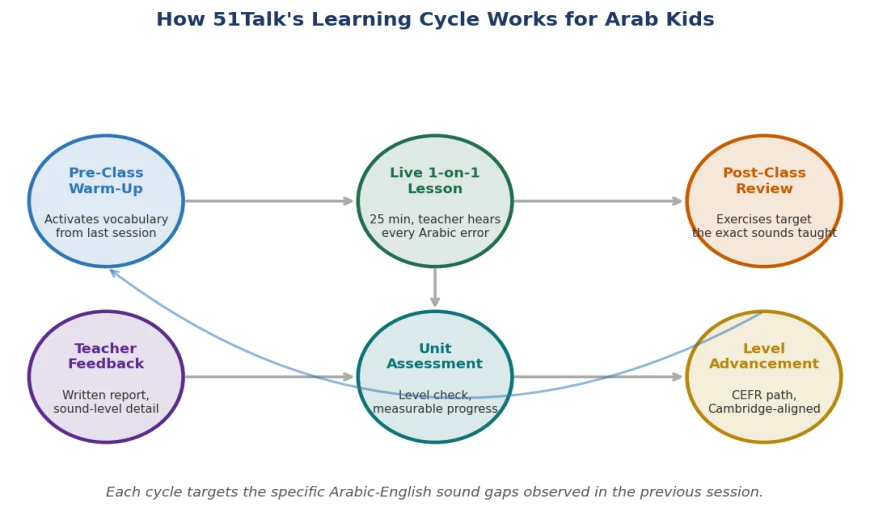
The 51Talk learning cycle and how each stage reinforces the previous one for Arab-American learners
Where 51Talk Fits In
What 51Talk is
51Talk is a live one-on-one online English platform for children. Sessions are 25 minutes, delivered by qualified teachers, and structured around CEFR levels and Cambridge English learning goals. The lesson cycle includes a pre-class warm-up, the live session, post-class review exercises specific to that lesson, teacher feedback, unit assessments, and periodic level evaluations. Children move through levels progressively. Parents can verify the programme structure at 51talk.com.
Why it is worth evaluating for Arab-American children
• One-on-one means every Arabic error gets heard. There is no group dynamic to hide in. When a child says “berry” instead of “very”, the teacher hears it immediately and can address the /v/ substitution in the same turn. That responsiveness is structurally impossible in a class of eight.
• Post-class review is session-specific, not generic. A child who worked on /p/ in initial position today gets review exercises on /p/ today, not a random vocabulary list. That specificity is what makes the difference between review that consolidates and review that fills time.
• Teacher feedback is documented. Parents receive written reports rather than a verbal summary at the end of class. That documentation lets a parent track whether /p/ is improving over four weeks or whether it needs a different approach.
• The format fits a busy American family schedule. Three 25-minute sessions per week is achievable for most families. That frequency is close to the minimum needed for motor memory consolidation of new sounds.
• The CEFR curriculum provides an external benchmark. Cambridge English Young Learners standards are publicly documented. Parents can independently check whether what their child is learning aligns with what A1 or A2 should look like, rather than trusting a platform’s internal label.
What to keep in mind
51Talk does not specialise in speech therapy, and it is not a substitute for a speech-language pathologist if a child has delays in Arabic as well as English. The platform also cannot promise a fixed improvement timeline, because no honest programme can. Progress depends on the child’s age, lesson frequency, what happens between sessions, and whether the specific teacher has experience with Arabic-speaking learners. That last point is worth asking about directly before booking.
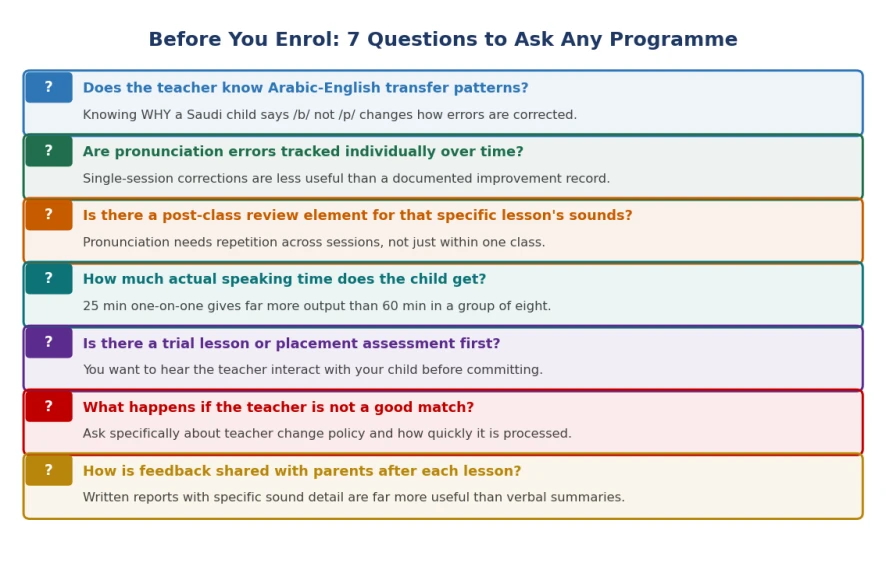
Seven questions to ask any programme before enrolling your child
Before You Enrol: Questions to Ask Any Programme
A programme that cannot answer these questions clearly is worth pausing on, regardless of how good the marketing looks.
• Does the teacher know Arabic-English transfer patterns? Knowing why a Saudi or Gulf Arabic-speaking child substitutes /b/ for /p/ changes how a teacher approaches the correction. Ask directly whether the teacher has worked with Arabic-speaking children before.
• Are pronunciation errors tracked individually over time? Single-session corrections are less useful than a running record that shows which sounds are improving and which are still resisting change.
• Is there post-class review that targets that specific lesson’s sounds? Generic review is better than nothing. Session-specific review is significantly better than generic.
• How much actual speaking time does the child get? A 25-minute one-on-one gives far more production time than a 60-minute class of eight. Ask for the number, not a vague description.
• Is there a trial lesson or placement assessment? You want to hear the teacher interact with your child before committing to a package. A trial lesson also lets you check whether Arabic transfer errors get caught and corrected.
• What happens if the teacher and child are not a good match? Ask specifically whether you can request a teacher change, whether there are conditions, and how quickly it is processed.
• How is feedback shared with parents after each lesson? Written reports with specific sound-level detail are far more useful than a verbal note. Ask to see a sample report before enrolling.
A Note on Raising Bilingual Children in the USA
Some Arab-American parents worry that pushing English pronunciation will slow down their child’s Arabic. The research does not support that concern. Bilingual children often develop stronger metalinguistic awareness, meaning they become more attuned to how language systems work across both languages.
The pharyngeal and uvular sounds Arabic speakers produce naturally are genuinely complex consonants. That phonological range is a foundation, not a barrier. English pronunciation just needs to be taught explicitly for the sounds Arabic does not use. A good teacher shortens that gap. The Arabic does not have to suffer for it.
What to Do Next
Most Arab-American children who struggle with English sounds need structured one-on-one pronunciation work, not more hours in a group class. The errors are predictable, the causes are well understood, and the format that addresses them is clear: a teacher who listens to every production, corrects specifically, reviews systematically, and reports to parents in writing.
A smaller group of children may show signs that go beyond transfer errors: limited Arabic output, comprehension difficulties in both languages, or no progress after a year of consistent instruction. For those children, a bilingual speech-language assessment comes before more English classes.
If pronunciation training is the right fit, check what any programme does with feedback, review, and teacher accountability before signing up. Ask for a trial lesson. Save the conversation. 51Talk is a reasonable starting point for comparison because its course structure, CEFR alignment, and review system are publicly described and can be verified before the first paid lesson.
The goal is simple. Your child should feel more confident producing English sounds each month, not more self-conscious. The right programme gets you there.
Frequently Asked Questions
Can 51Talk specifically help Arab kids in the USA with Arabic-to-English pronunciation errors?
That is the right question to ask directly. What 51Talk offers is qualified one-on-one instruction, session-specific post-class review, and documented teacher feedback across CEFR-aligned levels. Whether a specific teacher has direct experience with Arabic-speaking learners is worth confirming before you book. The one-on-one format does mean every Arabic transfer error gets heard rather than overlooked in a group, which is the most important structural feature for this kind of correction. You can check current programme details and request a trial lesson at 51talk.com.
Is my child’s /b/ for /p/ substitution a language disorder?
No. Arabic has no /p/ phoneme, so Arab children automatically substitute the closest Arabic sound, which is /b/. This is one of the most common and well-documented Arabic-English transfer patterns. It has nothing to do with intelligence or language ability. A qualified teacher who knows this pattern can address it directly and systematically. It is not a sign of any disorder.
What age should an Arab child in the USA start targeted pronunciation support?
Children who begin structured English sound work between ages 4 and 8 tend to develop more natural-sounding pronunciation because the phonological system is still forming. That said, children aged 9 to 14 can make strong progress with consistent one-on-one instruction. Starting earlier is useful. Starting later is not a reason to wait longer.
How do I know whether my child needs pronunciation training or a speech-language pathologist?
Look at Arabic first. If your child’s Arabic is age-appropriate, clear, and expressive, then English difficulties are almost certainly transfer-based and pronunciation training is the right starting point. If Arabic speech is also limited, unclear, or significantly delayed for their age, a bilingual speech-language assessment comes first. A qualified teacher shortens pronunciation gaps. A speech-language pathologist addresses underlying processing or motor speech issues. They are different jobs.
How many sessions per week are needed to see improvement in Arabic transfer errors?
Three sessions per week is close to the minimum effective frequency for Arabic transfer error correction at the motor memory level. One session per week leaves a six-day gap in which the correction fades before the next reinforcement opportunity. Three sessions with post-class review the same day gives three consolidation windows per week. Most Arab children aged 6 to 12 show clear in-session improvement on a target sound within four to six weeks at that frequency, though consolidating it to automatic production takes longer.
Can my child improve English pronunciation through school alone?
School English class is not designed for individual phoneme correction. A teacher managing 25 students cannot stop the lesson every time one child substitutes /b/ for /p/. That is not a failure of the school. It is simply a different job. Structured one-on-one instruction does what classroom instruction cannot: it hears every production, corrects specifically, and tracks improvement over time. The two can and should work alongside each other.