Your daughter sits down for an online English class. She clicks, watches, occasionally repeats a word. But when you ask her what she learned, she struggles to say. The platform looked interactive. The lesson did not stick.
For Saudi parents comparing online English programmes, the marketing all sounds the same: games, visuals, live teachers, progress tracking. The practical question is which combination of those features actually produces measurable English improvement rather than engaged-looking screen time.
This page compares the four features that matter most for Saudi families specifically: live lesson quality, how games are used, visual tool integration, and what parents can actually see and verify. It does not cover adult learners or platforms without a child-specific curriculum.
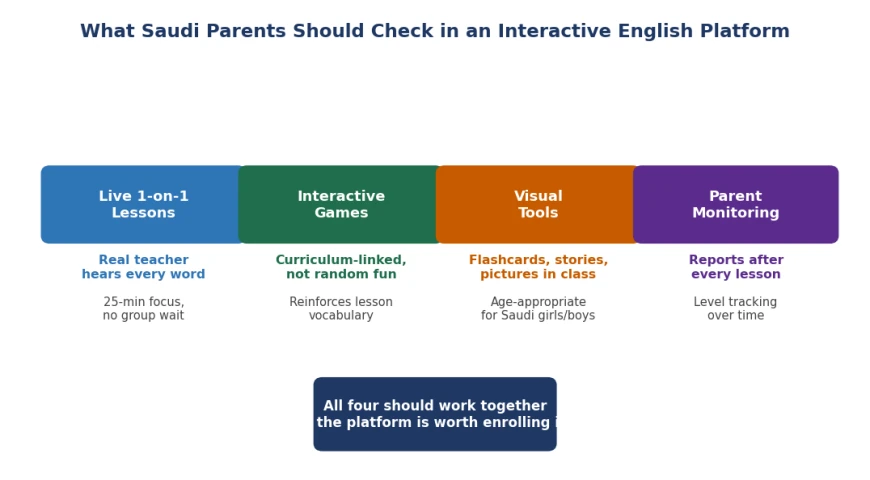
The four features Saudi parents should verify in any interactive English platform
Why “Interactive” Does Not Always Mean Effective
Interactive is one of the most overused words in online education marketing. A platform can be genuinely interactive — the teacher adapts in real time, games reinforce the vocabulary from that lesson, visuals are tied to speaking prompts — or it can be superficially interactive, meaning the child clicks buttons and watches animations while absorbing very little language.
The distinction shows up fastest in speaking time. In a genuinely interactive lesson, the child produces language repeatedly: answering questions, repeating target sounds, describing pictures, responding to the teacher. In a passive-interactive lesson, the child clicks to advance slides while the teacher narrates. One builds habit. The other fills time.
Six Dimensions to Compare Across Platforms
• Live teacher interaction. Does the child speak with a qualified teacher in every session, or does the platform rely primarily on automated content between occasional teacher check-ins?
• Game quality. Are games curriculum-linked, reinforcing the vocabulary and grammar from that specific lesson? Or are they decorative — fun content that does not connect to the learning path?
• Visual tools during lessons. Do teachers use flashcards, illustrated stories, and picture prompts as speaking stimuli, or as background decoration?
• Lesson length and frequency. For Saudi children aged 5 to 10, 25-minute sessions repeated three times a week outperform one 60-minute weekly session for retention.
• Parent monitoring. Can you see a written report after each lesson that names what was covered? Or only a star rating and a vague mood summary?
• Cultural appropriateness of content. Are lesson themes and visual materials suitable for Saudi families, with age-appropriate topics and no content that families would find uncomfortable?
| Feature | Strong Platform | Weak Platform |
| Live teacher per session | Every session, qualified | Occasional or shared |
| Game-curriculum link | Tied to lesson content | Random engagement games |
| Visual tool use | Active speaking stimulus | Background decoration |
| Parent report | Named content + sound detail | Star rating only |
| Cultural suitability | Age-appropriate, reviewed | Generic global content |
Where 51Talk Fits In
What 51Talk is
51Talk is a live one-on-one English platform for children offering 25-minute sessions with qualified teachers, CEFR-aligned curricula, and Cambridge English learning goals. Its lesson cycle includes pre-class warm-up, live interactive class, post-class review exercises, teacher feedback, and unit assessments. Parents can verify the programme structure at 51talk.com.
Why it is relevant for Saudi families
• One-on-one format means full lesson time for your child. No group waiting, no shared attention. Every question, every game, every correction is directed at your child specifically.
• Post-class review connects to the lesson. Review exercises revisit the vocabulary and sounds from that specific session, not generic content.
• Written teacher feedback after every class. Parents receive a report that names what was covered. That transparency is unusual and valuable for families who want to understand the learning path.
What to keep in mind
51Talk does not position itself as a culturally Saudi-specific platform, and parents should verify that specific teachers are appropriate for their child before committing to a long package. A trial lesson is the most reliable way to check teacher tone, lesson content, and platform fit.
Before You Enrol: Questions to Ask Any Platform
• Can I observe a full lesson before purchasing? Not just a demo. A real class with your child.
• Are the games tied to the lesson content, or separate entertainment? Ask to see an example of the review material.
• What does the parent report look like after each session? Request a sample before enrolling.
• How is teacher quality verified and maintained? Ask about qualifications, training, and feedback processes.
• Is the visual content reviewed for cultural appropriateness? Specifically relevant for Saudi families.
Frequently Asked Questions
Does 51Talk offer interactive lessons suitable for children in Saudi Arabia?
51Talk offers structured live 1-on-1 English lessons with qualified teachers, CEFR-aligned content, and a full lesson cycle including review and feedback. Saudi parents should take a trial lesson to verify that the teacher tone, content themes, and lesson pacing match their child’s needs. Visit 51talk.com to arrange a trial.
Are interactive games enough for a child to learn English?
Games are useful for vocabulary reinforcement and lowering speaking anxiety. They are not sufficient on their own. A child needs a live teacher to correct pronunciation, model sentence patterns, and respond to individual gaps. Games work best as one element of a structured lesson, not as the whole lesson.
How do I know if my child is actually learning or just being entertained?
Ask your child to tell you one thing they learned after the session, in English. If they can retrieve even one word or phrase, the lesson made something stick. If they cannot, the session may have been more entertaining than educational.
What parent monitoring features should I expect from a good platform?
At minimum: a written report after each class naming what was covered, a level or progress tracking system, and a clear mechanism for raising concerns. A star rating and “great lesson today” is not monitoring. It is a placeholder.
How many lessons per week do Saudi children typically need to see progress?
For children aged 5 to 10, two to three 25-minute sessions per week is the range most platforms recommend. Fewer than two sessions per week makes it difficult to sustain the vocabulary retention needed for consistent progress.
What to Do Next
Compare any platform you are considering against the six dimensions above. Request a sample parent report before enrolling. Take a trial lesson with your child present and watch whether the games, visuals, and teacher interaction are connected to each other, or whether they are simply happening in the same 25 minutes. The best interactive platform is the one where every element of the lesson reinforces the same language goal.