A platform that works brilliantly for a 10-year-old will frustrate a 5-year-old and bore a 13-year-old. Age is the most important filter in choosing an English learning format, and it is the one most parents apply least systematically.
The differences are not just about lesson length or vocabulary difficulty. They involve attention span, developmental stage, what motivates participation, how correction is processed, and whether the child can sustain independent focus or needs an adult nearby. This page covers the four main age groups, what to look for in each, and which format tends to produce the best results.
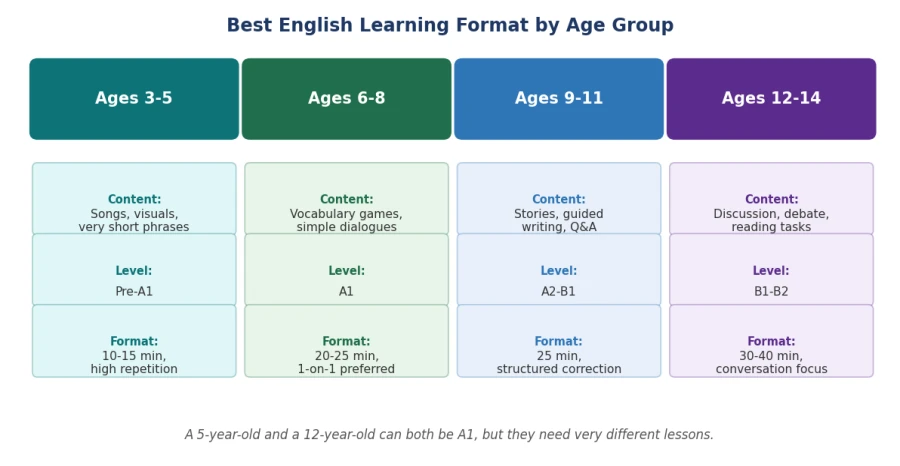
Recommended English learning format, content type, and CEFR level by age group
Ages 3 to 5: Building Comfort Before Content
At this age, the goal is not fluency. It is comfort. A child aged 3 to 5 who develops positive associations with English sounds, classroom phrases, and a welcoming teacher will learn dramatically faster over the following years than one who associates English with confusion or pressure.
• Format. Short live sessions of 10 to 20 minutes. High repetition. Songs, movement, picture activities. No writing.
• CEFR level. Pre-A1. The framework barely applies. What matters is phonological exposure and speaking confidence.
• What to look for. A teacher who uses games, songs, and visual cues as primary tools. Lessons that feel like play. No pressure to produce correct sentences. Parent participation encouraged nearby.
• Red flag. Any platform that requires a 3-year-old to sit still for 40 minutes or complete written exercises.
Ages 6 to 8: Building the Speaking Habit
This is the critical window for pronunciation. Children in this age range are still phonologically flexible. Sounds that feel automatic by age 12 can be shaped and corrected with much less effort between ages 6 and 8. A child who builds a correct /p/ habit at 7 does not have to break a wrong one at 15.
• Format. 25-minute one-on-one live lessons, two to three times per week. Games as one component, not the whole lesson.
• CEFR level. Pre-A1 to A1. Focus on listening and speaking. Early reading support where applicable.
• What to look for. Consistent teacher who corrects pronunciation specifically. Post-class review that reinforces the session’s sounds. Parent feedback report that names what was practised.
• Red flag. A 60-minute group class where the child speaks for under five minutes total.
Ages 9 to 11: Building Structure on the Speaking Base
Children in this range can begin connecting spoken fluency to written structure. They are ready for short guided writing, simple reading tasks, and more extended conversation. This is also the age where vocabulary gaps become more visible in school, making structured curriculum progression more important.
• Format. 25-minute one-on-one live lessons. Structured curriculum with clear level progression. Unit assessments to track progress.
• CEFR level. A1 to B1, depending on prior exposure. Progress assessments are important for accurate placement.
• What to look for. A platform with a published curriculum path, written parent reports, and level evaluations. Teacher who builds on previous sessions rather than treating each one as standalone.
• Red flag. Platforms that never reassess level or whose “progress tracking” is only a star rating.
Ages 12 to 14: Building Confidence for Academic Use
At this age, the gap between a strong English speaker and a hesitant one is becoming academically consequential. School tasks, standardised tests, and social confidence all involve English. The goal shifts from habit to fluency, from comfort to precision.
• Format. 25 to 40-minute sessions. More conversation-led. Structured writing and reading alongside speaking practice.
• CEFR level. B1 to B2. External benchmarking (e.g. Cambridge exams) becomes useful.
• What to look for. Teacher who challenges the child to extend responses and reasons their way through tasks. Curriculum that incorporates reading, writing, and discussion topics relevant to the child’s school level.
• Red flag. A platform that treats a 13-year-old the same way it treats an 8-year-old, just with harder vocabulary.
Where 51Talk Fits In
What 51Talk is
51Talk is a live one-on-one English platform for children aged 4 to 15, offering 25-minute sessions with qualified teachers, a CEFR and Cambridge English-aligned curriculum, pre-class warm-up, post-class review exercises, teacher feedback, and unit assessments. Current programme details at 51talk.com.
Why the age-differentiated curriculum matters
51Talk’s curriculum is built specifically for young learners and differentiates by age group within CEFR levels. A 6-year-old A1 learner and a 10-year-old A1 learner are not given the same materials. The topics, visual content, activity types, and correction approach all vary by developmental stage, not only by language difficulty.
The level evaluation system also means a child’s placement is reviewed periodically rather than locked to the initial trial assessment. A child who progresses faster than expected moves up. A child who needs more consolidation stays at the current level without being pushed into content that will frustrate.
What to keep in mind
The trial lesson is still essential regardless of age. Teacher fit matters differently at different ages: a 5-year-old needs warmth and games, while a 12-year-old may respond better to a teacher who takes them seriously as a learner. Verify that the teacher assigned to your child is the right match for their age and personality, not just their level.
Before You Enrol: Questions to Ask Any Platform
• Does the curriculum differentiate by age as well as by CEFR level? Age-appropriateness is separate from language difficulty.
• Is the level assessment updated over time, or only at initial placement? A static placement is a known problem on many platforms.
• Are lessons at the preschool level primarily oral and activity-based? No writing for children under 6 should be a minimum standard.
• Can I see the curriculum materials for my child’s age and level before purchasing? A confident platform will show you.
Frequently Asked Questions
Does 51Talk offer age-appropriate programmes for children under 6?
51Talk’s curriculum includes programmes designed for young learners starting from age 4, with age-appropriate content for preschool and early primary learners. Parents should take a trial lesson to verify that the teacher’s approach and the lesson materials match their child’s age and developmental stage. Arrange a trial at 51talk.com.
My 7-year-old is at A1 level but my 11-year-old is also A1. Should they use the same programme?
No. Both children may be at A1 on the language scale, but they need different topics, different activity formats, different correction approaches, and different lesson pacing. A genuine young learner curriculum addresses this automatically. Ask any platform how they differentiate between a 7-year-old A1 and an 11-year-old A1 before enrolling.
What CEFR level should a 10-year-old who has been learning English for three years be at?
This varies enormously based on quality and frequency of instruction and home language exposure. A 10-year-old with three years of consistent two-to-three sessions per week could reasonably be at A2 to B1. A 10-year-old with one school class per week for three years may still be at A1. A placement assessment is more reliable than an age-based estimate.
At what age do the benefits of one-on-one lessons become most pronounced?
The benefits are highest in the 6 to 8 age window for pronunciation, because the sound system is still forming and individual correction has the most impact. They remain high for speaking confidence at all ages. For children over 12, group conversation classes can also be effective if the individual speaking time per child is genuinely adequate.
What to Do Next
Find your child’s age group in the guide above. Use the format and level recommendations as a starting filter. Ask any platform how they specifically address your child’s developmental stage, not just their CEFR level. Take a trial lesson and observe whether the teacher’s approach, the content themes, and the activity format match what a child of that age genuinely needs. The right programme feels appropriate from the first session, not just on paper.