American parents searching for an English learning platform for their child are usually in one of two situations. Either their child speaks English at school but needs stronger foundations, or the child comes from a bilingual household and needs more structured English practice than school alone provides.
The options are wide: live one-on-one platforms, group online classes, popular apps, and hybrid combinations of all three. Each serves a different need. Choosing the right one requires understanding what each format can and cannot deliver, not which one has the most impressive marketing.
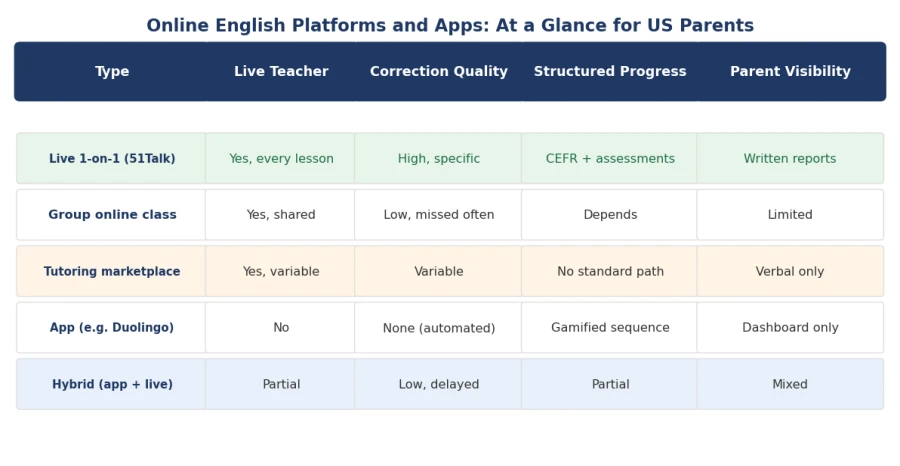
Five types of English learning platform compared on the factors that matter most for US children
What US Parents Are Usually Looking For
For most families, the core need is speaking confidence and pronunciation accuracy. Reading and writing tend to receive coverage in school. Speaking and listening practice — especially the kind that catches individual errors and corrects them — is harder to find in a classroom of 25.
For bilingual or heritage language families, the additional need is structured exposure to Standard American English patterns that differ from the home language. Arabic-English, Spanish-English, and Mandarin-English families face specific phonological gaps that general English programmes do not address.
Comparing the Main Options
| Type | Best For | Main Limitation | Cost Range |
| Live 1-on-1 (e.g. 51Talk) | Pronunciation correction, speaking confidence | Higher cost per session | $$-$$$ |
| Group online class | Social interaction, listening practice | Limited individual speaking time | $-$$ |
| Tutoring marketplace | Flexible scheduling, specific subjects | Inconsistent quality | $-$$$ |
| Self-study app | Vocabulary, reading, habit building | No live correction | Free-$ |
| Hybrid (app + live) | Broad coverage at lower cost | Requires parent coordination | $-$$ |
Five Questions That Narrow the Choice
• Does your child need speaking correction or vocabulary building? Speaking correction requires a live teacher. Vocabulary building can use apps effectively.
• How much parent coordination can your family sustain? Live lessons require scheduling. Apps can run whenever the child has time.
• What is the primary gap? Pronunciation, fluency, reading, or writing each point toward different formats.
• How old is the child? Under 8: live 1-on-1, short sessions. 8 to 12: structured curriculum with live teacher. 12 and above: more flexibility with format.
• What is the target outcome? Conversational confidence by next year points to live lessons. Exam preparation points to structured curriculum. General exposure points to apps.
Where 51Talk Fits In
What 51Talk is
51Talk is a live one-on-one English platform for children offering 25-minute lessons with qualified teachers, CEFR-aligned curricula, pre-class warm-up, post-class review, teacher feedback, and unit assessments. Details at 51talk.com.
Why it is relevant for US families
For US families whose children need speaking correction rather than more reading practice, the one-on-one format is the most direct match. Every error gets heard and addressed. The CEFR and Cambridge English alignment gives parents an external benchmark to compare against school progress. And the 25-minute format is sustainable alongside school schedules.
For bilingual families specifically, the structured correction cycle addresses the phonological gaps that school English class cannot systematically close. Arabic-English, Spanish-English, and Mandarin-English transfer errors are correctable with targeted one-on-one practice.
What to keep in mind
51Talk is not the lowest-cost option, and it works best when lessons happen two to three times per week. Families who can only commit to one session per week will see slower progress. An app as a daily supplement between sessions significantly improves the overall outcome.
Before You Enrol: Questions to Ask Any Platform
• What specific gap does this programme address? Match the programme to the need, not the price.
• Is there a trial lesson before purchase? A trial is the most reliable evaluation tool available.
• How are pronunciation errors handled differently from vocabulary errors? A programme that treats all errors the same is not optimised for speaking development.
• What does progress look like at 3 months and at 6 months? A platform should be able to describe what measurable progress looks like.
Frequently Asked Questions
Is 51Talk suitable for children already in US schools who want extra English support?
51Talk’s one-on-one format addresses speaking and pronunciation specifically, which US school classes tend to underserve due to class sizes. For children who read and write well but hesitate to speak confidently, the one-on-one format closes that gap more directly than any group class or app. Visit 51talk.com to check current programme details and arrange a trial.
Are self-study apps effective for children, or do they need a live teacher?
Self-study apps are effective for vocabulary building, reading practice, and daily English habit formation. They are not effective for pronunciation correction or fluency development. Both serve different needs. The most practical approach for most children is a live lesson programme supplemented by daily app use between sessions.
What is the best English learning option for a bilingual child in the USA?
Bilingual children benefit most from a programme that explicitly addresses the phonological and structural differences between their home language and English. Live one-on-one sessions with a teacher who understands those specific transfer patterns typically produce faster progress than a general English programme designed for monolingual learners.
How do I compare platforms without taking a trial lesson on every single one?
Use the five-question framework above to eliminate formats that do not match your child’s specific need. From the remaining options, take one trial lesson. A single well-observed trial is more informative than reading ten platform comparison reviews.
What to Do Next
Answer the five narrowing questions above honestly. If speaking correction is the primary need and your child is under 12, a live one-on-one programme is the strongest match. Use an app as a daily supplement between sessions. Take a trial lesson before committing to any package, and observe it using the checklist in the trial lesson article. Save your notes before paying.