A child who says “it was fine” when asked about their English lesson may be telling the truth or may be giving the answer that avoids further questions. For parents of shy, hesitant, or anxious children, the post-lesson conversation is often the most informative source of data about whether the programme is working, or whether the child is tolerating it rather than benefiting from it.
This page gives parents a framework for assessing comfort level that goes beyond the verbal answer. It covers observable signals, what different responses suggest, and how to distinguish early settling-in discomfort from a genuine mismatch that needs addressing.
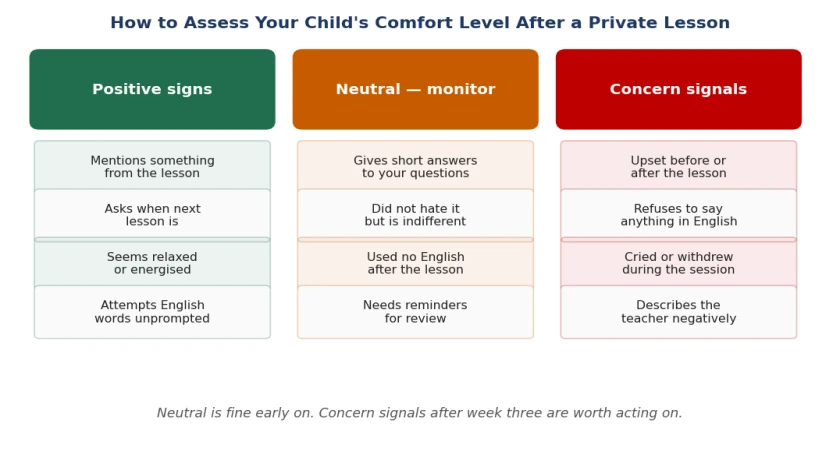
Positive, neutral, and concern signals after a private English lesson
Why Comfort Matters as Much as Progress
A child who is comfortable in English lessons attends them consistently, completes the review, and gradually builds on each session’s foundation. A child who is deeply uncomfortable attends reluctantly, resists the review, and shows progress only when pressed. Technically both children are progressing. Practically, only one has a sustainable learning relationship.
Comfort is not the goal in itself. Challenge and occasional frustration are necessary parts of any real learning. The question is whether the baseline emotional experience of the lesson is tolerable and improving, or distressing and static.
Signals to Observe, Not Just Words to Listen For
• Body language after the lesson. A child who slumps after a lesson has had a draining experience. A child who bounces out and mentions something the teacher said has had an energising one. Neither is definitive in a single lesson, but the pattern across four lessons is informative.
• Approach to the next lesson. A child who needs significant encouragement every week to attend the lesson is showing you something different from a child who reminds you of the lesson time. Consistent resistance is a signal to investigate.
• Spontaneous English after the lesson. A child who uses a word from the lesson in normal conversation later that day has integrated something. A child who cannot recall any content from the lesson has either not absorbed it or absorbed it under enough stress that retrieval is blocked.
• How they describe the teacher. Listen for specific details: the teacher said something funny, the teacher used a game about animals, the teacher kept asking them to repeat. Specific recollections indicate presence during the lesson. Vague descriptions or descriptions that focus on the difficulty indicate a different experience.
Three Comfort Tiers
| Signals | Comfort tier | What to do |
| Mentions lesson content, asks when next lesson is, uses English after class | Comfortable and engaged | Continue. Increase frequency if budget allows. |
| No strong reaction either way; attends without complaint but does not reference lesson | Neutral/settling | Normal for weeks 1-3. Monitor for change at week 5. |
| Resists attending, gives no content recollection, shows distress signals | Concerned | Review teacher fit or level before purchasing more lessons. |
Questions to Ask Your Child
• “Can you say one word you learned today?” Direct retrieval check. No shame if they cannot in week 1.
• “Did the teacher do anything you liked?” Opens a positive frame without pressure.
• “Was anything hard or strange?” Surfaces specific content issues.
• “Would you want to do it again?” The most direct comfort signal available.
Where 51Talk Fits In
What 51Talk is
51Talk is a live one-on-one English platform for children with 25-minute sessions, qualified teachers, and post-lesson feedback reports. Details at 51talk.com.
How 51Talk’s feedback report helps the comfort assessment
51Talk’s post-lesson teacher feedback report names specific vocabulary and skills covered. This gives parents a reference point for the retrieval question above. If the teacher’s report says the lesson covered /p/ sounds and the word “pencil,” and the parent asks the child to demonstrate one thing from the lesson, a child who retrieves “pencil” has both absorbed content and retained it with enough comfort to retrieve it. A child who cannot retrieve anything from a documented lesson may be experiencing emotional interference with memory consolidation.
What to keep in mind
Weeks 1 to 3 are settling-in weeks for most children. Neutral signals during this period are not concerning. Consistent concern signals after week 4 are worth acting on. Ask the platform about a teacher change or level adjustment rather than continuing unchanged.
Before You Enrol: Questions to Ask Any Platform
• What is the teacher change process if my child is not comfortable? Know this before you need it.
• Does the feedback report name specific content covered? Needed for the retrieval assessment.
• Is there an adjustment option if the level seems wrong? Level mismatch often presents as discomfort.
Frequently Asked Questions
Can 51Talk’s feedback system help me assess whether my child is genuinely comfortable?
Yes. The teacher’s post-lesson report names what was covered, which gives you the specific vocabulary to use in the retrieval question. Whether your child can retrieve that vocabulary 30 minutes after the lesson is a practical comfort and engagement indicator. Visit 51talk.com for trial details.
My child says the lesson was fine but shows no signs of engagement. What does that mean?
“Fine” from a child who shows no spontaneous post-lesson behaviour usually means tolerated, not engaged. It is not a failure, but it is a signal to investigate whether the teacher approach, the vocabulary level, or the lesson structure is matched to this child. A level that is too easy produces the same flat response as one that is too hard.
How many weeks of concern signals should I observe before making a change?
Two consecutive weeks of concern signals, after the initial settling-in period of weeks 1 to 3, is sufficient to warrant a teacher change or level adjustment conversation with the platform. Three weeks of concern signals without action typically means the discomfort deepens rather than resolves.
Should I reward my child for attending English lessons to improve their comfort?
Short-term external rewards can help a reluctant child through the first few sessions. Once the teacher relationship is established, the intrinsic reward of communication and understanding usually sustains attendance without external incentives. Relying on rewards indefinitely is a sign that the underlying comfort level has not improved.
What to Do Next
After the next lesson, observe the four body language signals above before asking any questions. Then ask the four questions in the order above. Match the child’s responses against the three comfort tiers. If the child is in the comfortable tier, the programme is working. If neutral, allow the settling-in period to continue but monitor. If concerned, contact the platform and initiate a teacher change or level review before the next session.