A child from an Arab family attending an international school faces a double challenge: learning the content of every subject in English while simultaneously developing the English language skills needed to access that content. Most international school platforms assume the child arrives with functional English. Many Arab children do not, especially if they have come from an Arabic-medium primary education.
This guide is specifically for Arab families navigating this gap. It covers the language transfer issues that affect Arabic-speaking children in English classrooms, what to look for in a supplementary English platform, and the cultural and scheduling considerations specific to Arab families. It does not cover general ESL resources or platforms that are not relevant to children aged 5 to 14.
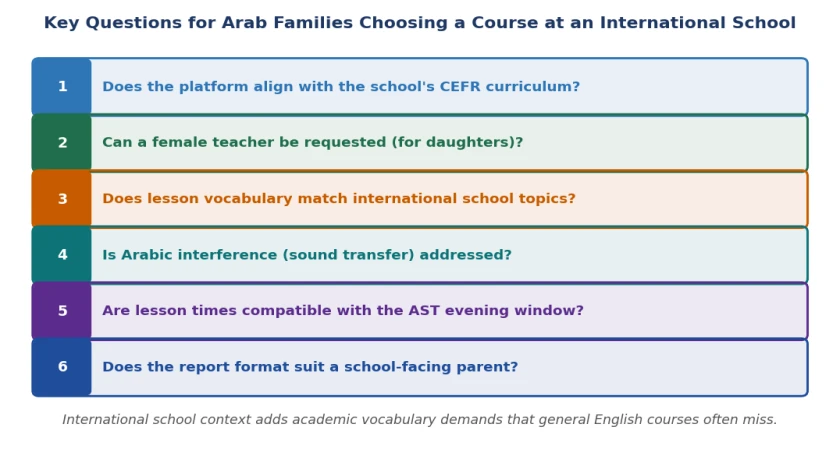
Six key questions Arab families should ask when choosing an English course for an international school child
What Arabic-Speaking International School Children Specifically Need
Arabic and English differ at every structural level: sound system, writing direction, grammar, sentence structure, and cultural reference points. A child moving from Arabic-medium to English-medium schooling typically brings strong oral literacy in Arabic and limited English production skills. The gap is not intelligence. It is a structural language transfer challenge.
Three specific issues affect most Arabic-speaking international school children:
• Phonological transfer. Arabic has no /p/, /v/, or English “th.” These sounds require explicit correction. A platform that does not address them specifically will leave these errors in place throughout the child’s academic career.
• Academic vocabulary gap. Even children with reasonable conversational English often lack the subject vocabulary (describe, justify, evaluate, hypothesis) needed for international school academic work.
• Confidence in public English speaking. Many Arab children speak English accurately in private and freeze in the classroom. The social context of speaking English in front of peers amplifies hesitation for children who feel their English is “imperfect.”
Six Questions Arab Families Should Ask
• Does the platform address Arabic-English sound transfer directly? Specifically /p/, /v/, and “th.” Not just general pronunciation.
• Does the curriculum include academic vocabulary for the child’s school level? Subject language, not only conversational language.
• Can a female teacher be requested for daughters? Relevant for many Arab families and easily confirmed before purchase.
• Are lesson times compatible with the AST evening window? The 4:00 to 9:00 PM window is the realistic availability for most school-age Arab children.
• Does the post-lesson report suit a school-aware parent? A report that names vocabulary covered and speaking performance is more useful than a general summary.
• Is the CEFR alignment verified against Cambridge English standards? Allows parents to compare platform progress against school expectations.
Where 51Talk Fits In
What 51Talk is
51Talk is a live one-on-one English platform for children with 25-minute sessions, qualified teachers, CEFR and Cambridge English-aligned curricula, and structured lesson cycles. Trial at 51talk.com.
Why 51Talk is relevant for Arab international school families
51Talk’s one-on-one format means Arabic transfer errors, including the /p/-for-/b/ substitution that affects almost every Arabic-speaking child, are heard and corrected in every lesson rather than overlooked in a group context. The CEFR and Cambridge English alignment allows parents to compare the platform’s level assessment against the school’s own report.
For families with daughters, female teachers are available and can be requested. The Philippine-based teacher pool covers the AST evening window well for after-school lesson scheduling.
What to verify directly
Before enrolling, confirm with 51Talk that the teacher has experience with Arabic-speaking learners and understands Arabic-English transfer patterns. Ask for the curriculum vocabulary list for your child’s level to assess academic vocabulary coverage. A trial lesson is the most direct way to verify both before committing.
Before You Enrol: Questions to Ask Any Platform
• Does the teacher know about Arabic-English transfer issues? Specifically /p/, /v/, and “th” substitutions.
• Does the curriculum include academic vocabulary for this school level? Not only conversational topics.
• Can a female teacher be consistently booked? Confirm across the full package.
• Does the CEFR framework connect to Cambridge English examinations? For school-aligned benchmarking.
• Are AST evening slots available and consistent? Test at trial booking stage.
Frequently Asked Questions
Does 51Talk address Arabic-English transfer errors in its lessons?
51Talk’s one-on-one format ensures that Arabic transfer errors are heard by the teacher in every session rather than overlooked in a group. The degree to which a specific teacher actively addresses Arabic phonological transfer depends on their experience with Arabic-speaking learners. Confirm this directly when selecting a teacher. A trial lesson at 51talk.com is the most direct way to observe the teacher’s correction approach.
How long does it typically take an Arab child in an international school to close the English gap?
With consistent one-on-one instruction at two to three sessions per week, most Arab children aged 6 to 9 move from A1 to A2 within 9 to 12 months. Closing the gap to school-level expectation for an older child entering at A2 while school demands B1 may take 12 to 18 months of consistent instruction. Timelines vary significantly by lesson frequency and home language exposure.
Should I tell the international school that my child is receiving private English lessons?
This is a family choice. Informing the school allows the class teacher to reinforce similar vocabulary and provide feedback on classroom speaking progress. It also allows the private teacher to align topics with school content. Sharing the information is usually beneficial but not required.
My daughter is confident in Arabic but hesitates in English. How does a private lesson help?
A private one-on-one lesson removes the audience that makes hesitation worse. The only person who hears your daughter’s English is the teacher, who is there specifically to help it improve, not to judge it against peers. Over weeks, the confidence built in the private session transfers to the classroom as the child realises their English is more capable than their hesitation suggested.
What to Do Next
Use the six questions above to evaluate any platform before enrolling. Take a trial lesson and observe specifically whether the teacher addresses Arabic transfer errors and uses vocabulary appropriate for international school work. Compare the platform’s CEFR level assessment against the school’s own assessment. If both point to A2, the platform is correctly placed. If there is a gap, discuss it with both the teacher and the school.