The language-learning space is full of bold promises right now. “Be fluent in 30 days.” “AI has replaced tutors.” “One app is all you need.”
These claims contain a grain of truth — AI has made genuine, measurable improvements to language learning — but they consistently overstate what today’s tools actually deliver. The difference between a learner who gets traction and one who stalls often comes down to understanding that distinction: knowing where AI genuinely helps, where it falls short, and how to fill the gap.
This is an honest look at all three.
Where AI Genuinely Earns Its Place
Not every AI claim is hype. For specific parts of the learning process, modern tools have become legitimately useful.
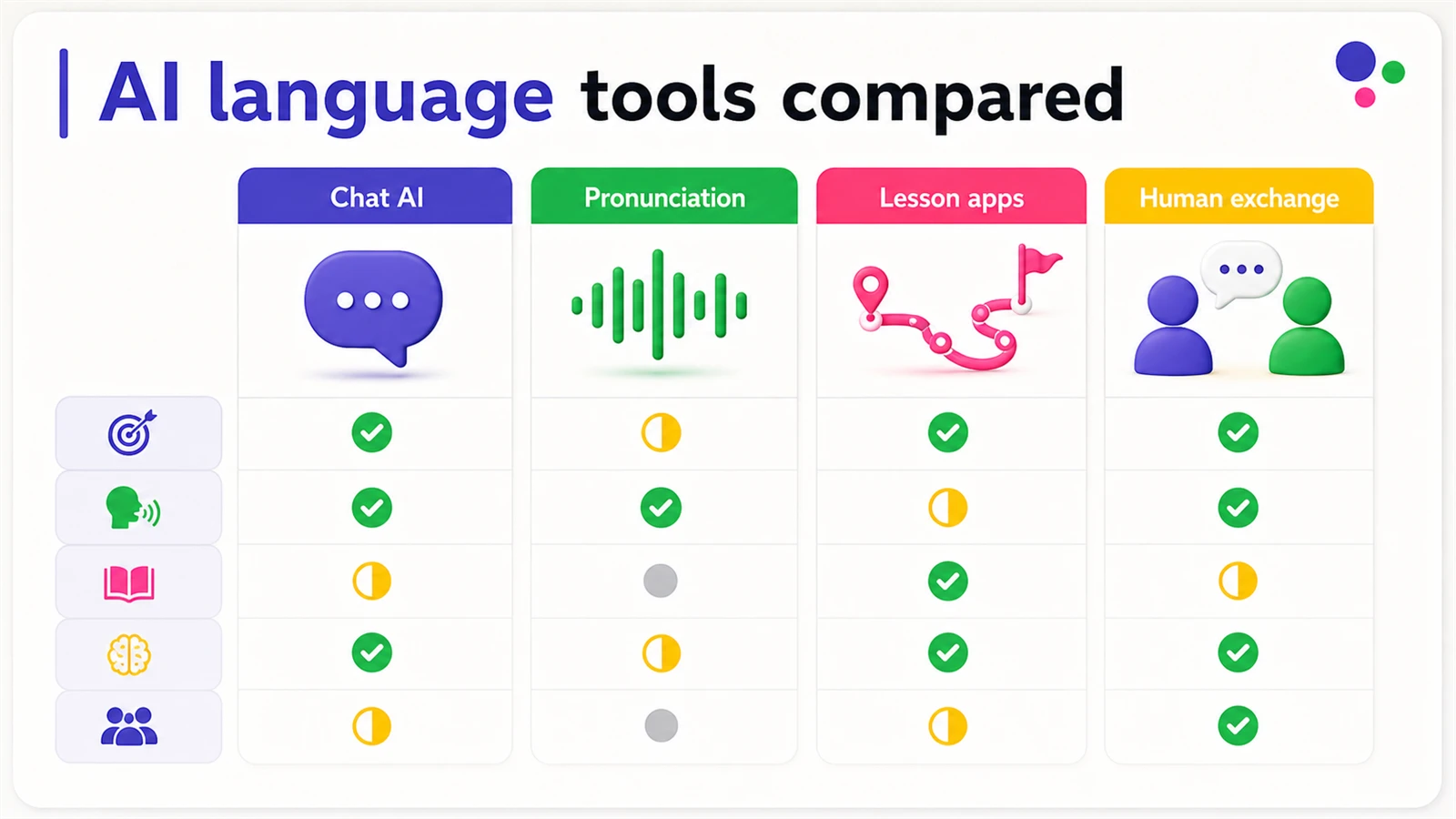
| AI Tool Type | Best For | Limitation |
|---|---|---|
| Grammar & translation AI (ChatGPT, DeepL) | Explanations, corrections, context | No real-time conversation pressure |
| Pronunciation AI (ELSA, Speechling) | Accent feedback, phoneme training | Can’t replicate natural speech flow |
| Vocabulary AI (Anki + AI decks) | Spaced repetition, custom lists | No contextual conversation |
| Conversation AI (Duolingo Max, Pi) | Low-stakes dialogue simulation | Predictable, low social pressure |
| Human exchange platforms (HelloTalk) | Real conversation, cultural nuance | Requires scheduling, less structured |
On-demand grammar and vocabulary explanations. You can ask an AI to break down the difference between two near-synonyms in your target language — complete with examples, context, and level-appropriate framing. No textbook adjusts on the fly like this. That flexibility is real value.
Contextual translation, not just word-swapping. Modern AI translation tools go well beyond dictionaries. They surface cultural connotations, register differences, and the situations where a phrase actually fits — and where it doesn’t. AI translation has grown far beyond dictionaries.
- Pronunciation feedback at any hour. Some tools analyze your spoken output and flag where it diverges from native patterns. It’s imperfect, but it’s available without scheduling, without judgment, and with infinite patience.
- Custom drills on any topic. Need 20 example sentences using Korean honorific past tense in the context of a work conversation? You can generate them in seconds. The ability to customize drilling content makes repetition feel purposeful rather than mechanical.
- Researching which language to study. This use case is underrated. AI tools are effective at synthesizing trade-offs — difficulty curves, speaker populations, career relevance, cultural richness — mapped to your specific goals and circumstances.
The Part AI Still Can’t Provide
Here’s what the 30-day fluency claims leave out.
Fluency is built in real interaction, not around it. AI conversation tools are genuinely impressive. But authentic conversation carries something they can only simulate: actual social stakes. The uncertainty of not knowing what someone will say next. The need to express yourself in real time without a pause to edit. The experience of making yourself understood — truly — by another person.
Research backs this up. A 2024 study on multimedia assisted language learning found that learners who combined AI tools with real human conversation practice progressed approximately 40% faster than those who relied on AI alone. The tools work best as accelerants within a broader practice — not as substitutes for the core of it.
Think of it as training versus competing. AI can be an extraordinary training partner: it runs drills indefinitely, explains anything on demand, and never gets tired or impatient. But a training partner isn’t the same as the actual game. In language learning, the actual game is real conversation with real people — and no tool currently on the market replaces that.
Using AI to Choose the Right Language
If you haven’t yet committed to a language, AI is a genuinely useful research tool. Most learners either follow instinct (“I’ve always wanted to learn Italian”) or pick based on vague utility (“Spanish seems practical”). Neither approach is wrong, but both skip trade-offs worth knowing about.
Prompts that cut through the generic rankings:
- “I’m interested in business opportunities in Southeast Asia and also love anime and gaming culture. Compare Japanese, Mandarin, and Indonesian for my goals.”
- “Give me a ‘day in the life’ scenario of someone who speaks Spanish fluently living in Miami — what does the language actually do for them?”
- “I have 30 minutes a day to study. How long would it realistically take me to reach conversational level in French vs. Korean?”
Prompts like these surface specifics that general guides don’t cover — trade-offs tied to your actual life and goals rather than averaged advice for a hypothetical learner.
Pair any AI research with community input: learner forums, language-specific subreddits, and language exchange platforms where people share firsthand experience. AI synthesizes information well; lived experience adds texture that data alone misses.
Treating AI as a Companion, Not a Replacement
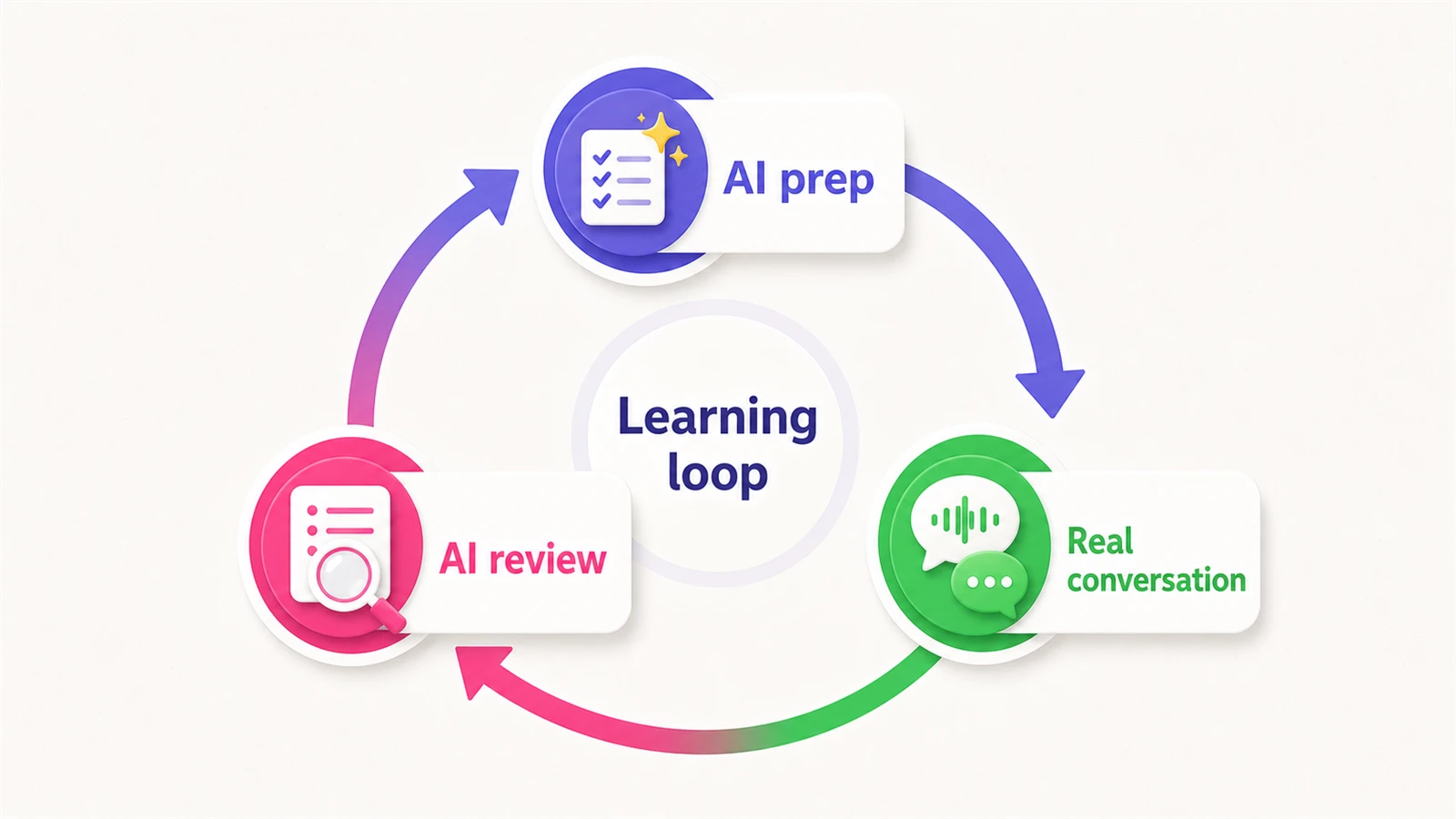
The most effective AI-assisted learners aren’t using AI instead of human conversation. They’re using it to make human conversation more productive — before and after each session.
- Before a conversation: Use AI to prepare. Pull up vocabulary relevant to the topic. Generate a few practice sentences. Think through questions you’ll likely encounter or want to ask. Walking into a language exchange session genuinely prepared makes the whole exchange higher quality.
- During a conversation: Put the AI away. Be present with the person. Make mistakes — working through them in real time is exactly where acquisition happens. This is the part no algorithm replicates.
- After a conversation: Return to AI for review. Dig into corrections you received. Ask for deeper explanations of grammar structures that tripped you up. Generate new examples of forms you struggled with. Solidify what the real conversation surfaced.
The loop — AI prep, real conversation, AI review — compounds over time. AI-assisted preparation makes your real conversations richer; feedback from real conversations makes your AI review sessions more targeted. Each session builds on the last.
This is multimedia assisted language learning at its most practical: not choosing between digital tools and human connection, but deliberately sequencing them.
How to Put the Loop Into Practice
You don’t need a complicated system. Here’s a minimal one that works:
Step 1: Use AI to commit to a language and set a concrete goal. Don’t just decide to “learn Japanese.” Frame it: “I want to hold a five-minute conversation about my daily routine in Japanese within six months.” Ask an AI whether that timeline is realistic and what it would take to get there.
Step 2: Find a language partner. Look for native speakers of your target language who are learning yours. Platforms like HelloTalk — with a large user base across hundreds of languages — connect learners with native speakers for real conversation. Send a brief, genuine introduction and start there.
Step 3: Use AI to prepare before each session. Ten minutes of focused AI-assisted prep before a language exchange is worth more than an hour of passive study. Vocabulary, likely phrases, one or two questions you actually want to ask.
Step 4: Review corrections with AI after each session. Many language exchange platforms let partners correct your written messages directly. Take those corrections to an AI for deeper explanation — turn each one into a mini lesson rather than a fleeting note.
Four steps. No expensive courses required. No waiting until you feel ready.
Frequently Asked Questions About AI Language Learning
Can AI replace a human language tutor? For structured practice — grammar explanations, vocabulary drilling, pronunciation feedback — AI tools now handle many things a tutor used to do, often more flexibly and at lower cost. But a human tutor or exchange partner still provides something AI can’t fully replicate: real social stakes, unpredictable conversation, and genuine cultural exchange. The best approach uses AI for prep and review, and real interaction for actual conversation practice.
What is the best AI tool for learning a language in 2026? There’s no single answer — the best tool depends on what you need. ChatGPT and Claude are excellent for explanations, grammar help, and custom practice content. ELSA and Speechling specialize in pronunciation. Duolingo Max offers structured lesson paths with AI conversation. For connecting with real native speakers, language exchange platforms add the human layer. Most serious learners use a combination rather than a single app.
How do I use ChatGPT to practice a language? Use it for targeted tasks: explain a grammar rule with examples in your target language, generate practice sentences on a specific topic, roleplay a scenario (ordering food, giving directions), or correct a paragraph you wrote. Treat it as a tireless study partner rather than a conversation simulator — its real strength is on-demand explanation and custom content generation, not replicating the pressure of real conversation.
Does AI language learning actually work? Yes, with an important qualifier. AI tools genuinely accelerate the structural parts of language learning — vocabulary acquisition, grammar understanding, reading comprehension. Research shows learners using AI tools alongside human conversation practice progressed about 40% faster than those using AI alone. The qualifier is that fluency ultimately requires real conversation with real people. AI works best as part of a broader practice, not as a standalone solution.
What’s the difference between AI language apps and language exchange apps? AI language apps (Duolingo, Babbel, ChatGPT-based tools) provide structured, on-demand practice with no scheduling required — you practice at your own pace with a system that never gets tired. Language exchange apps connect you with real native speakers for genuine conversation — messier, more unpredictable, and significantly more effective for developing real fluency. The distinction matters: AI apps build your foundation; language exchange with real people tests and develops it under real conditions.
How do I combine AI tools with real conversation practice? The most effective structure: use AI before a conversation to prepare vocabulary and likely phrases, have the real conversation without AI assistance, then return to AI afterward to review corrections and dig into grammar points that came up. This loop — AI prep, real exchange, AI review — makes both tools more effective than either used in isolation.
What AI Has Actually Changed
AI won’t teach you a language in 30 days. Anyone making that claim is overpromising.
What AI has changed is the friction layer around language learning. The waiting for a tutor. The hesitation to ask a basic question. The limited access to native-level content and explanations. It democratizes the support layer of language learning in a way that’s genuinely new.
But the language itself still lives in human exchange. That’s not a limitation of current AI technology — it reflects what language actually is. Language is how people connect with each other. The destination is always people. The tools just make the journey more efficient.
Start with a concrete goal, pair your AI tools with real conversation practice, and build the loop. That’s the approach that works.