How Arab-American Families Compare Curriculum, Lesson Format, and Progress Feedback
51Talk and Novakid both appear regularly when Arab-American families search for online English programmes for children. Both platforms have genuine strengths. Both are well-reviewed by a broad parent audience. And both are priced in a similar range, which makes the comparison feel like a coin flip to parents who are not sure what criteria to use.
For Arab-American families specifically, the comparison is not a coin flip. Arab-American children have a distinct language profile: they grow up in an English-speaking country, are typically fluent in English by school age, but carry Arabic phonological patterns into their English pronunciation that do not disappear through general exposure. The /b/ for /p/ substitution, the /f/ for /v/ substitution, and the various /th/ difficulties common to Arabic speakers persist in Arab-American children’s English for the same reason they persist in Saudi children’s English: the Arabic sound system does not contain these phonemes, and fluency does not automatically correct them.
This means the question is not which platform has better reviews or a more appealing interface. The question is which platform’s structure is designed to address the specific pronunciation gap that Arab-American children actually have. This guide works through the three dimensions Arab-American families ask about most: curriculum structure, lesson format, and progress feedback. It explains what each platform does on each dimension, what the differences mean for your child specifically, and how to decide which one is the right fit.
What Each Platform Is Built to Do
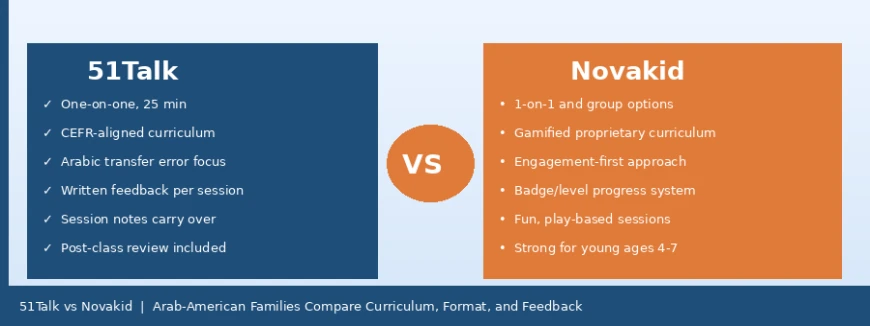
Before comparing features, it helps to understand what each platform was designed for. Both serve children learning English online, but their design priorities are different, and those priorities show up in every dimension of the comparison.
51Talk
51Talk is a live one-on-one English platform for children. Every session is 25 minutes, delivered by a qualified teacher, and structured around CEFR levels and Cambridge English learning goals. The lesson cycle includes a pre-class warm-up that references the previous session, the live lesson with real-time correction, post-class review exercises targeted to that session’s content, a written teacher feedback report after every session, and regular level assessments. The platform is designed for systematic, measurable language development with clear level progression and documented session outcomes.
The one-on-one format is not incidental to 51Talk’s design. It is central to it. The platform is built on the premise that individual language correction requires individual instruction: that errors a teacher cannot hear because they are managing a group of children cannot be corrected, and that Arabic transfer errors in particular are subtle enough that they will be missed in group settings even by attentive teachers.
Novakid
Novakid is a game-based English platform for children aged four to twelve. Sessions are offered in both one-on-one and group formats depending on the plan, and the curriculum is proprietary to the platform, built around engaging, visually rich content designed to feel more like play than formal instruction. Progress is tracked through levels and badges rather than formal reports. The emphasis is on building enthusiasm for English, developing speaking confidence in a low-stakes environment, and making the language feel accessible and enjoyable rather than effortful.
Novakid’s design priority is engagement. This is a genuine pedagogical choice, not just a marketing angle. Young children who have never had English instruction outside school often disengage from formal lesson formats. A platform that reduces the anxiety of performing in English by making the performance feel like a game serves a real need, particularly for children aged four to seven who are still developing their relationship with language learning.
Dimension 1: Curriculum Structure
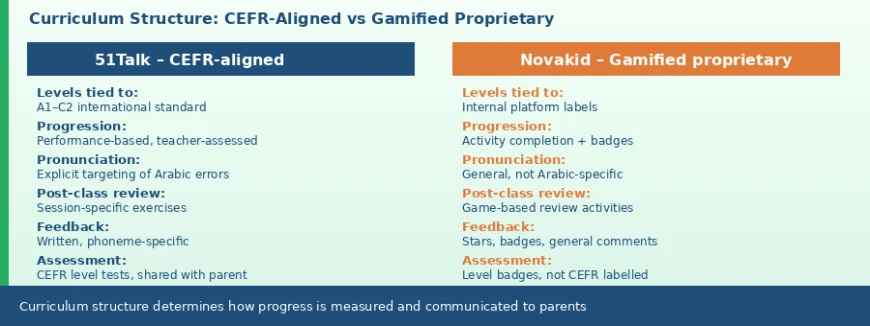
The curriculum structure of an online English programme determines how progress is defined, how it is measured, and how it is communicated to parents. This is the dimension where the two platforms differ most significantly for Arab-American families.
51Talk: CEFR-aligned with Cambridge English goals
51Talk’s curriculum is structured around the Common European Framework of Reference for Languages, the international standard that defines English proficiency from A1 (absolute beginner) to C2 (near-native). This means that when a 51Talk teacher says a child has moved from A1 to A2, that statement has a defined meaning in an internationally recognised framework. It tells parents, schools, and future programme providers exactly what the child can do in English at each level.
The practical consequence for Arab-American families is that progress is not relative to the platform’s own internal standards. An A2 child on 51Talk is an A2 English speaker by a standard that applies equally in the US, the UK, Saudi Arabia, and anywhere else. For families who may move or whose children may eventually take Cambridge English qualifications, that alignment is a tangible advantage.
The curriculum also embeds pronunciation work as a component of level progression rather than treating it as a separate optional extra. A child working toward A2 who has Arabic transfer errors will have those errors addressed as part of the curriculum, because accurate phoneme production is part of the A2 speaking standard. This is not a guarantee that every error will be corrected, but it is a structural reason for the teacher to target pronunciation rather than leaving it aside.
Novakid: proprietary gamified curriculum
Novakid’s curriculum is proprietary and does not map to CEFR levels. The platform uses its own level system, described through internal labels and visualised through badges and progress bars. For children aged four to seven who are building their first relationship with English, this distinction matters less: at the very early stages of language acquisition, engagement with the language is more important than alignment with a formal standard.
For Arab-American children aged eight and above who are working on pronunciation accuracy rather than initial language exposure, the absence of CEFR alignment has practical implications. Parents cannot compare their child’s Novakid level to a school assessment or Cambridge English result. They cannot use the platform’s level data as evidence of progress in an independent standard that exists outside the platform.
Novakid’s curriculum progression is also primarily activity-based rather than performance-based. A child advances through levels by completing activities rather than by demonstrating specific language competencies in an assessment. This produces steady progression through the platform’s content but does not guarantee that the child’s actual language ability has advanced to the level the badge suggests.
Dimension 2: Lesson Format
Lesson format is the dimension that most directly determines correction density: how many of your child’s pronunciation errors are actually heard and addressed in any given session.
51Talk: one-on-one, 25 minutes
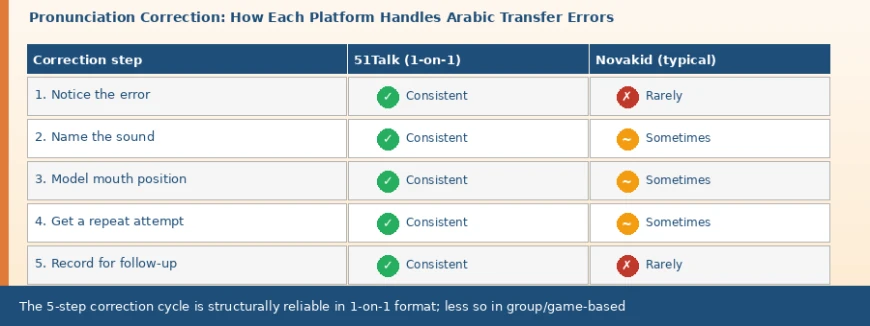
51Talk’s sessions are always one-on-one. There is no group format option. This is not a limitation; it is a deliberate design choice based on the premise that individual pronunciation correction requires individual instruction. In a 25-minute one-on-one session, the teacher hears every word the child produces. When the child says “ben” for “pen”, the teacher hears it, stops, names the specific sound, demonstrates the correct mouth position, and asks for a repeat attempt before the session moves forward. This five-step correction cycle, notice, name, model, repeat, record, can run at its full quality because there are no other children competing for the teacher’s attention.
Child speaking time in a well-structured 25-minute one-on-one session is approximately eight to twelve minutes. This sounds modest but is highly productive because every production is monitored and corrected. Eight to twelve minutes of individually corrected speaking time is significantly more valuable for pronunciation improvement than thirty minutes of group speaking time where Arabic transfer errors pass unaddressed.
Novakid: one-on-one and group options
Novakid offers both one-on-one and group lesson formats depending on the plan. For the purposes of this comparison, the relevant question is what the group format means for pronunciation correction density.
In a group session of six to eight children, each child speaks for approximately five to eight minutes on average. More importantly, a teacher managing six to eight children cannot stop the lesson to address one child’s /b/-for-/p/ substitution every time it appears without disrupting the lesson flow for the other children. Arabic transfer errors that do not cause comprehension breakdown, which is most of them, will be allowed to pass in the interests of keeping the group moving. This is not poor teaching. It is an inherent structural limitation of the group format.
Novakid’s one-on-one sessions, when chosen, operate similarly to other one-on-one platforms: the teacher can hear every production and has the time to address individual errors. The correction depth in a Novakid one-on-one session depends on whether the teacher makes pronunciation correction a priority. Whether the teacher’s approach aligns with the five-step correction cycle is a question worth asking before booking.
The game-based session design
Novakid’s sessions are designed around game-based activities: interactive exercises, visual prompts, animated characters, and reward systems that make the session feel like play rather than instruction. For children who are reluctant to engage with English in a structured lesson format, this design is genuinely valuable. A child who would refuse to attempt a pronunciation drill will often attempt the same sound in the context of a game because the stakes feel lower.
The implication for pronunciation work is that the session’s primary goal is engagement rather than correction. A Novakid teacher who interrupts a game activity to run a five-step correction cycle on a /b/-for-/p/ substitution is working against the session’s design logic. The session is designed to keep the child flowing through the activity. Correction that fits naturally into the activity flow will happen; correction that requires stopping the game will happen less often.
Dimension 3: Progress Feedback
Progress feedback is how parents know whether the programme is producing results. The feedback systems of 51Talk and Novakid are structured very differently, and the difference has significant practical implications for Arab-American parents who want to verify that their child’s specific pronunciation errors are being addressed.
51Talk: written phoneme-specific reports
51Talk provides a written feedback report after every session. For the report to constitute verifiable evidence of progress, it needs to name specific phonemes rather than give general encouragement. A report that says “/p/ substitution corrected three times; child produced pen and park correctly by end of session” is actionable. It tells the parent which sound was targeted, what the correction looked like, and whether in-session improvement occurred.
Before enrolling, Arab-American parents should request a sample feedback report from 51Talk and check whether it contains phoneme-specific information. This is the single most important pre-enrolment step for parents who want to use the feedback system as evidence of progress. If the sample report is general, ask whether more specific reporting is possible for enrolled students.
The session note carry-over feature is equally important. The feedback from Monday’s session should be visible to the teacher at Wednesday’s session. This allows corrections to compound rather than restart, and it allows the Wednesday report to reference whether Monday’s corrections held. Without carry-over, each session is an independent event and the feedback reports cannot show cross-session retention.
Novakid: badges, levels, and general comments
Novakid’s progress system is built around badges, level progression, and in-app visualisations of achievement. This system is effective for motivating children and for giving parents a general sense that their child is advancing through the platform’s curriculum. It is not designed to provide phoneme-level evidence of pronunciation progress.
A Novakid session that addresses a child’s /v/ substitution in passing during a game activity will not produce a report naming the /v/ phoneme as a correction target. The feedback will reflect the child’s engagement with the session content, their completion of activities, and any general language points the teacher noticed. Parents who want to know whether Arabic transfer errors are being addressed systematically will not find that information in a Novakid progress report.
This is not a hidden limitation. Novakid is transparent about its engagement-first approach. The question for Arab-American parents is whether the absence of phoneme-specific feedback matters for their child’s specific learning goal. For a child who is building initial English confidence and vocabulary, it may not. For a child who needs targeted correction of specific Arabic transfer errors, it does.
Side-by-Side Comparison: All Three Dimensions
This table compares 51Talk and Novakid across all three dimensions and additional features that Arab-American families ask about. Verify specific details directly with each platform before booking.
| 51Talk | Novakid | |
| Session format | One-on-one only, 25 minutes | One-on-one and group options, 25-50 min |
| Curriculum standard | CEFR-aligned, Cambridge English goals | Proprietary gamified curriculum |
| Level progression | Performance-based, teacher-assessed | Activity completion + badges |
| Pronunciation approach | Explicit correction of Arabic errors | General, engagement-first |
| Arabic transfer errors | Specifically targeted every session | May be caught; not systematic |
| Post-class review | Session-specific exercises, included | Game-based review activities |
| Feedback reports | Written per session, phoneme-specific | Badges, levels, general comments |
| Session note carry-over | Teacher has prior session notes | Varies by platform setup |
| Parent dashboard | Ask platform before booking | Progress visible via app |
| CEFR assessment | Yes, at regular intervals | No, uses internal level labels |
| Age range primary fit | Ages 7-12, pronunciation accuracy focus | Ages 4-9, engagement and fluency focus |
| Teacher matching | Request Arabic-learner experience | Platform-matched teacher |
| Monthly cost (approx.) | $80-$150 at 3x/week | $80-$130 per plan |
| Trial lesson | Yes, available at 51talk.com | Yes, trial available |
| Best suited for | Pronunciation accuracy, Arabic errors | Engagement, early fluency, confidence |
Which Platform Fits Your Child’s Situation
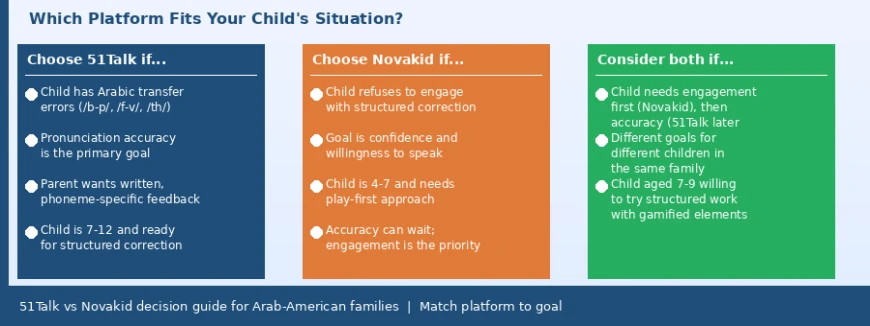
The right platform depends on your child’s current situation and the specific goal you are working toward. This table maps eight common scenarios Arab-American families describe to the platform that is the better structural fit for each one.
| Situation | Better fit | Why |
| Child has /b/ for /p/ and /f/ for /v/ substitutions after years of English school | 51Talk | These are Arabic transfer errors that need explicit one-on-one correction. They are not addressed by gamified exposure. |
| Child aged 5 who has never had English lessons and refuses structured activities | Novakid | The play-first approach builds willingness to engage with English before correction-focused work begins. |
| Child aged 8 who is fluent but has noticeable Arabic accent patterns in pronunciation | 51Talk | Fluency is in place; the gap is phoneme accuracy. One-on-one structured correction addresses this directly. |
| Child aged 6 who is confident in Arabic but shy in English | Novakid then 51Talk | Novakid’s low-stakes game environment builds speaking confidence first; structured accuracy work follows once confidence is established. |
| Parent wants to track progress with specific phoneme-level data | 51Talk | The written feedback report after every session names the phonemes addressed. Novakid’s reporting is badge-based. |
| Child gets bored quickly and disengages after 15 minutes | Novakid or 51Talk with caveats | Novakid’s game-based format maintains younger children’s attention. 51Talk’s 25-min one-on-one is also short but less game-based; teacher style matters more. |
| Family wants CEFR-aligned level tracking for school or exam purposes | 51Talk | 51Talk’s curriculum is CEFR-aligned with regular level assessments. Novakid’s internal labels do not map to CEFR. |
| Child is already in US school all day and needs only pronunciation supplement | 51Talk | School provides the general English exposure; the gap is individual pronunciation correction. One-on-one structured sessions fill that gap specifically. |
51Talk for Arab-American Families: What to Confirm Before Booking
If 51Talk is the platform you are evaluating for pronunciation accuracy work, these are the specific features worth confirming directly before committing to a plan.
Arabic-learner teacher experience
Ask whether you can request a teacher who has worked with Arab-American or Arabic-speaking children and is familiar with the Arabic-English phonological transfer patterns, specifically /b/ for /p/, /f/ for /v/, /sh/ for /ch/, and /d/ or /t/ for /th/. A teacher who knows these patterns catches them automatically. A teacher who does not may miss them even in a one-on-one setting.
Feedback report specificity
Request a sample feedback report before enrolling. Check specifically whether it names phonemes. A report that names sounds is a report you can use as progress evidence. A report that does not is a report you cannot distinguish from an engagement summary.
Session note carry-over
Ask whether the teacher at each session has access to the feedback from the previous session. This is the mechanism that allows corrections to build across sessions rather than restart. It is also the mechanism that allows the feedback report to note whether prior corrections are holding.
CEFR level assessment process
Ask how frequently CEFR level assessments are conducted and whether parents receive a written result stating the CEFR level. This is the testable evidence that is independent of teacher reporting and can be compared across time.
A trial lesson is available at 51talk.com. Use it to verify correction quality directly, check whether the feedback report from the trial contains phoneme-specific information, and confirm the session note carry-over before committing. Save the answers to the questions above in writing before the first paid session.
Novakid for Arab-American Families: When It Makes Sense
Novakid is not the wrong choice for Arab-American children. It is the wrong choice for Arab-American children whose primary need is systematic pronunciation correction of Arabic transfer errors. For children whose primary need is something else, Novakid may be the better fit.
Children who refuse to engage with structured correction
For a child who shuts down when asked to practise sounds deliberately, Novakid’s game-first environment can build the willingness to speak English at all. Once that willingness is in place, structured pronunciation work is more productive because the child is not starting from a position of resistance. A three-month Novakid engagement-building phase followed by a 51Talk pronunciation-accuracy phase is a reasonable sequenced plan for children in this situation.
Children aged four to six building first English exposure
At ages four to six, the primary language development goal is exposure and habit formation rather than accuracy correction. A platform that makes English feel enjoyable and normal is more appropriate at this age than one that runs five-step correction cycles on phoneme errors. Novakid’s design fits this age range well. The CEFR alignment and phoneme-specific feedback that matter from age seven onward are less critical at this stage.
Children already receiving pronunciation correction elsewhere
For a child who is already working with a speech-language pathologist or a specialist pronunciation tutor on Arabic transfer errors, Novakid can serve as a complementary platform for general English fluency and confidence work. The phoneme correction is happening in the specialist setting; Novakid provides the broader English exposure and speaking practice that rounds out the programme.
Parent Evaluation Checklist: Ten Questions for Both Platforms
Use this checklist before committing to either platform. It covers the features that matter most for Arab-American families comparing pronunciation accuracy outcomes.
| Question | Field | 51Talk | Novakid |
| Is the session one-on-one? | Format | Always | Option (confirm plan) |
| Are Arabic transfer errors explicitly targeted? | Pronunciation | Yes | Not systematically |
| Is there a written feedback report naming phonemes? | Feedback | Yes (request sample) | No — badge system |
| Is the curriculum CEFR-aligned? | Curriculum | Yes | No — internal labels |
| Is there a post-class review tied to session sounds? | Review | Yes | Game-based, not tied |
| Do session notes carry over between lessons? | Continuity | Yes | Verify before booking |
| Can I request a teacher with Arabic-learner experience? | Teacher | Ask when booking | Platform-matched |
| Is a trial lesson available? | Trial | Yes — 51talk.com | Yes — check platform |
| What does progress look like on the parent dashboard? | Visibility | Written reports + CEFR | Badges and level labels |
| What happens if teacher match is not right? | Policy | Ask: change process | Ask: change process |
What to Do Next
Start with your child’s primary goal. If it is pronunciation accuracy, specifically addressing Arabic transfer errors that have persisted despite years of US school English instruction, the structural conditions for achieving it are present in 51Talk and largely absent in Novakid. The one-on-one format, the CEFR-aligned curriculum, the phoneme-specific feedback reports, and the session note carry-over all point in the same direction.
If the primary goal is engagement and confidence building, particularly for a child aged four to seven or a child who actively resists structured English work, Novakid’s game-based design addresses that goal more directly. Pronunciation accuracy can follow once confidence is established.
If you are not sure which goal should come first, ask one question: when your child speaks English in a normal conversation, do you hear consistent Arabic transfer errors, specifically /b/ for /p/ or /f/ for /v/? If yes, those errors are the primary gap and they need structured correction. If no, or if the child barely speaks English at all, confidence and engagement come first.
Both platforms offer trial lessons. Take both trials if you are genuinely uncertain. Bring the checklist. Read the feedback reports from both trials. The comparison in writing, between what each platform’s trial report tells you, will usually make the decision clearer than any feature comparison can.
Frequently Asked Questions
Does 51Talk offer trial lessons for Arab-American families in the US, and how do I request a teacher with Arabic-learner experience?
Trial lessons are available at 51talk.com. When you enquire, ask specifically whether a teacher with experience working with Arabic-speaking children can be assigned for the trial, and mention that Arabic-English transfer patterns, specifically /b/ for /p/ and /f/ for /v/, are the primary concern. A platform that can give a specific answer to this question has teacher-matching capacity that addresses Arabic-learner needs. Also ask to see a sample feedback report before the trial so you can evaluate the phoneme-specific reporting level before committing.
Can Novakid’s one-on-one option deliver the same pronunciation correction as 51Talk?
In principle, a Novakid one-on-one session with a teacher who makes pronunciation correction a priority can deliver the five-step correction cycle for individual errors. In practice, the platform’s game-based session design means the teacher is working within a structure that prioritises activity flow over correction interruptions. Whether a specific Novakid teacher applies rigorous pronunciation correction in a one-on-one setting is a function of that teacher’s approach rather than a platform-level guarantee. If you choose Novakid for one-on-one sessions, ask the teacher directly before booking how they handle Arabic transfer errors and whether they are familiar with /b/-for-/p/ and /f/-for-/v/ substitutions.
My child is 9 and has been on Novakid for 6 months. Should I switch to 51Talk?
Ask one question first: do you still hear Arabic transfer errors in your child’s natural English speech after six months of Novakid sessions? If yes, the sessions have been building engagement and vocabulary but have not addressed the specific pronunciation patterns. Switching to 51Talk for structured pronunciation work at this point is reasonable. If the Arabic transfer errors are largely absent after six months, the Novakid programme has served its purpose and you can evaluate whether continued sessions serve a different goal, such as CEFR-aligned level progression or exam preparation.
Is the cost similar between the two platforms, and is one better value for money?
Both platforms are priced in a broadly similar range for comparable session frequencies, typically $80 to $150 per month at two to three sessions per week. The value comparison depends on the goal. For pronunciation accuracy specifically, 51Talk delivers more value per dollar because the one-on-one format ensures every error is heard and the written feedback reports provide verifiable evidence. For engagement and early exposure, Novakid’s game-based format may deliver more enjoyment per dollar for young children who would find structured correction unrewarding. Calculate cost per corrected speaking minute using the method in the 51Talk Cost Guide rather than comparing monthly prices directly.
Can I use both platforms at the same time for different goals?
Yes, and for some Arab-American families this makes sense. A child who does two 51Talk sessions per week for structured pronunciation correction and one Novakid session for game-based vocabulary exposure and English enjoyment is getting two different types of value from two different structures. The risk is scheduling overload and the confusion of mixing two different teaching styles and feedback systems. If you do run both simultaneously, keep the goals explicit: 51Talk is for pronunciation accuracy, Novakid is for fluency and confidence. Do not expect Novakid to contribute to pronunciation evidence and do not expect 51Talk to feel like the Novakid game. They are different products serving different purposes.
How do I explain to my child the difference between the two platforms when choosing?
You do not need to. Tell your child they are going to try a new English activity and see whether they like it. Run the trial for whichever platform you are evaluating. After the trial, ask your child one specific question: what did you practise today? Their answer tells you what they retained, which is more informative than asking whether they liked it. Retention of specific language points, even if the child frames it as a game they played, is a positive signal. A child who remembers only that they had fun without any language retention is giving you a different signal.