Description: A practical guide for Saudi parents evaluating whether 25-minute online English lessons are sufficient for their child — covering attention windows, speaking time calculations, post-class review, and how session length interacts with frequency.
Is a 25-Minute English Lesson Enough for Your Child?
A Practical Guide for Parents in Saudi Arabia
Twenty-five minutes sounds short. When you are comparing English programmes for your child and one of them says the sessions are only 25 minutes long, it is natural to wonder whether that is enough time to actually learn anything. A school class is 45 minutes. A private lesson is usually an hour. Why would a shorter session be better?
The honest answer is that it depends entirely on what happens inside those 25 minutes and how often the sessions happen. A 25-minute one-on-one lesson where the child speaks for ten minutes and receives real-time correction on every error can produce more measurable pronunciation improvement than a 60-minute group class where the same child speaks for five minutes and three errors go unaddressed.
This guide works through the question practically. It covers what child attention research tells us about lesson length, how to calculate actual speaking time in different formats, why frequency matters more than duration for pronunciation specifically, and what to check before enrolling your child in any programme. It is written for Saudi parents evaluating online English options, and it uses 51Talk’s 25-minute format as the primary example because that is the most common length parents ask about.
The Attention Question
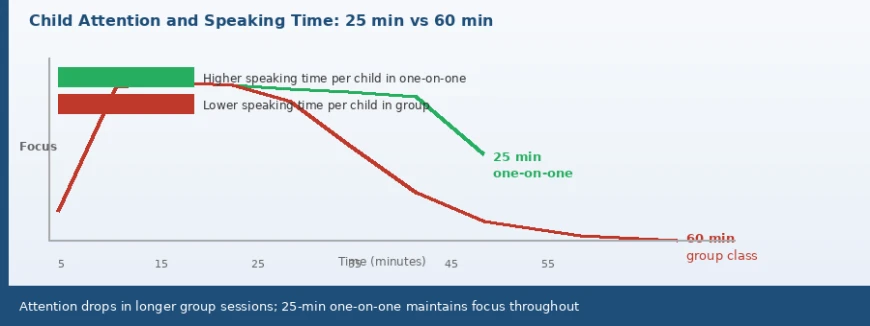
Children’s sustained attention is not proportional to lesson length. A five-year-old can maintain high-quality focus for roughly 10 to 15 minutes before cognitive fatigue sets in. A ten-year-old can stretch that to about 20 to 25 minutes. Beyond those windows, the child is often still physically present but no longer processing new information at full capacity.
This is why a 60-minute lesson with a young child is not twice as effective as a 30-minute lesson. It is often less effective in total, because the first half runs well and the second half runs on diminishing returns. The child looks engaged, the lesson continues, but the retention from the second 30 minutes is substantially lower than from the first.
A 25-minute one-on-one lesson sits inside the peak attention window for children aged five to twelve. There is no second half where attention drops. The lesson ends before the fatigue curve bends downward, which means the child is producing language and absorbing correction at high quality for the entire session.
How this affects pronunciation specifically
Pronunciation correction requires active attention in a specific way. When a teacher addresses a /p/ substitution, the child needs to: hear the correction, understand what is different, feel the new mouth position, attempt the sound again, and receive confirmation. That sequence takes 20 to 30 seconds. If the child’s attention is drifting, steps three, four, and five get compressed or skipped entirely, and the correction does not stick.
In a 25-minute lesson where the child is alert throughout, every correction cycle can run at full quality. In the second half of a 60-minute lesson, correction cycles degrade. The teacher says “try again”, the child attempts it, but the physical feedback loop that makes the correction stick is not happening at full capacity.
How to Calculate Actual Speaking Time
The most important number in any English lesson is not the total session length. It is how many minutes the child actually speaks. Speaking time is where pronunciation improvement happens. Listening, vocabulary display, and reading-along activities do not move the needle on pronunciation. Producing sounds under correction does.
Speaking time in a 25-minute one-on-one lesson
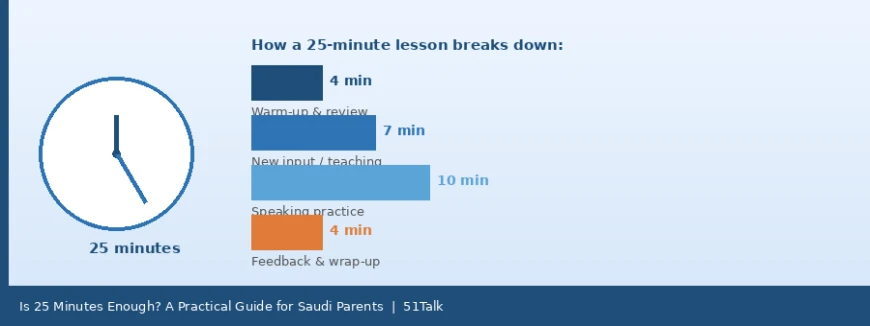
In a well-structured 25-minute one-on-one session, the time breaks down roughly like this:
1. Warm-up and review: four minutes. The child activates sounds and vocabulary from the previous session. This is speaking time with a backward-looking correction function.
2. New teaching input: six to seven minutes. The teacher introduces new content. The child is partially listening, partially responding. Speaking time is lower here.
3. Practice and production: ten minutes. The child is speaking, being corrected, repeating, and producing target language at the highest density.
4. Wrap-up and preview: three to four minutes. The session closes, the post-class review is introduced, and the child knows what to focus on before the next session.
That gives roughly ten minutes of high-quality speaking and correction time in a 25-minute one-on-one session. For a child working on pronunciation, ten minutes of one-on-one speaking time with real-time correction is a substantial amount.
Speaking time in a 60-minute group class with eight children
The same calculation in a group format is stark. A 60-minute class with eight children contains roughly the same total speaking time as a one-on-one session: maybe 45 to 50 minutes of lesson content. Divided across eight children, each child gets five to six minutes of speaking time on average. Some children get more because they volunteer. Some get less because they are quiet or the teacher’s attention is elsewhere.
For pronunciation, the group format has a second problem: errors are not caught reliably. A child who says “berry” for “very” in a group activity will often not be corrected because the teacher is managing eight children simultaneously and the error does not stop the lesson from moving forward. In a one-on-one session, the same error is caught and addressed every time.
Why Frequency Beats Duration for Pronunciation
Pronunciation is a motor skill, and motor skills are developed through repetition distributed across time, not through long single sessions. This principle applies to everything from learning to ride a bicycle to learning to produce /p/ correctly after years of substituting /b/.
The reason is how motor memory consolidates. When a child practises a new sound in a session, the neural pathway for that movement is activated but not yet stable. During the hours and days after the session, the brain consolidates the pattern during rest periods, particularly sleep. If the next practice session happens within two or three days, the consolidation process is reinforced before the pattern has faded. If the next session is a week away, a significant part of what was built in the last session has degraded and has to be rebuilt.
What this means in practice
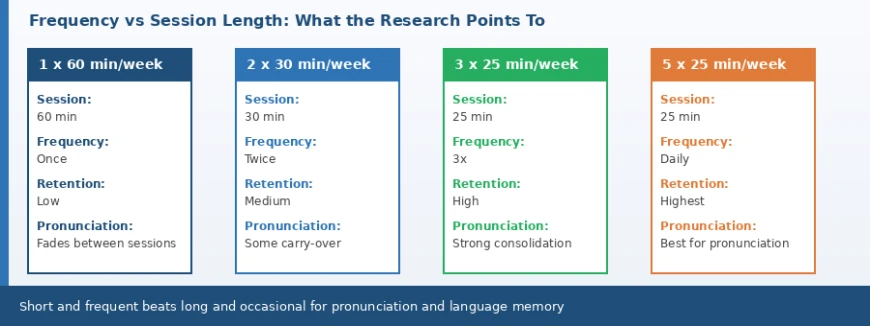
Three 25-minute sessions per week produces stronger pronunciation improvement than one 75-minute session per week. The total practice time is the same. The retention is not. Spreading practice across three days gives the motor memory system three consolidation windows instead of one.
Five sessions per week is even more effective for pronunciation than three, for the same reason. Daily short practice, whether through a live session or home drills targeting the same sounds, keeps the consolidation cycle running without gaps. Saudi families often have more scheduling flexibility for short sessions than for long ones, which makes the 25-minute format practically useful as well as pedagogically sound.
The forgetting curve and how to beat it
Without review or practice, people forget a substantial portion of new learning within 24 hours. For pronunciation, the forgetting is not about knowing the word. It is about motor pattern decay: the mouth position that felt natural in the session starts to drift back toward the Arabic default without practice. The post-class review exercises that follow a live session exist specifically to interrupt this decay. If those exercises target the exact sounds practised in the session and happen within a few hours of the session ending, the consolidation curve is reset before it falls too far.
This is one reason why post-class review exercises linked to specific session content are more valuable for pronunciation than generic vocabulary review. The decay clock starts immediately after the session. Targeted review the same evening restores the pattern before it fades.
When 25 Minutes Is Enough, and When It Is Not
The straightforward answer to the title question is: yes, 25 minutes is enough for pronunciation work with children, and in most cases it is more than enough per session. The qualification is that “enough” depends on how often the sessions happen and what the post-class review looks like.
When 25 minutes is enough
• The child is aged five to ten. Attention windows are shorter, and 25 minutes sits inside the peak focus range for this age group. A full 60-minute session often runs too long for sustained quality engagement.
• The goal is pronunciation accuracy. Pronunciation requires short, corrective, high-attention practice. Twenty-five focused minutes of one-on-one correction beats 60 minutes of lower-intensity group exposure for phoneme-level work.
• Sessions happen at least three times per week. Frequency compensates for brevity. Three 25-minute sessions per week gives the motor memory system three consolidation windows, which is more effective than one longer session.
• Post-class review is structured and sound-specific. If the 25-minute session is followed by ten to fifteen minutes of targeted review exercises the same day, the effective practice time per session is 35 to 40 minutes, not 25.
• There is a clear feedback loop between sessions. If the teacher’s written feedback from Monday’s session is visible at Wednesday’s session, the teacher can build directly on what was addressed two days earlier rather than starting fresh.
When 25 minutes may not be enough
• Sessions happen only once a week. One 25-minute session per week is too infrequent for pronunciation work. The motor memory decay between sessions is too severe. If the programme only offers one session per week, it needs to be supplemented with daily home drills on the same target sounds.
• The child is older and working on complex content. A twelve-year-old working on grammar, reading comprehension, and essay writing may genuinely need more than 25 minutes per session to cover the material. For older learners with primarily fluency and content goals, longer sessions can be appropriate.
• There is no review between sessions. A 25-minute session without post-class review is genuinely short. The review is what converts a 25-minute session into a 35-to-40-minute learning event. Without it, the session ends and the decay clock runs unchecked.
Format Comparison: 25-Minute One-on-One vs Other Options
This table compares three common lesson formats across the dimensions that matter most for Saudi children working on English pronunciation.
| 25-min one-on-one | 60-min one-on-one | 60-min group (8 children) | |
| Estimated speaking time per child | ~10 min | ~20 min | ~5-8 min |
| Attention quality throughout | High | Drops after 25-30 min | Varies; distraction common |
| Pronunciation errors caught | All | All | Many missed in group flow |
| Real-time correction possible | Yes | Yes | Limited |
| Post-class review targeting session sounds | Yes (built in) | Depends on platform | Rarely |
| Written feedback per session | Yes (51Talk) | Depends on platform | Rarely |
| Scheduling flexibility | High | Moderate | Fixed timetable |
| Best suited for | Pronunciation, accuracy | Older learners, more content | Exposure, social practice |
How 51Talk Makes 25 Minutes Work
The 25-minute format only delivers its potential benefits if the session structure is designed around them. A poorly run 25-minute lesson that spends twelve minutes on teacher explanation and three minutes on student speaking is not more effective than a 60-minute group class. The format is the starting point, not the guarantee.
What 51Talk is
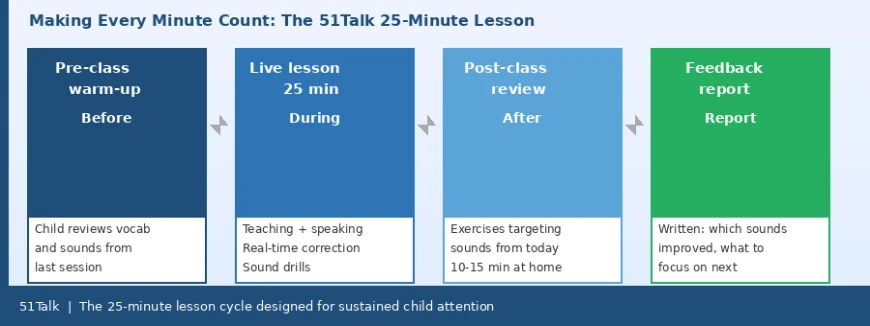
51Talk is a live one-on-one English platform for children. Every session is 25 minutes, delivered by a qualified teacher, and structured around CEFR levels and Cambridge English learning goals. The lesson cycle includes a pre-class warm-up that activates content from the previous session, the live lesson with real-time correction, post-class review exercises that target the specific sounds and vocabulary from that session, a written teacher feedback report, and regular unit and level assessments.
How the 25-minute structure is used
• Pre-class warm-up activates the last session. Before the live lesson begins, the child reviews vocabulary and target sounds from the previous session. This bridges the forgetting curve and means the live 25 minutes starts from a restored baseline rather than from scratch.
• High speaking-time ratio in the live session. The one-on-one format means the child is the only speaker being managed. There is no queue, no waiting for other children, no group activity where the child can stay quiet. Estimated speaking time is around ten minutes of the 25, which is a high ratio compared to group formats.
• Real-time correction of Arabic transfer errors. When the child produces /b/ for /p/ or /f/ for /v/, the teacher addresses it immediately. The one-on-one format means no error can pass unnoticed by drifting into group noise.
• Post-class review extends the session to ~40 minutes. The review exercises after the live session are designed around the sounds from that lesson. They add ten to fifteen minutes of targeted practice the same day, which resets the consolidation curve before the decay window opens.
• Written feedback report guides home practice. Parents receive a written summary after each session noting which sounds were addressed and what to focus on. This makes the home practice between sessions directed rather than generic.
What to ask 51Talk before booking
Ask what the typical breakdown of speaking time is per session. Ask whether the post-class review exercises are session-specific or the same for all children at that level. Ask whether the teacher’s feedback from one session is visible to the teacher at the next session. And ask whether the teacher has experience with Arabic-speaking learners, specifically whether they recognise and address Arabic-English transfer patterns like /b/ for /p/ and /f/ for /v/. These questions have clear, verifiable answers. A trial lesson is available at 51talk.com to test the correction quality directly.
Parent Checklist: Evaluating Any 25-Minute Programme
Use this checklist before committing to any short-format English programme. It covers speaking time, correction quality, review structure, feedback, frequency, continuity, and policy.
| Question to ask or verify | Field | Why it matters |
| How many minutes does the child actually speak in a session? | Speaking time | Less than 8 minutes in a 25-min one-on-one is too low |
| Is there a pre-class warm-up that activates sounds from the last session? | Review continuity | Warm-ups that reference previous session content close the forgetting gap |
| Does the teacher give real-time pronunciation correction, not just move on? | Correction quality | One-pass errors are rarely retained; in-session correction is essential |
| Is there a post-class review exercise linked to sounds from this specific session? | Review structure | Generic review is less effective than session-targeted review |
| Is a written feedback report provided after each session? | Reporting | Verbal summaries get forgotten; written reports guide home practice |
| Can sessions be scheduled 3-5 times per week without extra cost pressure? | Frequency | 3-5 short sessions per week outperform 1-2 long sessions for pronunciation |
| Is the same teacher available consistently across sessions? | Continuity | A teacher who does not know your child’s error history cannot track progress |
| What is the policy for make-up sessions if one is missed? | Policy | Saudi family schedules vary; flexible rescheduling protects lesson frequency |
What to Do Next
A 25-minute one-on-one English lesson is enough for pronunciation work with children aged five to twelve, provided the sessions happen at least three times per week and are followed by targeted post-class review the same day. Those two conditions matter more than the session length itself.
Before enrolling in any programme, calculate the actual speaking time per session rather than looking at the total lesson length. For pronunciation, ten minutes of one-on-one speaking with real-time correction outperforms 45 minutes of group content where the same child speaks for five minutes and several errors go unaddressed.
If the programme you are evaluating is 51Talk, the trial lesson is the right place to check correction quality directly. Watch whether the teacher catches Arabic transfer errors, names the specific sound, demonstrates the correct position, and gets the child to repeat before moving on. Ask to see a sample feedback report. Check whether the post-class review is linked to that specific session’s content.
The question is not whether 25 minutes is enough in the abstract. The question is whether these 25 minutes are structured, frequent, and followed up correctly. When they are, the format works. When they are not, length alone will not save the lesson.
Frequently Asked Questions
Does 51Talk offer more than one session per week, and is the pricing structured for frequent short sessions?
51Talk’s programme is designed for regular scheduling, and multiple sessions per week are standard for most enrolled children. Pricing structures vary by region and plan, so the best approach is to check current details and availability at 51talk.com before booking. When you enquire, ask specifically how many sessions per week are recommended for pronunciation goals and whether the post-class review exercises change with each session or follow a fixed template. Both answers tell you a lot about how the programme handles the frequency question.
My child’s school does 45-minute English lessons. Why would 25 minutes online be more effective?
Because the formats are structurally different. A 45-minute school lesson typically involves one teacher managing 25 to 30 students. Each child speaks for two to three minutes on average, and pronunciation errors pass unaddressed because stopping to correct them for one child while managing a full class is not practical. A 25-minute one-on-one session gives one child ten minutes of speaking time and catches every error. The school lesson and the one-on-one session are not competing: they serve different functions. The school lesson builds vocabulary, reading, and grammar in a structured curriculum. The one-on-one session addresses what the school lesson cannot: individual pronunciation correction at the sound level.
How do I know if my child is actually speaking for ten minutes in a session or if the teacher is dominating the lesson?
Ask the teacher directly after the first or second session: roughly what percentage of the session was the child producing language? A good teacher can give you a specific answer. Alternatively, during a trial lesson, track the time yourself. Note when the teacher is explaining versus when the child is speaking or attempting sounds. If the ratio is less than one-third of the session going to the child’s production in a one-on-one format, the lesson structure needs adjustment. You can raise this directly with the platform.
Does the post-class review add to the cost, or is it included in the session?
At 51Talk, the post-class review exercises are part of the lesson cycle and included in the session cost. They are not a separate purchase. The review is designed to be completed by the child at home, ideally the same day as the session, and takes roughly ten to fifteen minutes. Parents do not need to supervise it directly, but knowing which sounds it targets (from the written feedback report) lets you prompt your child to focus if they are tempted to rush through it.
Is 25 minutes enough for an older child, say twelve or thirteen years old?
For pronunciation specifically, yes. The motor memory consolidation principle applies equally at twelve as at seven: short and frequent beats long and occasional. However, if the child is working on exam preparation, extended writing, or advanced grammar alongside pronunciation, they may benefit from longer or additional sessions to cover the content volume. The best approach is to separate the goals: use short, frequent one-on-one sessions specifically for pronunciation work and supplement with longer content-focused sessions or schoolwork for grammar and reading. Trying to do everything in a single 25-minute session at secondary level often means pronunciation gets squeezed out in favour of content.
What should I do between sessions to make the most of the 25-minute format?
Three things. First, make sure your child completes the post-class review exercises the same day as the session, not the night before the next one. The review works by interrupting the forgetting curve early. Second, read the written feedback report and run a five-minute home drill targeting the same sounds that were flagged. If the report says /ch/ and /sh/ were the focus, do three minimal pair repetitions at the dinner table that evening. Third, keep a note of which sounds were addressed each week. After four to six weeks, you will have a clear picture of which sounds are consolidating and which are still requiring correction, which tells you where to focus home practice going forward.