A trial lesson tells you whether the platform works, whether the teacher can hold your child’s attention, and whether the content is pitched at roughly the right level. What it does not tell you is whether the platform’s policies, progress tracking, and flexibility will suit your family over six or twelve months of regular lessons. That gap is where most post-purchase regret originates.
These 10 questions are designed to be asked after the trial, when you have enough direct experience to evaluate the answers intelligently, but before you hand over payment for a full package. Each question targets a specific dimension that parents commonly overlook until it becomes a problem. Ask them in order, record the answers in writing, and use them alongside the trial experience to make a confident decision.
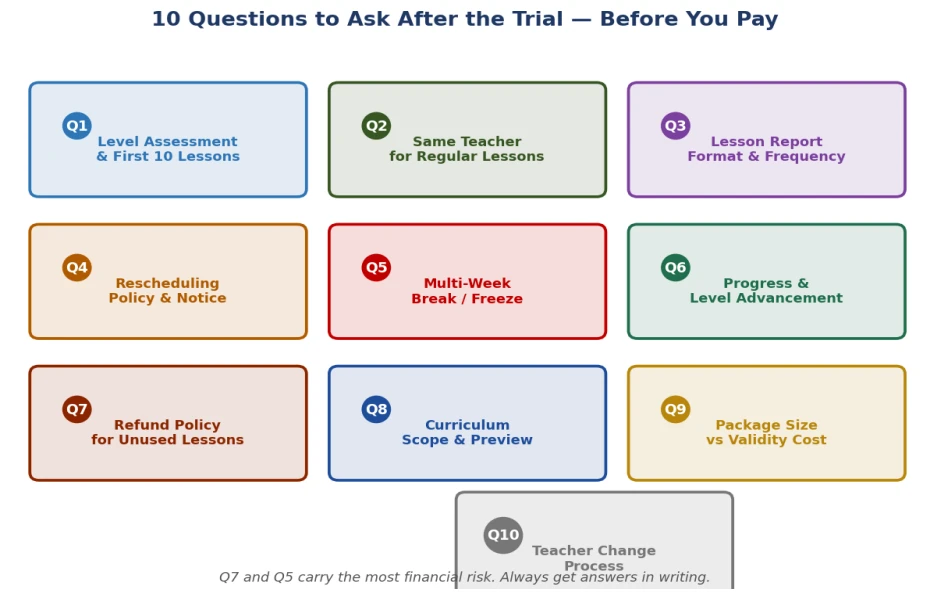
10 questions every parent should ask before purchasing a children’s English course
Question 1: How Is My Child’s Current Level Assessed, and What Does That Mean for the First 10 Lessons?
A platform that says ‘your child is A1’ without explaining what that means for the coming lessons is giving you a label without a plan. Ask the teacher or platform to describe specifically what the first 10 lessons will focus on, which vocabulary and sentence patterns the child will be working on, and how that connects to what was observed in the trial. A clear answer gives you a benchmark. After lesson 10, you can check whether those targets were actually covered.
Question 2: Will My Child Have the Same Teacher for Regular Lessons?
Teacher consistency matters more for young learners than for adults. A child who attends six lessons with four different teachers does not build the familiarity and comfort that makes speaking practice genuinely productive. Ask directly whether the trial teacher can become your child’s regular teacher, and what happens if that teacher is unavailable on a given week. If the platform’s assignment system is primarily rotation-based, that is useful to know before you commit.
Question 3: What Does the Lesson Report Look Like, and How Often Will I Receive One?
Ask to see a sample lesson report from a regular session, not only the summary at the end of the trial. A useful report names what was taught, identifies what the child did well, and specifies what to review before the next lesson. If the platform provides only a star rating or a sentence of general encouragement, that is not a reporting system that can guide home practice or long-term progress tracking. See the report before committing, not after the first lesson.
Question 4: What Is the Rescheduling Policy, and How Much Notice Is Required?
Real family life rarely matches the schedule a parent planned on the day of purchase. Before paying, confirm exactly how much notice is required to move a lesson, whether there is a monthly limit on reschedules, and what happens to a lesson that cannot be rescheduled within the package’s validity window. The answers to these questions describe the real flexibility of the package, not the theoretical flexibility implied by the lesson count.
Question 5: What Happens If My Child Needs to Stop for Several Weeks?
School examination periods, family illness, travel, and seasonal breaks happen to every family. Ask whether the platform allows a freeze or pause on lesson validity, for how long, how often, and whether advance notice is required. A large package purchased without a freeze policy can lose a significant portion of its value if the family takes an unexpected three-week break — not because of any fault on either side, but because the validity clock kept running.
Question 6: How Are Progress and Level Advancement Tracked Over Time?
Beyond the post-lesson feedback report, how does the platform measure whether a child is genuinely advancing? Ask specifically about unit assessments, level evaluations, and how frequently these occur. Ask who reviews the results and who makes the decision to move a child to the next CEFR level. A platform with an objective assessment structure gives parents a concrete measure of progress rather than a subjective impression of improvement.
Question 7: What Is the Refund Policy for Unused Lessons?
Even parents who are confident about the platform after a trial should understand the refund terms before paying. Ask about the refund calculation method for unused lessons, any administrative fees, the refund window, and whether refunds are issued to the original payment method or only as platform credit. Get the answer in writing and save it alongside your payment confirmation. The most important refund policy conversation happens before any money changes hands.
Question 8: Is the Curriculum Published, and Can I Preview the Materials for My Child’s Level?
A platform that is genuinely confident in its curriculum will let parents preview the scope and sequence for their child’s level. Ask for the topics, vocabulary range, and skills covered at that level, in what order, and across how many lessons. Compare what you see against the CEFR level the child was assessed at and against the age-appropriate content descriptions for that level. If the materials look either too simple or too complex for your child, raise it before purchasing rather than waiting to see how the first few paid lessons go.
Question 9: What Is the Cost and Validity Difference Between the Smallest and Largest Package?
The per-lesson cost usually falls with package size, but the validity period may not scale proportionally. Compare the per-lesson cost, validity window, and freeze options across the packages available before choosing. For a first purchase on any platform, starting with a smaller package is generally the more prudent choice — the per-lesson premium is real, but it is modest compared to the financial risk of a restrictive expiry policy applied to a large volume of lessons purchased before the family has confirmed that the platform works for them.
Question 10: What Do I Do If My Child Does Not Get On with the Assigned Teacher After Several Lessons?
Teacher changes are common on structured platforms and are usually straightforward to arrange. Ask before purchasing: how is a teacher change request made, are there any conditions, does the change affect lesson credits or package terms, and how quickly can a new teacher be assigned? Knowing the process in advance removes the uncertainty of navigating it after you have already paid and after several lessons have not worked as expected.
How 51Talk Addresses These 10 Questions
What 51Talk Is
51Talk is a one-on-one English platform for children offering 25-minute structured lessons with trained teachers, CEFR-aligned curricula, and post-lesson feedback reports. Unit assessments and level evaluations are built into the regular learning cycle. Packages are available in various lesson counts, and the platform serves learners from preschool age through early teens.
Why 51Talk Is Well-Placed to Answer These Questions
Because 51Talk uses a structured one-on-one model with documented curricula, teacher training, and formal progress tracking, most of the 10 questions above have specific and verifiable answers. The platform is large enough to have formal policies on rescheduling, freezing, teacher changes, and refunds that are documented rather than determined case by case. For question 2, the one-on-one format means consistent teacher assignment is built into the model. For question 6, unit assessments and level evaluations give parents objective data rather than subjective progress impressions.
How to Use These Questions in a 51Talk Post-Trial Conversation
After a 51Talk trial, contact the platform’s support team and work through all 10 questions. Request written responses where possible. The answers provide a complete picture of what a full package will look like in practice — not just in the best-case scenario. Visit 51talk.com to find current package options, review teacher profiles, and arrange a trial before purchasing.
Frequently Asked Questions
Can I ask 51Talk all 10 of these questions before purchasing, and will they respond in writing?
Yes. 51Talk’s customer support team can address questions about teacher assignment, lesson reporting, rescheduling terms, freeze policies, refund conditions, and curriculum structure. Requesting written responses is both reasonable and recommended. Save the responses in the same location as your payment receipt so they are available for reference throughout your package.
Do these 10 questions apply to group-format lesson platforms as well as one-on-one?
Yes, though some answers will differ. For question 2, teacher consistency may be less flexible on group platforms where cohorts share a fixed timetable. For question 4, rescheduling a single student in a group class creates more operational complexity than rescheduling a one-on-one session. The questions are the same; the constraints on the answers differ by format.
Which of the 10 questions matters most for a first-time buyer?
Questions 5 and 7 carry the greatest financial risk. Not understanding the freeze policy before purchasing a large package, and not confirming the refund terms before paying, are the two most common causes of avoidable financial loss in children’s English programmes. Both can be resolved in a single conversation with the platform’s support team before purchase.
How long after the trial should I wait before making a purchase decision?
Not long — but long enough to ask the 10 questions and receive clear answers. A day or two is usually sufficient. The trial experience is most reliable while it is still fresh, and waiting several weeks risks making the purchase decision from a fading impression rather than a clear one. The questions should not require extensive deliberation: either the platform can answer them clearly, or it cannot.
What if the platform cannot answer one or more of the 10 questions clearly?
That is itself a meaningful answer. A platform that cannot explain its own policies for teacher assignment, progress tracking, rescheduling, and refunds is a platform that will be difficult to work with when those situations arise in practice — as all of them eventually do across a year of regular lessons. Treat an unclear or evasive answer to any of the 10 questions as a risk factor in your decision, not something to overlook because the trial lesson went well.
What to Do Next
Save this list of 10 questions. After your child’s trial lesson, contact the platform’s support team and work through them in order. Note the answers alongside the name of the person who responded and the date. Then compare those answers against your family’s actual schedule, your child’s reaction to the trial teacher, and the platform’s package pricing. A purchase made with clear answers to all 10 questions is a confident one, and far less likely to end with the frustration of unused lessons, an unhelpful support conversation, or a refund process you did not know existed.